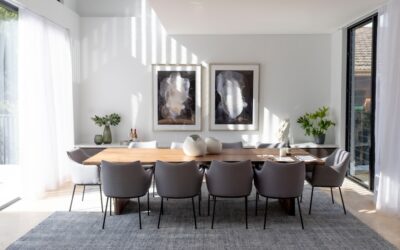
Choosing an area rug for dining room use trips up more people than almost any other rug decision, and it is almost always a sizing problem. A rug that looks generous rolled up in the store shrinks visually the moment you set a table and chairs on it, and one that is too small turns the whole arrangement awkward, with chair legs catching the edge every time someone stands up. Get the size right, though, and a rug anchors the dining area, defines the space, protects the floor, and warms the whole room.
Over years of helping people lay out dining spaces, I have found the sizing math is simpler than it seems once you learn one rule. This guide covers that rule, how to match the rug shape to your table, and the material and placement choices that make a dining rug practical as well as pretty.
The One Rule That Solves Sizing
Here is the single most important guideline: the rug must be large enough that all four legs of every chair stay on the rug even when the chairs are pulled out to sit down. This is the chair-pullout rule, and it is non-negotiable for a dining room. If the back legs drop off the edge when someone slides their chair back, the chair rocks, the rug bunches, and the whole thing feels cramped and cheap.
In practice this means the rug should extend at least twenty-four inches, and ideally closer to thirty, beyond every edge of the table. That extra border gives chairs room to slide back and still land on the rug. Measure your table’s length and width, add roughly four to five feet total to each dimension to account for that overhang on both sides, and you have your minimum rug size. Erring larger is almost always better than erring smaller here.
Measuring Your Table and Space
Start by measuring your dining table’s footprint at its largest, including any leaves you keep in regularly. Then add the pullout allowance to each side. A common rectangular table seating six often needs an eight-by-ten rug, while a smaller table for four may work with a six-by-nine. Larger tables that seat eight or more frequently call for a nine-by-twelve. These are starting points; your table’s exact dimensions and the pullout rule always take precedence over generic size charts.
Just as important, check the rug against the room itself. Leave a consistent band of bare floor, generally somewhere between a foot and a foot and a half, between the rug’s edge and the walls or surrounding furniture, so the rug frames the dining zone without crowding it wall to wall. If the required rug would nearly touch the walls, the table may simply be too large for the room, and a smaller table or a different layout is the real fix.
Matching Rug Shape to Table Shape
The most pleasing dining layouts echo the table’s shape in the rug. A rectangular or oval table pairs naturally with a rectangular rug, letting the overhang stay even all the way around. A square table looks balanced on a square rug, and a round or oval table is beautifully complemented by a round rug that mirrors its curve. This shape harmony is subtle, but a round table stranded on a rectangular rug always looks slightly off.
That said, the pullout rule still governs. A round rug under a round table must be large enough that chairs pulled out in any direction stay on it, which for a round table means a genuinely big circle. Because chairs around a round table pull straight back radially, you need generous diameter. If the room cannot accommodate a round rug that large, a rectangular rug sized to cover the pullout footprint is the more practical choice even under a round table.
Choosing a Durable, Cleanable Material
A dining room is a spill zone, full stop. Food drops, wine tips, sauce splatters, and chairs drag back and forth over the same spots thousands of times. That reality should steer you toward materials that clean easily and wear well. Flat-weave rugs and low-pile constructions are ideal because crumbs and spills sit on the surface rather than sinking into deep fibers, and chairs glide over them without catching, unlike a plush high pile that grabs chair legs and traps debris.
Synthetic fibers like polypropylene are champions here because they resist stains, release spills with a damp cloth, and often tolerate a scrub that would ruin a delicate natural fiber. Wool is a lovely, durable natural option that hides soil well and feels wonderful, though it costs more and needs gentler care with spills. Natural fibers like jute and sisal look great but can be tough to clean when food gets ground in, so weigh their texture against how messy your household’s meals really get.
Placement and Layout Details
Center the rug under the table so the overhang is even on all sides; an off-center rug reads as a mistake even when the size is right. With the table set in place, sit in each chair and pull it back as you would to stand, confirming the legs stay on the rug through the whole motion. This real-world test catches sizing problems that a tape measure alone can miss, especially with heavy chairs or a table pushed toward one wall.
Think about the room’s proportions too. In an open-plan space where the dining area shares a room with a living zone, the rug helps carve out and define the dining spot, so let its size and placement clearly frame the table as its own area. Keep the rug’s orientation aligned with the table and the room’s main lines rather than skewed at an angle, which almost always looks unsettled under a dining set.
Color, Pattern, and Style
Beyond size, the look of the rug does real work in a dining room. Busy patterns and mid-tone colors are your friends here because they hide the inevitable crumbs, spills, and traffic marks between cleanings, whereas a solid pale rug shows every dropped pea and every splash of sauce. A patterned rug with several colors also gives you flexibility to change chair cushions or table linens without the rug clashing, and it disguises the wear that concentrates under the most-used seats.
Think about how the rug relates to the rest of the room too. It should complement the table and chairs rather than compete with them; if your dining set is ornate, a quieter rug lets it shine, while a simple table can carry a bolder patterned rug. Scale the pattern to the room, since a large-scale motif can overwhelm a small space and a tiny print can disappear under a big table. The right pattern makes the dining area feel pulled together while quietly doing the practical job of hiding the mess that dining rooms inevitably generate.
Padding and Everyday Care
Do not skip a rug pad under a dining rug. A good pad keeps the rug from sliding when chairs push against it, adds a little cushion, and, crucially, protects both the rug and the floor beneath from the constant chair traffic. On hard flooring especially, a pad prevents the rug from creeping across the room over weeks of use and stops the backing from scuffing the finish. Choose a pad cut slightly smaller than the rug so it stays hidden.
For upkeep, vacuum regularly to lift the crumbs that inevitably collect, and treat spills immediately by blotting rather than rubbing, which pushes stains deeper. Rotate the rug periodically so wear and sun-fading stay even, since the spots under the most-used chairs take the hardest beating. With the right size, a cleanable material, and a good pad, an area rug for dining room use will look sharp and hold up through countless meals, family dinners, and the occasional spilled glass.