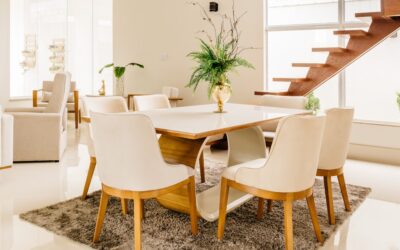
The single most common decorating mistake under a dining table is a rug that is too small, leaving chairs teetering half-on and half-off the edge every time someone sits down. Getting a dining area rug right is mostly a sizing exercise: the rug has to be big enough that the back legs of every chair stay on the rug even when guests push back from the table. Beyond size, the material has to survive crumbs, spills, and chairs dragging across it, which rules out some of the plush, delicate rugs that work beautifully in a bedroom. Get those two things right and a dining rug anchors the room, adds warmth, and quietly defines the space.
The Golden Rule of Sizing
Here is the rule that prevents the most regret: the rug should extend at least 24 inches, and ideally 30 inches, beyond all sides of the table. That clearance lets chairs pull out without catching the edge or sliding off the rug onto bare floor. People consistently buy too small, so when in doubt, size up.
To find your size, measure the length and width of your table, then add at least 48 inches to each dimension (24 inches per side). For example:
- A table around 40 by 60 inches needs roughly an 8 by 10 foot rug.
- A larger table around 44 by 72 inches calls for a 9 by 12 foot rug.
- A small square table for four pairs well with a 6 by 6 or 8 by 8 foot rug.
Always measure with the chairs pushed out as if someone is sitting, not just tucked in, because that pushed-out position is where a too-small rug fails.
Matching the Rug Shape to the Table
Echoing the table shape usually looks most balanced:
- Rectangular table: A rectangular rug is the natural match and the most common choice.
- Round table: A round rug mirrors the table and softens a square room, though a square or rectangular rug also works.
- Square table: A square rug keeps the proportions tidy.
- Oval table: A rectangular or oval rug both work; rectangular is easier to find.
The shape is a guideline, not a law. A round rug under a rectangular table can look intentional in the right room, but matching shapes is the safe, reliably good-looking default.
Best Materials for Under a Table
A dining rug lives a harder life than most. It faces dropped food, spilled wine, and chair legs grinding across it daily, so material choice is practical, not just aesthetic:
- Flatweave and low-pile rugs: The top pick for dining rooms. Chairs slide easily, crumbs sweep off, and spills wipe up rather than sinking into deep fibers.
- Wool: Naturally stain-resistant and durable, with some give underfoot. A great long-term choice if you do not mind the cost.
- Synthetic fibers (polypropylene, nylon): Highly stain-resistant, affordable, and easy to clean, making them ideal for homes with kids.
- Indoor-outdoor rugs: Built to be washed off and shrug off spills, increasingly popular under dining tables for exactly that reason.
Avoid thick shag and high-pile rugs under a dining table. Chairs catch and tip on deep pile, crumbs disappear into it, and spills are far harder to clean. Save the plush rugs for the living room or bedroom.
Color and Pattern Choices
Practicality should guide your color choice as much as taste. Patterned rugs and medium-to-darker tones hide the inevitable crumbs and small stains far better than a solid cream rug, which shows every drip. A busy pattern is forgiving in a way a pale solid never will be.
For coordinating with your room, you can either let the rug be the statement piece with a bold pattern or keep it neutral so the table and chairs stand out. If your dining space flows into a living room, pick a rug that relates to that space’s palette so the two areas feel connected rather than competing.
Do You Need a Rug Pad
Yes, in almost every case. A rug pad under a dining rug serves three purposes: it grips the rug so it does not shift when chairs slide across it, it cushions the rug and reduces wear from chair legs, and it protects the floor underneath from scratches. On hard floors especially, a non-slip pad keeps the rug from creeping and bunching every time someone gets up.
Choose a pad cut slightly smaller than the rug so it stays hidden, and pick a felt-and-rubber pad for the best combination of grip and cushion. The pad is a small expense that meaningfully extends the life of the rug.
Cleaning and Care
Because a dining rug catches food, regular care keeps it presentable:
- Vacuum regularly to lift crumbs and grit before they grind into the fibers.
- Blot spills immediately. Press a clean cloth straight down to absorb liquid; do not rub, which spreads the stain.
- Spot-clean with a mild solution suited to the rug’s material, testing in a hidden corner first.
- Rotate the rug periodically so traffic and sun fade evenly.
- Deep-clean washable or indoor-outdoor rugs by hosing or machine washing per the care label.
Common Mistakes to Avoid
A few predictable errors trip people up, and knowing them in advance saves a return trip or a do-over:
- Buying too small. By far the most common mistake. Chairs that slide off the edge ruin both the look and the function. Always size for chairs pushed out.
- Choosing high pile. Plush and shag rugs catch chair legs, trap crumbs, and make spills hard to clean. Stay low-pile under a table.
- Picking a pale solid. A cream or white rug shows every drip and crumb. Patterns and medium tones forgive real-world dining.
- Skipping the pad. Without a pad the rug shifts every time a chair moves and wears out faster.
- Ignoring the room flow. A rug that clashes with an adjacent open-concept living area can make the whole space feel disjointed.
Avoid these five and you have sidestepped nearly every dining rug regret people post about after the fact.
Putting It All Together
A dining area rug is one of the easiest upgrades to get wrong and one of the most rewarding to get right. Lead with size, since the 24-to-30-inch overhang rule solves the most common problem before it starts. Choose a low-pile, stain-resistant material that survives meals, add a quality rug pad for grip and floor protection, and lean toward patterns or medium tones that forgive the realities of eating over a rug. Do that, and you get a surface that warms the room, protects your floor, defines the dining space, and still looks good years and many dinners later.