Round tables look simple, but a few inches of diameter decide whether four people eat comfortably or six people sit knee to knee. As a quick reference, round table dimensions line up with seats like this: 30 to 36 inches seats two, 36 to 44 inches seats four, 48 to 54 inches seats four to six, 60 inches seats six to eight, 72 inches seats eight to nine, and 84 inches seats ten. Standard height is 28 to 30 inches no matter the diameter.
The logic behind those numbers is edge space. Each diner needs 24 to 26 inches of the table’s circumference, and a round table’s circumference is its diameter times 3.14. A 48 inch round has about 150 inches of edge, which fits five people in a pinch and four with room to spare.
- Round Table Dimensions Chart From 30 to 84 Inches
- Small Rounds: 30 to 42 Inch Breakfast and Bistro Tables
- Mid and Large Rounds: 48 to 84 Inches
- Room Size Minimums and Chair Spacing
- How to Pick the Right Diameter
- Base Styles and Height
- Round Tablecloth Sizes by Table Diameter
- Troubleshooting Fit Problems
- General Cost Ranges
- When to Call a Pro
- Frequently Asked Questions
- What is the standard round table size?
- What size round table seats 6 people?
- How many people can sit at a 36 inch round table?
- Is a 38 inch round table big enough for 4?
- How much space do I need around a round table?
- What does a 36 inch round table measurement mean?
- What size round table seats 12 people?
- What size chairs fit a 36 inch round table?
- What are the standard dimensions of a round side table?
The full chart, room-size minimums and spacing tips follow, along with notes on small breakfast tables and how to choose between the most popular sizes.
Round Table Dimensions Chart From 30 to 84 Inches
Use the “comfortable” column for everyday meals and armchairs, and the “maximum” column for occasional gatherings with armless chairs.
| Diameter | Comfortable seats | Maximum seats |
|---|---|---|
| 30 in. | 2 | 2 |
| 36 in. | 2 to 3 | 4 |
| 38 to 40 in. | 3 to 4 | 4 |
| 42 to 44 in. | 4 | 4 to 5 |
| 48 in. | 4 | 5 to 6 |
| 54 in. | 5 to 6 | 6 |
| 60 in. | 6 | 8 |
| 66 in. | 7 | 8 |
| 72 in. | 8 | 9 to 10 |
| 84 in. | 9 to 10 | 11 |
Ask ten furniture retailers for the standard round table size and most will say 48 inches for four and 60 inches for six. Those two diameters dominate showroom floors because they fit typical dining rooms and seat the most common household sizes. Treat them as defaults, then adjust for your chairs and room.
Small Rounds: 30 to 42 Inch Breakfast and Bistro Tables
Small rounds earn their keep in kitchens, nooks and apartments. They are also where buyers most often guess wrong, because a few inches matter a lot at this scale.
30 inch rounds
A 30 inch table is a bistro or cafe size. It seats two for coffee or a light meal. Two full dinner plates plus serving dishes will crowd it.
36 inch rounds
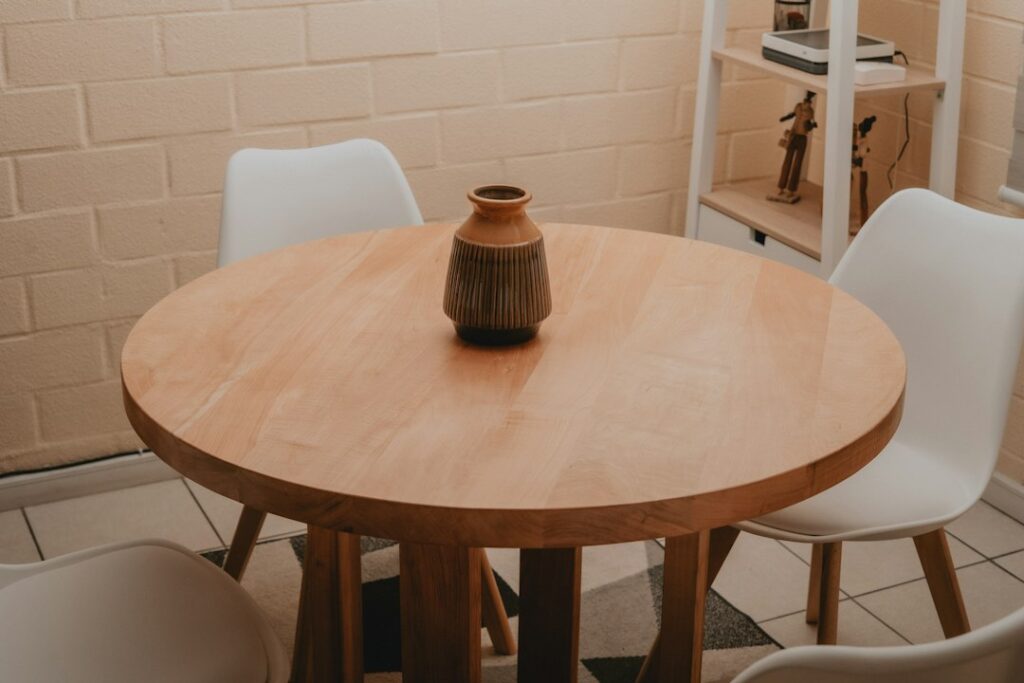
A round dining table 36 inches across is the classic breakfast nook size. Two people dine comfortably, three can share a casual meal, and four can squeeze in with small plates. A 36 inch round pedestal table is especially popular in tight kitchens because the single center base lets chairs tuck in from any angle without fighting corner legs.
38 to 40 inch rounds
The extra couple of inches makes a noticeable difference. A 38 inch round kitchen table gives four diners about 30 inches of edge each, close to the comfortable target, while still fitting a 9 by 9 foot area. If you are choosing between 36 and 40 inches for four people, 40 is the better choice when the room allows it.
42 inch rounds
At 42 inches, four people can eat a full dinner with serving dishes on the table. This is the smallest size that feels like a dining table rather than a breakfast spot.
Mid and Large Rounds: 48 to 84 Inches
Our diameter-specific guides cover the 48, 60 and 72 inch sizes in depth; here is the quick overview.
48 inches is the everyday family round. Four people get roughly 37 inches of edge each, which feels spacious, and a fifth chair fits for a guest. Most homeowners find that a six person round table needs at least 54 inches to avoid elbow collisions.
54 inches is an underrated size. It seats six with armless chairs and still fits rooms that cannot handle a 60 inch top.
60 inches seats six comfortably and eight snugly. At this diameter, reaching the center becomes harder, so a lazy Susan of 18 to 24 inches is a common addition.
72 inches seats eight with room for platters. The center is now out of reach for most people, so serving dishes travel around the table or sit on a sideboard.
84 inches seats ten. Tables this large are rare in homes because they need a room at least 13 feet square and make cross-table conversation difficult. Many hosts who need ten seats choose an oval or rectangle instead.
Room Size Minimums and Chair Spacing
Every round table needs 36 inches of clearance from its edge to the nearest wall or furniture so chairs can pull out. Where people walk behind seated diners, aim for 42 to 48 inches. Double the clearance and add the diameter to find the minimum room dimension.
- 36 inch round: 108 inches, or 9 by 9 feet.
- 42 inch round: 114 inches, or about 9.5 by 9.5 feet.
- 48 inch round: 120 inches, or 10 by 10 feet.
- 54 inch round: 126 inches, or 10.5 by 10.5 feet.
- 60 inch round: 132 inches, or 11 by 11 feet.
- 72 inch round: 144 inches, or 12 by 12 feet.
- 84 inch round: 156 inches, or 13 by 13 feet.
Round table dimensions only tell half the story without chairs. Chair spacing on a round works best when each chair has 24 to 26 inches of edge. Measure your chair’s widest point; if it is over 20 inches (common with armchairs or upholstered seats), lean toward the comfortable column of the chart. Chairs with tapered backs fit rounds better than boxy chairs because the backs splay outward naturally.
How to Pick the Right Diameter
- Count your daily diners. Size for the everyday number, not the once-a-year crowd.
- Measure the room or nook. Subtract 72 inches (36 on each side) from the shorter dimension. That is your maximum diameter.
- Measure your chairs. Multiply chair width plus 4 to 6 inches by the number of diners, then divide by 3.14.
- Compare the two results. If the chair math exceeds the room limit, choose slimmer chairs or a different shape.
- Check the base. Pedestal bases free up leg room. Four-leg bases can block a seat, especially on tables under 48 inches.
- Consider an extension leaf. Some rounds open into ovals with a center leaf, turning a 48 inch round into a 66 to 72 inch oval for guests.
Base Styles and Height
Standard dining height is 28 to 30 inches, paired with chair seats about 18 inches high. Counter-height rounds run 34 to 36 inches with 24 to 26 inch stools, and bar-height tables run 40 to 42 inches with 28 to 30 inch stools. Counter and bar heights suit small rounds in kitchens where the table doubles as prep space.
Base style changes the usable seating more on rounds than on any other shape. A single pedestal works up to about 54 to 60 inches; beyond that, a split pedestal or a wide spider base keeps the top stable. Four-leg bases are sturdy but can land between diners or right where a knee wants to go. Check that the base footprint leaves at least 12 inches of knee space from the table edge.
Round Tablecloth Sizes by Table Diameter
Pick a round tablecloth by adding twice the drop you want to the table diameter. A lap-length cloth drops about 10 to 15 inches on each side, and a floor-length cloth on a 28 to 30 inch high table drops about 30 inches, so it adds roughly 60 inches. Round up to the nearest cloth size sold.
| Table diameter | Lap-length cloth | Floor-length cloth |
|---|---|---|
| 30 in. | 50 to 60 in. | 90 in. |
| 36 in. | 56 to 66 in. | 96 in. |
| 48 in. | 68 to 78 in. | 108 in. |
| 60 in. | 80 to 90 in. | 120 in. |
| 72 in. | 92 to 102 in. | 132 in. |
Troubleshooting Fit Problems
The table wobbles. Pedestal rounds on uneven floors rock easily. Adjustable levelers under the base or felt pads of different thickness fix most wobbles. On large rounds, a wobble can mean the top is too heavy for the base, so check the maker’s stated diameter limit.
Chairs keep hitting the base. The pedestal foot may be too wide. Choose chairs with straight front legs or reposition seats so they fall between the base feet.
The table looks lost in the room. A round that is too small for its room floats awkwardly. A round rug sized 24 to 36 inches larger than the table on every side anchors it, and a pendant light hung 30 to 36 inches above the top helps define the zone.
Reaching the center is awkward. Above 60 inches, add a lazy Susan or keep serving dishes off the table.
General Cost Ranges
Small 30 to 42 inch rounds are often among the least expensive dining tables, with basic models in the low hundreds of dollars. Mid-size 48 to 60 inch tables in solid wood or quality veneer commonly fall between several hundred and a couple thousand dollars. Large 72 to 84 inch rounds, stone tops and custom pedestals cost more because of material weight and engineering. Expanding rounds with self-storing leaves typically cost more than fixed tops of the same diameter.
When to Call a Pro
Most buyers can choose a round table on their own with a tape measure and a cardboard template cut to size. A custom furniture maker can build an unusual diameter or a base designed around a specific nook. An interior designer helps when the table must coordinate with a banquette, a built-in or an open-plan layout. If you plan to center a new pendant light over the table, a licensed electrician should handle the wiring and any permit.
Frequently Asked Questions
What is the standard round table size?
The most common sizes are 48 inches for four people and 60 inches for six, both at a height of 28 to 30 inches.
What size round table seats 6 people?
A 54 inch round seats six with armless chairs, and a 60 inch round seats six comfortably with room for serving dishes.
How many people can sit at a 36 inch round table?
Two people dine comfortably, three can share a casual meal, and four can squeeze in with small plates and slim chairs.
Is a 38 inch round table big enough for 4?
Yes for casual meals. Each diner gets about 30 inches of edge, though a 42 inch round gives more room for serving dishes.
How much space do I need around a round table?
Allow 36 inches from the table edge to walls or furniture, and 42 to 48 inches where people walk behind seated diners.
What does a 36 inch round table measurement mean?
It means the tabletop is 36 inches across, measured straight through the center from edge to edge. That diameter is the number used for every round size, so a 5 foot round table is 60 inches across and a 4 foot round is 48 inches. Height is listed separately and is usually 28 to 30 inches for dining tables.
What size round table seats 12 people?
A round table about 96 inches (8 feet) across seats 12 people. Using the 24 to 26 inches of edge each diner needs, 12 seats call for roughly 290 to 310 inches of circumference, which works out to a diameter of about 92 to 99 inches. A table that size needs a room around 15 feet square, so many hosts use an oval or long rectangle instead.
What size chairs fit a 36 inch round table?
Armless side chairs about 16 to 19 inches wide fit best around a 36 inch round. The table has roughly 113 inches of edge, enough for two to three of those chairs to sit comfortably, or four slim ones for a quick meal. Chairs over 20 inches wide, armchairs and bulky upholstered seats crowd a table this size, and a seat height near 18 inches suits the standard 28 to 30 inch table height.
What are the standard dimensions of a round side table?
Most round side tables measure 18 to 24 inches across and stand about 20 to 26 inches tall. A good fit sits within an inch or two of the sofa or chair arm height so a lamp or drink is easy to reach. In tight spaces, a 15 to 18 inch round leaves walking room, while a 24 inch top holds a lamp plus books.