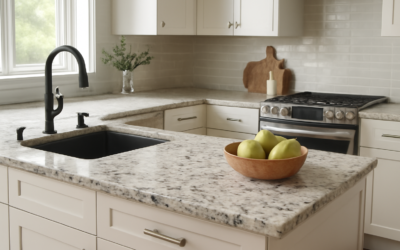
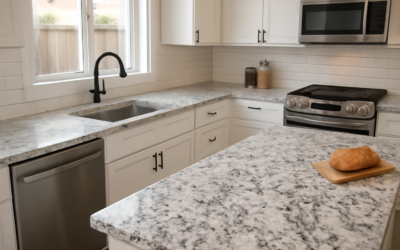
If you want a natural stone that reads as light and airy but still carries real depth and movement, salinas granite deserves a place on your shortlist. This Brazilian stone, sometimes sold as Salinas White, pairs a soft cream-to-white background with scattered burgundy-red garnet crystals and flecks of gray and black minerals. The result is a countertop that brightens a kitchen the way marble does, yet brings the toughness and low maintenance homeowners expect from granite.
Part of our Countertops guide — explore the full guide →
Having fabricated and installed a wide range of natural stone over the years, I can tell you that this variety photographs well but looks even better in person. The garnet inclusions catch light at different angles, so the slab shifts subtly as you move around the room. Below is everything you need to know before you commit to a full kitchen or bath in this material.
What Salinas Granite Actually Looks Like
The defining trait is contrast on a pale field. The base ranges from warm ivory to a cooler off-white, and across it you’ll find speckles and small clusters of deep red garnet, along with charcoal and smoky-gray minerals. Unlike heavily veined marble-look stones, this granite reads as a fine-to-medium grain pattern rather than long dramatic rivers of color.
Because every slab is cut from a natural block, expect variation. Some slabs lean whiter with sparse red flecks, while others carry denser garnet and a busier surface. That is not a defect; it’s the nature of quarried stone. Always view the exact slabs going into your home rather than approving from a small sample chip.
Best Design Pairings
- White or cream shaker cabinets: creates a bright, timeless kitchen with the red flecks adding warmth.
- Navy or deep green cabinetry: the pale field keeps a dark base from feeling heavy.
- Warm wood tones: the garnet notes tie beautifully into oak, walnut, and hickory.
- Backsplashes: a simple white subway tile or a full-height slab backsplash both work; busy mosaics compete with the stone.
Durability and Everyday Performance
Granite is one of the hardest countertop materials you can buy, rating roughly 6 to 7 on the Mohs scale. In practical terms, that means it resists scratching from knives, sliding cookware, and daily wear far better than marble or most engineered surfaces under abrasion. You can set a hot pan from the stove directly on it without the thermal-shock or scorching worries that plague solid surface and, to a lesser degree, quartz.
The stone is also dense and, once sealed, highly resistant to staining. Kitchens see red wine, coffee, oil, and citrus daily, and a properly maintained slab shrugs those off with a routine wipe-down. For a light-colored granite, this staining resistance matters more than it would on a black or dark brown stone where spills hide easily.
Sealing and Maintenance
Every natural granite has some porosity, and a lighter background shows problems sooner than a dark one, so sealing is non-negotiable here. Most fabricators apply a penetrating sealer before delivery, but you should confirm it and plan to reseal on a regular schedule.
Simple Sealing Test
Pour a tablespoon of water onto the surface and wait 15 minutes. If the water beads or sits on top, your seal is intact. If the stone darkens where the water sat, it’s time to reseal. Most kitchens need resealing once every 12 to 18 months, though high-use areas near the sink may want it annually.
Daily Care Checklist
- Wipe spills promptly, especially wine, oil, and anything acidic.
- Clean with warm water and a few drops of dish soap, or a stone-safe pH-neutral cleaner.
- Avoid bleach, ammonia, vinegar, and abrasive powders, which degrade sealer over time.
- Use a cutting board to protect your knives, even though the stone can take it.
- Set trivets under slow cookers and hot appliances to be safe, despite the stone’s heat tolerance.
Where It Works Best in the Home
Kitchen countertops and islands are the most common application, and the stone’s brightness makes small kitchens feel larger. It also performs well as a bathroom vanity top, where its stain resistance handles toothpaste, cosmetics, and hair products. Because it tolerates heat and moisture, it works around fireplaces as a hearth or surround and on outdoor kitchen counters in mild climates, provided you keep it sealed against the elements.
Full-height backsplashes cut from the same slab are increasingly popular. Running the stone up the wall eliminates grout lines behind the range, which is both easier to clean and visually seamless. Just budget for the extra material, since backsplash slabs add square footage.
Cost and What Drives the Price
Expect installed pricing in the range of roughly $45 to $75 per square foot for most Salinas White jobs, with fabricated-and-installed totals depending on slab availability, thickness, and edge work. As a light Brazilian import, it typically lands in the mid tier, more than builder-grade granites but well below exotic quartzites and premium marbles.
Typical Cost Breakdown
- Material: $25 to $45 per sq ft for the raw slab.
- Fabrication and installation: $20 to $35 per sq ft including cutting, edging, and setting.
- Edge upgrades: ogee, bullnose, or mitered edges add $10 to $25 per linear foot.
- Sink cutouts: $100 to $250 each for undermount fitting.
For a mid-size kitchen with roughly 40 to 55 square feet of counter, many homeowners land between $2,500 and $4,500 installed. Always get a firm quote based on your actual layout and the specific slabs you select.
Pros and Cons at a Glance
Advantages
- Bright, marble-like appearance with the toughness of granite.
- Excellent heat resistance for a busy cooking kitchen.
- Strong scratch and stain resistance once sealed.
- Natural, one-of-a-kind slabs; no two kitchens look identical.
Drawbacks
- Requires periodic resealing, unlike engineered quartz.
- Light background shows dirt and needs prompt spill cleanup.
- Slab-to-slab variation means you must hand-select your material.
- Heavy stone requires professional handling and sturdy cabinet support.
Frequently Asked Questions
Is Salinas granite the same as Salinas White?
Yes. The stone is marketed under both names, and different suppliers may label the same or very similar Brazilian material either way. Because names in the stone trade are inconsistent, always confirm you’re looking at the actual slabs, not just a name on a website.
Does it stain easily?
No, provided it’s sealed. The pale background means any stain that does occur is more visible than on a dark stone, which is exactly why staying current on sealing and wiping spills quickly matters here.
Can I cut directly on it?
You can without damaging the stone, but you’ll dull your knives fast and can wear the sealer over time. Use a cutting board for the sake of your blades.
How long will it last?
Granite countertops routinely last decades, often the lifetime of the kitchen, with only routine sealing and cleaning. It’s one of the most durable surfaces you can install, which is a large part of why it holds resale value.
The Bottom Line
For homeowners who love the brightness of marble but need a hard-working surface, salinas granite is a smart middle path. You get a luminous cream field, distinctive burgundy garnet accents, and the day-to-day durability granite is known for, all at a mid-tier price. Commit to the modest sealing routine, hand-select your slabs, and this stone will reward you with a kitchen that looks refined for decades.