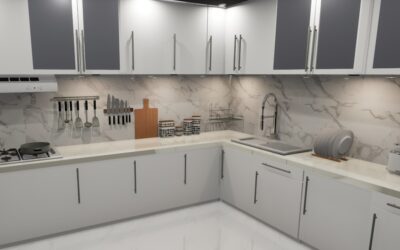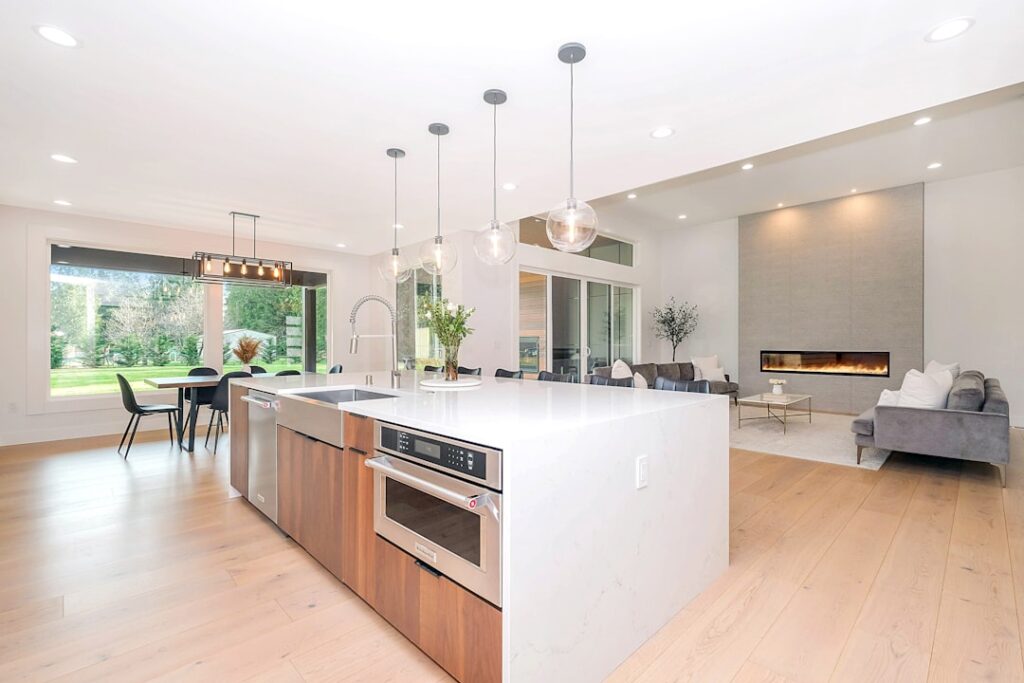
The single most expensive mistake in a kitchen remodel is choosing a countertop from a postage-stamp showroom chip. Sample countertops are how you avoid spending $4,000 to $12,000 on a slab that clashes with cabinets, fights your backsplash, or simply looks nothing like the photo. This guide covers where to order real samples, how to evaluate them in your own kitchen lighting, and the differences in slab variation that matter most for each material.
Part of our Countertops guide — explore the full guide →
Why Showroom Chips Lie
A 4×4 inch quartz chip from the Cambria, Silestone, or Caesarstone wall display shows you about 1/200th of a typical slab. Natural stone like granite or marble varies tremendously across a single block, with veining shifting from heavy to subtle across a 10-foot run. Engineered materials are more consistent but still show pattern variation based on production batch and slab orientation.
Showroom lighting is the second problem. Most chip displays sit under cool 4000K LED bars that flatten warm undertones. Your kitchen probably runs 2700K to 3000K under cabinets, with mixed daylight from windows. A quartz that reads bright white in the showroom can read pink-beige under your cabinets.
Where to Order Larger Samples
Most major brands ship samples directly from their website. Cambria sends 4×4 inch chips free, but their full-size 12×12 inch samples cost $19 and ship in five business days. Silestone offers complimentary 5×5 inch samples through cosentino.com. Caesarstone ships 4×4 chips free or larger samples through their My Caesarstone portal.
For natural stone, big-box retailers like MSI Surfaces, Daltile, and Florida Tile offer 6×6 inch granite and marble samples through local stocking yards, usually free with pickup. The most useful option for high-end projects is to visit a slab yard such as Walker Zanger, Marble Granite Direct, or Arizona Tile and tag the actual slab you will receive. Take six to eight photos in different lighting before you leave.
Testing Samples in Your Kitchen
Tape the sample to the front of your existing cabinet at counter height, 36 inches off the floor. View it under three lighting conditions: morning daylight, mid-afternoon, and evening with only under-cabinet and overhead lights on. Most homeowners only check one lighting condition and regret the choice when they see the finished countertop at night.
Set common kitchen items on or near the sample — a stainless toaster, a wood cutting board, your dish towel, a coffee mug. Look at the sample with your backsplash sample and cabinet door sample taped together. If the sample disappears or fights with anything, you have your answer. Live with the layout for at least 72 hours before ordering.
Material-Specific Sample Strategies
For quartz, the chip predicts the final look reasonably well because manufacturing is tightly controlled. Pay attention to the matte versus polished finish — Caesarstone Concrete and Silestone Suede finishes show fingerprints far more than polished, and the chips do not always make that obvious.
For granite and marble, never rely on a chip. Always visit the actual slab. Look for movement, fissures, repaired areas, and crystal patterns under raking light. Quartzite from suppliers like Antolini and Levantina is sold by the slab, and a single bookmatched pair from one block looks dramatically different from a non-matched pair. Tag the specific slabs you want held for fabrication.
Brand Spotlight: Cambria, Silestone, and Dekton
Cambria, made in Le Sueur, Minnesota, dominates the high-end quartz market with patterns like Brittanicca, Ella, and Berwyn. Pricing runs $75 to $130 per square foot installed for standard colors, $130 to $175 for premium designs. Their quartz is 93 percent ground quartz with 7 percent polymer resin and rates 7 on the Mohs hardness scale.
Silestone by Cosentino has been the volume leader for two decades. Their Eternal series mimics calacatta marble convincingly and runs $65 to $110 per square foot installed. Dekton, also from Cosentino, is a sintered ultra-compact surface fired at 2,200 degrees F and can be used indoors and outdoors. Dekton resists UV fade, runs $110 to $180 installed, and is the only material rated for full outdoor kitchen countertops without color shift.
Backsplash and Cabinet Coordination
Bring your cabinet door sample and backsplash sample together when evaluating countertop samples. White Shaker cabinets pair convincingly with almost anything, but maple, cherry, and stained oak cabinets fight cool gray quartz. Warm-toned cabinets demand warm-toned counters with cream, beige, or honey undertones, not stark white.
For backsplashes, the rule is one statement element per surface. If the countertop has dramatic veining like Cambria Brittanicca Gold or a quartzite like Taj Mahal, the backsplash should be quiet — subway tile, a soft cement tile, or a solid color. If the backsplash is busy zellige or a patterned cement tile, choose a calmer countertop like Caesarstone Pure White or a fine-grain quartz with minimal movement.
Common Sample Mistakes to Avoid
Three errors crop up repeatedly. First, ordering a sample online without checking the brand’s reproduction accuracy disclosure. Cambria explicitly states that samples are representative only and final slabs vary. Second, evaluating samples only in store lighting. Always take them home. Third, choosing based on cost per square foot alone — installation, edge profile, sink cutout, and slab joints can add $400 to $1,500 that varies between fabricators.
Order three to five sample countertops at the same time. Eliminate fast — most people can narrow five samples to two within a day, then debate the last two for a week. Once you commit, view the actual slab before signing the fabrication agreement. That single visit prevents 80 percent of the regret stories you read in remodeling forums.
Edge Profiles and Sample Limitations
One detail samples cannot show is the edge profile. Standard eased and 1/4 inch bevel come included; ogee, bullnose, mitered waterfall, and full bullnose edges add $15 to $45 per linear foot. Ask the fabricator for a small piece of scrap stone routed with your chosen edge profile so you can see it in person. Many quartz brands like Cambria and Caesarstone publish photos of edge profiles on their websites, but a physical sample reveals how light reflects off the routed surface.
Sample tiles also don’t show how the seam will appear. On a 10-foot island with two slabs joined in the middle, the seam location and bookmatching pattern dramatically affect the finished look. Ask the fabricator for a seam diagram with the slab layout marked. Premium fabricators use digital templating with software like Slabsmith to show seam placement before cutting. Skip any fabricator who can’t provide this layout — they’re guessing where the seams will land.