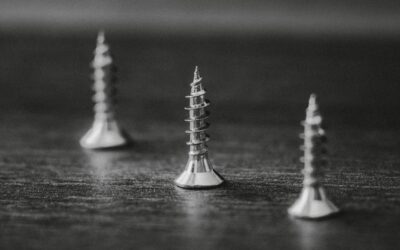
Grab the wrong box of screws for a steel-stud job and you will strip out tips all afternoon — or worse, spin holes so sloppy the board never snugs tight. Self drilling drywall screws exist for one specific situation: fastening drywall to heavy-gauge steel framing, 20-gauge structural and thicker, where an ordinary sharp-point screw cannot pierce the metal. Their tips are miniature drill bits that bore a pilot hole before the threads engage. Used in the right place they are indispensable; used in the wrong place they actually hold worse than the cheap screws they replaced. This guide sorts out the point types, the gauge thresholds, and the buying details that matter.
Part of our Paint & Walls guide — explore the full guide →
Drill Point vs. Sharp Point: What the Tip Actually Does
Drywall screws come with two fundamentally different tips. Sharp-point screws (often called Type S for steel or Type W for wood) end in a needle point that displaces material as the screw drives — perfect for wood and for light-gauge steel studs, the 25-gauge and 20-gauge drywall framing used in most interior partitions, which is thin enough (0.018 to 0.033 inch) for a sharp point to punch through in a fraction of a second.
Self-drilling screws — Type S-12 in drywall terminology, with the familiar Tek-style fluted tip — end in a genuine cutting point with a relieved flute that evacuates metal chips as it bores. That drill point can penetrate steel from about 0.033 inch up to 0.112 inch (roughly 20-gauge structural through 12-gauge) before the threads ever bite. The number designations map to capability: a #2 drill point handles up to about 0.100 inch of steel, a #3 up to 0.140. For drywall work, standard S-12 screws with a #2-class point cover everything you will meet in residential and light commercial framing.
When You Actually Need Self-Drilling Screws
The dividing line is steel thickness, and it is sharper than most people realize. Use self-drilling screws when fastening drywall to:
- Structural steel studs, 20-gauge (33 mil) and heavier — the load-bearing studs used in exterior walls, tall partitions, and headers. If the stud gauge is 33 mil structural, 18-gauge (43 mil), 16-gauge (54 mil), or 14-gauge (68 mil), sharp points will skate, wander, and burn up.
- Steel door frames and jamb struts, typically 16 to 14-gauge.
- Angle iron, red-iron clips, and furring attached to structural members in commercial fit-outs.
- Resilient channel or furring channel over heavy-gauge framing, where the screw must pass through two layers of metal.
Stick with standard sharp-point Type S screws for ordinary 25-gauge and light 20-gauge non-structural interior studs, and Type W coarse-thread screws for wood framing. The quick field test when gauge is unknown: press a sharp-point screw against the stud with firm drill pressure — if it pierces and seats within about two seconds, the framing is light-gauge and sharp points are correct. If the tip dances and squeals, switch boxes.
Why Self-Drilling Screws Are Wrong for Light-Gauge and Wood
Using self-drilling screws everywhere seems like cheap insurance, but the physics argues otherwise. In thin 25-gauge steel, a drill point bores a hole nearly as large as the screw’s minor diameter before the threads arrive, leaving only a sliver of metal for the fine threads to grip — pull-out strength drops measurably compared with a sharp point that pierces and lets threads form into displaced metal. The drill point also takes longer to start in thin material, because the flute must chew through before threads engage, and the screw can walk across the stud face in that interval.
In wood, the fluted tip acts like a tiny auger that bores a pilot as it goes, again reducing thread engagement, and the fine threads typical of S-12 screws hold poorly in softwood regardless. Wood wants coarse threads, full stop. There is also a cost angle: self-drilling drywall screws run roughly 2 to 3 times the price of standard screws — about $30 to $45 per thousand versus $12 to $20 — so blanket use burns money while delivering weaker connections in most of the wall. Match the point to the material and both problems vanish.
Sizes, Threads, and Head Types
For hanging 1/2-inch or 5/8-inch drywall on heavy steel, the workhorse is a #6 x 1-1/4 inch S-12 bugle-head screw, fine thread, with a Phillips #2 drive. The bugle head is the same self-countersinking curve as any drywall screw, designed to dimple the paper without tearing it. Common variations and when to reach for them:
- #6 x 1 inch S-12 — single-layer 1/2-inch board where a shorter grab suffices; minimum penetration past the steel should be 3/8 inch.
- #6 or #8 x 1-5/8 to 2-3/8 inch S-12 — double-layer board, shaftwall liners, and board over rigid insulation.
- Pan-head and hex-washer-head self-drillers — framing screws for stud-to-stud and track connections, not for board; the flat underside does not countersink.
- Winged self-drillers — for attaching wood or cement board to heavy steel; wings ream clearance in the top material, then snap off in the steel.
Quality matters more with self-drillers than with commodity screws because the point geometry does the work. Grainger, Fastenal, Hilti, Simpson, and Senco-brand collated versions run consistent; bargain-bin imports with soft points are where stripped tips and snapped screws come from. Look for case-hardened steel and, in damp or exterior-adjacent assemblies, a corrosion-resistant coating rather than plain phosphate, which is an indoor-only finish.
Driving Technique on Heavy Steel
Technique changes slightly when the screw has to drill before it threads. Use a drywall screw gun or an impact-free drill at 2,000 to 2,500 RPM — self-drilling points cut best at high speed with steady, firm pressure, and an impact driver’s hammering can chip carbide-hard tips and snap #6 shanks. Keep the screw square to the work; angling a drill point causes it to wander and oval the hole. Let the point finish drilling before leaning in — you will feel the screw drop as threads engage — then let the clutch or depth stop seat the head just below the paper surface without breaking it. A torn paper face costs that screw most of its holding power, same as with any drywall fastener. Spacing follows normal drywall practice: 12 inches on ceilings, 16 inches in the field of walls, or per the fire-rated design where one applies.
Troubleshooting Failed Fasteners
Even with the right screw, heavy steel occasionally wins a round, and the failure mode tells you what to change. A tip that spins without penetrating means either too little pressure, too low an RPM, or a dulled point from a previous glancing start — discard the screw, since a self-drilling point only gets one good career. A screw that drills through but strips before seating usually hit a doubled-steel condition (stud plus track, or a clip) thicker than the point rating; step up to a #3-point or a #8 diameter. Snapped shanks point to an impact driver or a hard sideways load during driving. And if heads pop through the drywall paper on heavy studs, the depth clutch is set too deep for the harder substrate — steel does not yield like wood, so the setting that dimples perfectly on light-gauge overdrives on structural. Recalibrate on a scrap corner whenever the framing gauge changes, and keep a small pilot bit in the pouch for the rare 12-gauge clip that defeats everything else.
Buying Guide and Bottom Line
For a typical job, estimate one screw per square foot of board and buy 10 percent extra. A 1-pound box (roughly 200 screws of #6 x 1-1/4) runs $8 to $12; 5-pound contractor boxes drop the unit cost by a third. Check the box labeling for “S-12” or “self-drilling” plus a drill-point capacity spec — genuine self drilling drywall screws will state the steel thickness range, and that number is the whole reason to buy them. Keep two boxes in the kit: sharp-point Type S for the light-gauge interior studs that make up 90 percent of steel framing, and S-12 self-drillers for door frames, structural studs, and anything the sharp points refuse to bite. Choosing between them takes one look at the framing, and getting it right is the difference between a wall screwed tight in an afternoon and a bucket of burned tips.