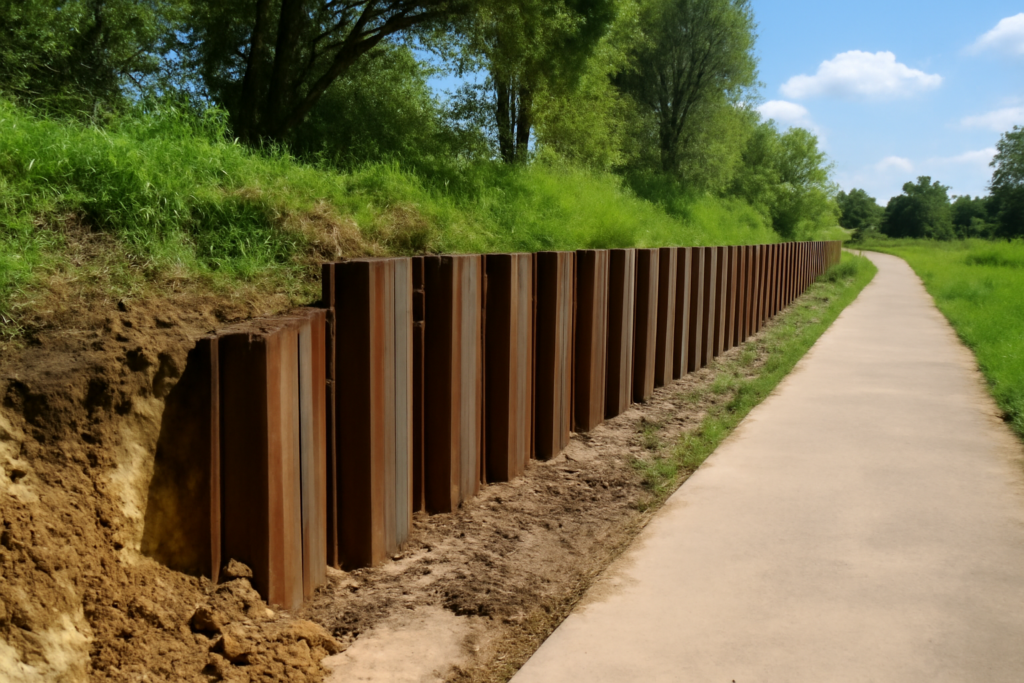
When a hillside needs holding back and there’s simply no room to dig a wide footing — a waterfront lot, a tight urban side yard, a spot right up against a property line — a sheet piling retaining wall is often the only practical answer. Instead of stacking block on a broad concrete base, these walls drive interlocking vertical sections deep into the ground, using the earth itself as the anchor. That vertical, low-footprint approach is why you see them along shorelines, canals, and excavations where every inch of horizontal space is spoken for.
This guide explains how sheet piling works, the materials involved, what installation actually looks like, and the real-world costs so you can judge whether it fits your project.
How a Sheet Pile Wall Holds Back Soil
A conventional gravity or block wall resists soil pressure with mass and a wide base. A sheet pile wall works completely differently. Long panels are driven vertically deep into the ground — often as deep below grade as the wall stands above it — and the embedded portion resists the soil’s push through the passive pressure of the earth clamped around it.
The panels interlock along their edges, joining into a continuous barrier that keeps soil and water from squeezing through. For taller walls, engineers add tiebacks or anchors driven back into stable soil behind the wall, dramatically increasing how much load the wall can hold.
Common Materials
Sheet piles come in several materials, each suited to a different job:
- Steel is the workhorse — enormous strength, drivable through dense soils, and the standard for deep excavations, bulkheads, and heavy loads. It can corrode over decades in saltwater without protective coatings.
- Vinyl (PVC) and composite panels resist rot, marine borers, and corrosion entirely, making them popular for residential seawalls and lakefront bulkheads. They’re lighter and easier to install but suit shorter walls.
- Aluminum offers corrosion resistance at moderate strength for lighter marine work.
- Timber is the old-school, low-cost option for short walls, though it’s largely given way to vinyl for longevity.
For most homeowner-scale shoreline or drainage projects, vinyl sheet piling hits the sweet spot: it won’t corrode, it handles residential loads, and it costs far less to install than steel.
Where Sheet Piling Beats Other Walls
Sheet piling earns its keep in specific situations. It’s the go-to when:
- Space is tight — there’s no room for the wide footing a block or gravity wall demands.
- Water is involved — shorelines, canals, retention ponds, and high water tables where you need to hold back soil and water together.
- Soil is soft or unstable, where a shallow footing would fail but deep-driven piles find purchase.
- You need a fast, low-excavation install that doesn’t require digging out and hauling away tons of earth.
For a dry backyard slope with plenty of room, a segmental block wall is usually cheaper and easier. Sheet piling’s advantages appear specifically when water, tight space, or poor soil rule the simpler options out.
How Installation Works
Installation is what separates sheet piling from a weekend project. The panels are driven into the ground with specialized equipment — a vibratory hammer that shakes them down through the soil, an impact hammer for dense conditions, or a hydraulic press for low-vibration urban sites near existing structures.
Each panel is threaded into the interlock of the one before it, forming that continuous wall as the crew works down the line. For taller walls, anchors or tiebacks are then installed behind the wall. Getting the first panel plumb is critical — every following panel follows its lead, so a crooked start compounds down the entire run. This is heavy-equipment work that belongs with an experienced marine or geotechnical contractor.
What It Costs
Costs swing widely with material, wall height, soil, and water access. As rough ballparks for planning:
- Vinyl residential seawall or bulkhead: often $150 to $400 per linear foot installed.
- Steel sheet piling: frequently $300 to $600-plus per linear foot, higher for deep or anchored walls.
- Engineering and permits: waterfront work almost always requires a permit and often a stamped design, adding to the budget.
Water access, mobilization of heavy equipment, and soil conditions can push costs well beyond these ranges. Always get a site-specific quote, because a shoreline job with barge access costs very differently from a dry driveway.
Drainage and Longevity
Even though sheet piling resists water better than block, drainage still matters. Hydrostatic pressure — water building up behind the wall — is the number-one force that fails retaining walls of every kind. On non-marine walls, weep holes or a drainage system relieve that pressure. On seawalls, the design accounts for tidal and wave loading directly.
For longevity, vinyl and composite panels can last 40 to 50 years in the water without corroding. Steel lasts decades but benefits from coatings or cathodic protection in saltwater. Match the material to your environment and the wall will outlast most other structures on the property.
Permits and Professional Design
Nearly any waterfront or significant retaining wall triggers permitting, and for good reason — a failed shoreline wall damages neighboring properties and the waterway itself. Expect to involve a geotechnical or structural engineer, especially for walls over about 4 feet or any wall holding back water. The engineering fee is small insurance against a wall that leans, blows out, or gets red-tagged.
Cantilevered vs. Anchored Sheet Pile Walls
Not all sheet pile walls are built the same way, and the design changes with height. Understanding the two basic types helps you follow what an engineer recommends:
- Cantilevered walls rely entirely on the depth of the embedded portion to resist the soil. They’re simple and economical but practical only up to modest heights — typically under about 10 to 15 feet — because taller cantilevers would need impractically deep embedment.
- Anchored (tieback) walls add horizontal anchors or tiebacks near the top, driven or drilled back into stable soil behind the wall. This dramatically increases the height and load the wall can handle and reduces how deep the piles must go.
For most residential shoreline bulkheads, a cantilevered vinyl wall handles the job. Tall commercial or deep-excavation walls almost always need anchoring, which is one more reason engineering isn’t optional as the wall grows.
Lifespan and Maintenance Expectations
One appeal of sheet piling is how little upkeep it needs once it’s in the ground, but the maintenance picture depends heavily on material. Vinyl and composite panels are essentially maintenance-free — they don’t rot, rust, or attract marine borers, and they routinely last 40 to 50 years in constant water contact. Steel is enormously strong but corrodes over decades in saltwater unless it’s coated or protected with a cathodic system, so coastal steel walls need periodic inspection.
Regardless of material, keep an eye on a few things over the years:
- The cap: many walls get a concrete or timber cap on top, which should stay intact and sealed.
- Backfill and drainage behind the wall, since washout or clogged weeps raise pressure on the panels.
- Interlock separation or leaning, which signals the wall is overloaded and needs professional evaluation.
- Scour at the base on waterfront walls, where currents can undermine the toe.
Catch these small issues early and a well-built sheet pile wall quietly outlasts nearly everything else on the property.
The Bottom Line
A sheet piling retaining wall is the specialist’s tool for the hardest sites — waterfront, tight, or soft-soil locations where a conventional wall simply won’t fit or won’t hold. It trades the DIY-friendliness of stacked block for the ability to go vertical with a minimal footprint and stand up to water. If your project involves a shoreline or a cramped, wet slope, it’s often the right and sometimes the only answer. Bring in an experienced contractor and an engineer, budget realistically per linear foot, and you’ll get a wall that quietly does one of the toughest jobs in landscaping for decades.