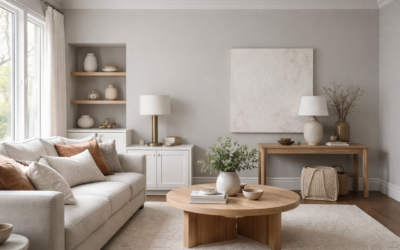
Dark grays are where most paint regrets happen, because a color that looks rich on a chip can turn flat or muddy on four walls. Gauntlet Gray Sherwin Williams (SW 7019) avoids much of that because it is a warm, earthy gray rather than a cold, steely one. With a light reflectance value of about 17, it sits firmly in dark territory, yet it reads softer than charcoal because its brown and taupe base keeps it from looking harsh.
It is a common pick for accent walls, cabinets, front doors, exterior body color and moody dens. It is also a dependable middle step when Urbane Bronze or Iron Ore feel too heavy. The specs, undertones, pairings and comparisons that follow will help you decide whether it suits your room.
- Gauntlet Gray Sherwin Williams Specs at a Glance
- What Undertones Does Gauntlet Gray Have?
- Is Gauntlet Gray Sherwin Williams Right for Your Home?
- Best Rooms and Uses
- Coordinating Colors
- Gauntlet Gray vs Similar Sherwin-Williams Colors
- How to Test and Paint It Well
- Troubleshooting
- General Cost Ranges
- When to Call a Pro
- Frequently Asked Questions
Gauntlet Gray Sherwin Williams Specs at a Glance
The numbers come from the manufacturer’s color page. Screen colors vary by monitor, so treat the hex value as a reference rather than a match.
| Spec | Value | What it means |
|---|---|---|
| Color number | SW 7019 | Use this code when ordering or matching |
| LRV | 17 (17.428, listed as dark) | Reflects little light; makes walls feel enclosed and cozy |
| RGB / Hex | 120, 115, 110 / #78736E | Red slightly higher than blue, so it leans warm |
| Color family | Neutral | Works as a backdrop for wood, brass and warm whites |
| Undertone | Warm taupe, brownish gray | Reads earthy, not blue or icy |
| Fan deck location | 244-C6 | Find it in the store’s color strip system |
| Use | Interior and exterior | Good for siding, doors and shutters as well as rooms |
| Best rooms | Dens, offices, dining rooms, bedrooms, cabinetry | Spaces where a darker, enveloping feel is welcome |
| Suggested sheen | Matte or eggshell walls, satin or semi-gloss cabinets and trim | Lower sheen hides wall flaws; higher sheen cleans easier |
What Undertones Does Gauntlet Gray Have?
Gauntlet Gray is a warm gray with a brown-taupe base. Its RGB values step down evenly from red to blue, which is a typical signature of a warm neutral. In practice that means it looks like a deep stone or driftwood color, not like slate or graphite.
Lighting shifts it noticeably:
- North-facing rooms: Cool, indirect light pulls out its gray side. It can look heavier and slightly cooler, and in a small north room it may feel dim.
- South-facing rooms: Warm daylight brings out the taupe and brown, so it looks softer and more welcoming.
- East and west rooms: Expect a lighter, warmer look in the sunny half of the day and a moodier gray in the other half.
- Warm white bulbs (2700K to 3000K): Leans cozier and more brown.
- Cool white bulbs (4000K and up): Leans flatter and grayer.
Because the color is dark, the room’s other surfaces bounce a lot of their own color onto it. A red brick fireplace, orange oak floors or green lawn outside a window can all tint it. Test it in the real room before committing.
Is Gauntlet Gray Sherwin Williams Right for Your Home?
Gauntlet Gray Sherwin Williams suits homes that already lean warm: wood floors, cream or white cabinets, stone, and brass or black hardware. It is less suited to spaces built around cool blue-gray tile and chrome, where a cooler charcoal may look cleaner. Hold the chip against your floor and countertop together; if all three feel like one earthy family, it is a good candidate.
Best Rooms and Uses
An LRV of 17 is dark enough to change how a room feels. It pulls walls inward, which is great for comfort and drama, and less great if the room is already short on light.
Where it shines
- Accent walls: Behind a bed or a sofa, it adds depth without the starkness of black.
- Home offices and dens: Pairs well with wood shelving and leather.
- Kitchen islands and lower cabinets: Grounds a white kitchen and hides scuffs better than a light color.
- Exteriors: A popular body or shutter color, especially with crisp white trim and natural wood or stone.
- Front doors: Gives a refined, solid look on a light house.
Where to be careful
- Small bathrooms or hallways with no windows can feel cave-like.
- Low ceilings feel lower if you carry it up onto them.
- Rooms with a lot of cool gray tile may clash with its warm undertone.
Coordinating Colors
Sherwin-Williams lists three coordinating colors for Gauntlet Gray: Eider White (SW 7014), a soft, lightly gray white; Repose Gray (SW 7015), a light warm gray; and Armagnac (SW 6354), a warm orange-tan accent. That trio gives a ready scheme: Eider White on trim and ceilings, Repose Gray on adjoining walls and Armagnac for a pop on a door or in decor.
Other combinations that tend to work well with a warm dark gray:
- Warm or soft whites on trim for clean contrast without a stark, blue-white edge.
- Light greiges on open-plan walls so the dark color reads as an intentional anchor.
- Natural wood: White oak, walnut and cedar all look good against it.
- Metals: Brushed brass and matte black hardware both suit it.
- Greens and rust tones in fabrics and plants, which play off the taupe base.
Gauntlet Gray vs Similar Sherwin-Williams Colors
These comparisons use LRVs from each color’s manufacturer page. A gap of more than about 5 LRV points is usually easy to see side by side.
| Color | LRV | How it compares |
|---|---|---|
| Dorian Gray SW 7017 | 39 | Same warm gray character, much lighter; a midtone rather than a dark |
| Gauntlet Gray SW 7019 | 17 | Deep warm gray; dark but not near-black |
| Urbane Bronze SW 7048 | 8 | Darker and browner, with a bronze, olive-leaning feel |
| Iron Ore SW 7069 | 6 | Nearly black soft charcoal; far heavier on walls |
Gauntlet Gray vs Dorian Gray
These two share a warm, earthy base, but Dorian Gray is more than twice as reflective. Choose Dorian Gray if you want a gray that feels warm and grounded but still works on all four walls of a medium room. Pick Gauntlet Gray if you want real depth.
Gauntlet Gray vs Urbane Bronze
Urbane Bronze is much darker and reads distinctly brown-bronze with a hint of green. Gauntlet Gray stays more clearly gray. If you like Urbane Bronze on a chip but fear it on walls, Gauntlet Gray is a safer step.
Gauntlet Gray vs Iron Ore
Iron Ore is close to black. On cabinets and exterior trim it gives a bold, graphic look. Gauntlet Gray gives a softer contrast and shows less dust and lint on matte finishes, which is a practical win on lower cabinets.
How to Test and Paint It Well
A dark color rewards careful prep and punishes shortcuts. Here is a simple sequence:
- Sample big. Use peel-and-stick samples or paint two coats on poster board at least 12 by 12 inches. Move them around the room and look at morning, afternoon and evening light.
- Prep the walls. Fill holes, sand patches smooth and clean greasy areas. Dark colors with any sheen show flaws.
- Use a tinted primer. When covering a light color, ask the store for a gray-tinted primer. It cuts the number of finish coats.
- Cut in first, then roll. Work one wall at a time to keep a wet edge. A quality paint roller kit with a 3/8 inch nap cover suits most smooth walls.
- Plan on two coats. Dark colors almost always need two finish coats for even depth.
- Box your paint. Mix all gallons together in a bucket so there is no color shift from can to can.
Troubleshooting
- Looks too brown: The room probably has warm light or warm floors bouncing onto it. Cooler bulbs help, or step to a cooler gray.
- Looks flat and dull: Usually a north room with little light. Add warm lamps or move it to a single accent wall.
- Visible roller marks: Common with dark, low-sheen paint. Keep a wet edge, avoid going back over half-dry areas and finish each wall in one session.
- Touch-ups show: Touch up with the same batch, same sheen and the same applicator. Feather the edges.
- Burnished spots on matte walls: Dark matte finishes can shine when rubbed. Use eggshell in hallways and kids’ rooms.
General Cost Ranges
A premium interior paint from a paint store typically falls in a mid to premium price band per gallon, with regular sales lowering the price. A 12 by 14 foot room usually needs about 2 gallons for two coats on the walls, plus primer if you are covering a light color. Professional interior painting is commonly quoted per room or per square foot of wall, and dark colors may cost a little more because of the extra coat and careful cutting in.
When to Call a Pro
Dark colors on cabinets, two-story foyers and exterior siding are jobs where a professional painter earns the fee. Cabinets need degreasing, sanding and a durable enamel; tall walls need scaffolding; and exteriors need weather timing and good prep. If your home was built before 1978, test for lead before sanding old paint, and hire a lead-safe certified contractor if the test is positive.
Frequently Asked Questions
Is Gauntlet Gray warm or cool?
It is warm. Its brown-taupe base makes it read like a deep stone gray, though it can look cooler in north light.
What is the LRV of Gauntlet Gray?
The manufacturer lists it at 17.428, which rounds to 17 and is classed as dark.
What trim color goes with Gauntlet Gray?
Eider White is one of the manufacturer’s listed coordinating colors. Many people also use a soft warm white so the contrast stays crisp but not stark.
Is Gauntlet Gray good for exterior siding?
Yes, it is rated for interior and exterior use, and it is a popular body color with white trim and natural wood accents. Sample it outdoors first, since full sun lightens it.
Is Gauntlet Gray darker than Dorian Gray?
Much darker. Dorian Gray has an LRV around 39, so it reflects more than twice as much light as Gauntlet Gray.