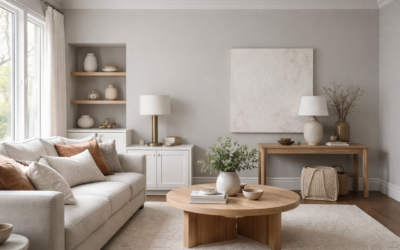
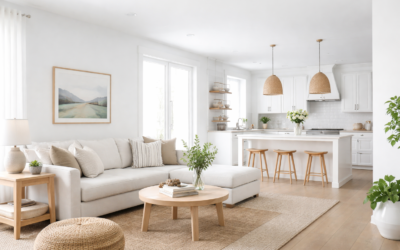
If you have been hunting for a white that does not turn yellow or creamy on the wall, Sherwin-Williams Site White (SW 7070) is worth a close look. It is a pale gray-white with a Light Reflectance Value (LRV) of 72.956 on the maker’s color page, usually rounded to 73. That is light, but well below the bright whites in the 80s, so it reads as a soft, cool off-white rather than a crisp, stark one.
Its color data is almost perfectly balanced (RGB 220, 222, 220), with a whisper more green than red or blue. Sherwin-Williams describes it as a cool white with a touch of blue undertone, and in shaded rooms it can take on a cool, slightly gray-green cast and a clean, quiet gray-white in good daylight. It never pulls warm or beige, which is why people choose it for modern kitchens, gray-and-white bathrooms and as a softer alternative to bright white walls.
- Sherwin Williams Site White Specs at a Glance
- What Site White Looks Like in a Room
- Rooms and Uses Where It Works
- Coordinating Colors
- Site White Compared With Near Colors
- How to Test and Apply It
- Troubleshooting
- Is Sherwin Williams Site White Right for Your Home?
- General Cost Ranges
- When to Call a Pro
- Frequently Asked Questions
The maker rates it for interior and exterior use and files it under the White and Pastel color family.
Sherwin Williams Site White Specs at a Glance
All figures below come from the Sherwin-Williams color page for SW 7070, except sheen guidance, which depends on the paint product you buy. Use them to plan, then confirm with a physical sample.
| Spec | Value | What it means |
|---|---|---|
| Color number | SW 7070 | Order by number; many whites have similar names |
| LRV | 72.956 (about 73) | Light, but softer than bright whites in the 80s |
| Hex / RGB | #DCDEDC / 220, 222, 220 | Nearly neutral with a faint green-gray lean |
| Color family | White and Pastel | Sits at the gray end of the whites |
| Undertone | Cool, touch of blue (maker) | No yellow or beige; can read slightly gray-green in shade |
| Locator number | 257-C7 | Position on the in-store fan deck |
| Use | Interior and exterior | Walls, ceilings, cabinets, siding and trim |
| Best sheen | Eggshell or matte for walls; satin or semi-gloss for trim and cabinets | Higher sheen reads a touch brighter |
What Site White Looks Like in a Room
On a chip, Site White can look almost like a plain white. On four walls, its gray shows. In a north-facing room with cool, indirect light, expect it to read as a pale gray with a slightly cool, gray-green edge. In a sunny south-facing room, the warm light balances it and it looks like a soft, clean white.
Artificial light matters as much as daylight. Warm bulbs (around 2700K) soften it toward neutral. Cool daylight bulbs (5000K and up) push it gray and can make it feel a little clinical. A middle color temperature around 3000K to 3500K tends to show it at its most balanced.
Because it is not a bright white, it does not glare in very sunny rooms, which is one reason designers like it for spaces with big windows.
Rooms and Uses Where It Works
Kitchens
Site White on walls pairs well with white or light gray cabinets, gray-veined quartz or marble-look counters and stainless appliances. On cabinets, it gives a soft painted look that hides minor smudges better than a bright white.
Bathrooms
Its cool cast suits gray tile, white subway tile and chrome or matte black fixtures. Use a satin or bath-rated finish for moisture resistance.
Living rooms and bedrooms
It makes a calm backdrop for gray, navy, black and green furnishings. With very warm wood floors, it can look cool by contrast, so test it there first.
Exteriors
Outdoors, strong sun washes colors lighter, so Site White reads as a fresh, soft white on siding. It pairs with black windows, charcoal roofs and gray stone.
Ceilings
Use it on ceilings in the same room for a cohesive, enveloped look, or use a brighter white on the ceiling if you want the room to feel taller.
Coordinating Colors
The maker lists three coordinating colors for Site White: Pure White (SW 7005), Gray Screen (SW 7071) and Cadet (SW 9143). That trio gives you a brighter white for trim, a slightly deeper gray-white for adjoining rooms and a darker blue-gray for accents.
| Role | Color | Why it works |
|---|---|---|
| Trim and doors | Pure White (SW 7005, LRV 83.957) | Brighter and softer, gives gentle contrast |
| Adjoining rooms | Gray Screen (SW 7071, LRV 58.547) | Same cool family, one clear step deeper |
| Accent wall, island or door | Cadet (SW 9143, LRV 31.218) | Cool gray-blue accent from the maker’s list |
| Dark contrast | Charcoal or near-black gray | Crisp outline for windows, doors and railings |
Be careful with very warm, yellow-leaning whites as trim. Next to them, Site White can look grayer or greener than you want. Hold samples side by side before deciding.
Site White Compared With Near Colors
Site White vs Pure White (SW 7005). Pure White is much brighter (LRV 83.957) and slightly warmer (hex #EDECE6). If Site White feels too gray, Pure White is the obvious step up. If Pure White feels too bright, Site White is the step down.
Site White vs Reserved White (SW 7056). These two have almost the same depth (Reserved White is LRV 74.078). Reserved White is described by the maker as having a hint of green undertone (hex #E0E0D9), and it reads slightly softer. Pick Reserved White for a gentler, more tranquil white; pick Site White for a cooler, grayer feel.
Site White vs Reflection (SW 7661). Reflection is a step darker (LRV 66.058) with a very similar cool tone (hex #D3D5D3). It is a good choice when you want the same look with more visible gray.
Site White vs Gray Screen (SW 7071). Gray Screen is clearly a light gray rather than a white (LRV 58.547). It is a strong partner for an adjacent room or a two-tone wall.
How to Test and Apply It
- Order large samples. Peel and stick paint samples or painted boards at least 12 inches square give an honest read. Tiny chips exaggerate how white it is.
- Test against fixed finishes. Place samples next to cabinets, counters, flooring and tile, which you are not changing.
- View at several times of day. Check morning light, afternoon light and evening lamps.
- Prep the surface. Clean, patch and sand, then prime any patches, stains or dark previous colors so the gray-white covers evenly.
- Apply two coats. Light colors need two full coats for even color, especially over a darker wall.
Troubleshooting
It looks too gray. The room probably has cool or low light. Try a warmer bulb, or step up to a brighter white like Pure White.
It looks green. Strong green from outdoor foliage, or a yellow-leaning trim beside it, can exaggerate its slight green lean. Change the trim white or test a warmer white.
Patchy finish. Usually unprimed patches or one coat over a darker color. Spot-prime and apply a full second coat.
Is Sherwin Williams Site White Right for Your Home?
A quick way to decide is to look at what already stays in the room. Sherwin Williams Site White suits homes where the fixed finishes lean cool or neutral, and it struggles where everything else leans warm.
- Good fit: gray or white tile, cool-toned quartz, black or chrome hardware, gray or ash-toned floors, blue and green fabrics.
- Good fit: bright rooms where a stark white would glare, or open plans that need one calm wall color throughout.
- Test carefully: honey or orange-toned wood floors, cream trim, beige carpet and brass-heavy lighting, where the gray can read cold.
- Probably skip: small, dark, north-facing rooms if you want them to feel warm; a creamier white or a light greige will do more there.
If you are repainting a whole house, many people use Sherwin Williams Site White as the main wall color and step to Gray Screen in rooms that need a little more depth, with Pure White on trim everywhere. That keeps the palette consistent from room to room while still giving each space some contrast.
General Cost Ranges
The color does not change the price; the product line does. Mid-grade interior paint generally falls in a range of roughly $35 to $60 per gallon, with premium lines higher. One gallon covers about 350 to 400 square feet per coat. Professional interior painting often runs around $2 to $6 per square foot of wall, depending on prep, ceiling height and trim work.
When to Call a Pro
A painter makes sense for high ceilings, stairwells, cabinets (which need careful prep and a durable finish) and multi-story exteriors where ladder work becomes risky. In homes built before 1978, test old paint for lead before sanding or scraping, and use lead-safe practices or a certified contractor.
Frequently Asked Questions
What is the LRV of Sherwin-Williams Site White?
The maker lists Site White (SW 7070) at an LRV of 72.956, usually rounded to 73. It is a light color, but softer than bright whites.
Is Site White warm or cool?
It is cool. The maker describes a touch of blue undertone, and it can show a faint gray-green cast in shaded rooms or north light.
What trim color goes with Site White?
The maker coordinates it with Pure White (SW 7005), which is brighter and gives a soft contrast. Avoid strongly yellow whites beside it.
Is Site White a gray or a white?
The maker files it with the whites, but it is a gray-white. On the wall it reads as a very pale cool gray in low light and a soft white in bright light.
What sheen is best for Site White?
Matte or eggshell suits most walls, satin suits kitchens and baths, and satin or semi-gloss suits trim, doors and cabinets.
Can Site White be used outside?
Yes. It is rated for interior and exterior use and reads as a fresh soft white on siding in direct sun.