Anything under 3 feet tall does not require an engineer or a permit in most municipalities, which is why short retaining wall ideas have exploded as a DIY weekend project. A 24-inch wall can transform a sloped yard into terraced garden beds, level a patio pad, or hide an ugly grade change next to a driveway — all without the structural calculations and pricing of a full-height wall. The catch is that “short” does not mean “easy.” Drainage, base prep, and material choice still make the difference between a wall that lasts 25 years and one that bellies out by year three. Here are seven approaches that work.
1. Dry-Stacked Natural Stone
The most timeless look is irregular fieldstone or weathered limestone, dry-stacked without mortar. Stone weight does the work — gravity locks the wall in place. For a 24-inch wall, you want stones in the 30 to 80-pound range with at least one flat face per piece. Pennsylvania bluestone, Tennessee fieldstone, and reclaimed New England wallstone all sell for $200 to $400 per ton delivered.
One ton typically covers about 25 to 40 square feet of wall face. A 30-foot run of 2-foot wall (60 sq ft) needs roughly 1.5 to 2.5 tons of stone, putting material at $400 to $1,000. Add a tamped gravel base 6 inches deep and 1 inch of setback per course as you build.
2. Manufactured Concrete Block
The DIY-friendliest material is interlocking concrete retaining wall block — brands like Allan Block, Pavestone, Belgard, and Versa-Lok. Each block weighs 30 to 80 pounds, has a built-in lip that locks into the course below, and stacks without mortar.
Pricing runs $3 to $7 per block at Home Depot or Lowe’s, with each block covering about 0.7 square feet of face. A 30-foot, 2-foot wall costs roughly $250 to $600 in block plus $80 for base gravel and $40 for landscape fabric. Total DIY material around $400 to $800 plus a weekend of labor.
3. Pressure-Treated Timber Walls
Landscape timbers (6×6 ground-contact pressure-treated) make a clean, modern wall for under 3 feet. Stack them log-cabin style with #4 rebar driven through pre-drilled holes into the soil and use 8-inch landscape spikes to lock each course to the one below.
A 6x6x8 ground-contact timber runs $25 to $40 at most lumber yards. For a 30-foot, 2-foot wall, you need roughly 12 timbers, plus rebar, plus a deadman every 8 feet for backfill anchoring. Materials around $350 to $500. Realistic lifespan in wet climates is 15 to 20 years before rot starts at the base course.
4. Gabion Baskets (The Industrial Look)
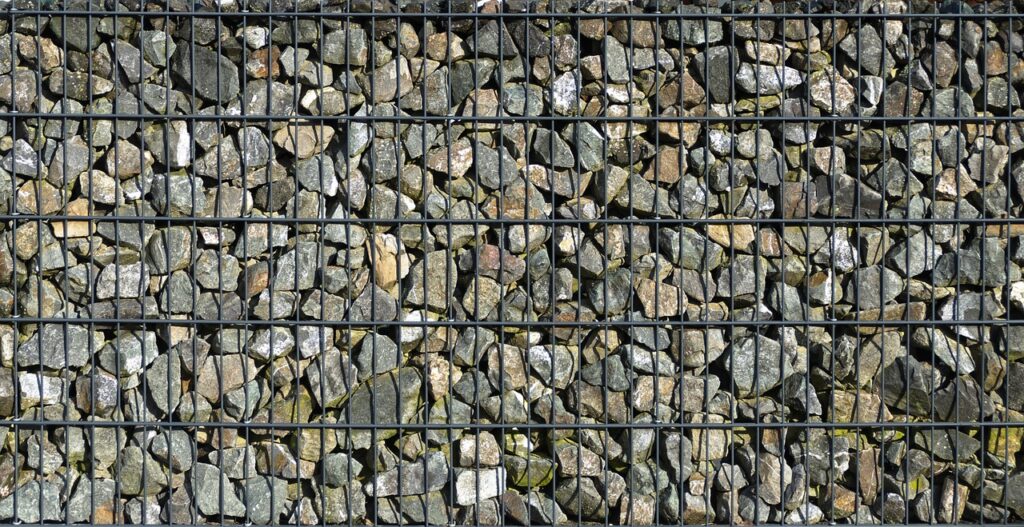
Wire-mesh gabion baskets filled with crushed stone are a designer favorite for modern landscapes. They drain freely (no perforated pipe needed), tolerate uneven settling without cracking, and develop a weathered patina that looks intentional.
PVC-coated gabion baskets cost $40 to $80 each in 2x2x3-foot units. A 30-foot wall needs 10 baskets ($500), filled with $150 of locally sourced 2 to 4-inch crushed stone. Total around $700, plus the time to fill each basket by hand. Looks especially good when the wall caps with a single piece of bluestone or steel.
5. Mortared Brick or Cut Stone
For formal garden settings, a mortared wall in salvaged brick or cut Indiana limestone reads as old-world permanence. The base must sit on a concrete footing dug below frost line — typically 12 to 36 inches deep depending on your climate zone. That adds material and labor beyond what dry-stacked walls require.
This is the most expensive and least DIY-friendly of the short retaining wall ideas — expect $40 to $80 per square foot installed, or $1,200 to $2,400 for a 30-foot, 2-foot wall. Best left to a mason if you want it to last.
6. Steel Edging or Corten Steel
For a wall under 18 inches, you can skip masonry entirely and use 1/4-inch steel landscape edging or Corten weathering steel. Sheets come in 10 or 20-foot lengths and 6 to 24 inches tall. Drive vertical anchors every 4 feet, set the sheet, backfill with gravel and topsoil.
Corten steel develops a rust-red patina that protects the underlying steel and never needs sealing. Cost runs $25 to $40 per linear foot for the steel plus another $10 to $15 per foot for anchors and base prep. The look is sharp, minimalist, and pairs well with prairie-style plantings.
7. Tiered Mini-Walls for Steep Slopes
When the grade change is more than 3 feet but you want to stay under permit thresholds, build two parallel walls each 24 inches tall, set 3 to 6 feet apart with a planting terrace between them. Code generally treats them as independent walls if they are separated by more than twice their height.
This approach uses the same materials as a single wall but doubles the material cost. The payoff is a softer, more landscaped look — perfect for sloped front yards where a single 5-foot wall would feel oppressive. Plant lavender, ornamental grasses, or low junipers in the terrace.
Base Prep and Drainage: The Critical Steps
Regardless of material, two things make or break a short retaining wall. First, the base. Dig a trench at least 6 inches deep and twice as wide as the wall, fill with 4 to 6 inches of compacted 3/4-inch crushed gravel, level meticulously. A wall is only as straight as its first course.
Second, drainage. Even short walls need water to escape. Lay landscape fabric against the soil behind the wall, install a 4-inch perforated pipe at the base of the wall (sloped to daylight), and backfill the first 12 inches behind the wall with the same crushed gravel. Skip these and you will see your wall heave during the first freeze-thaw cycle or bulge after the first heavy rain.
- Trench depth: 6 inches minimum, 8 inches in clay soils
- Base gravel: 4 to 6 inches compacted #57 stone
- Setback: 1 to 1.5 inches per foot of wall height
- Drainage backfill: 12 inches of clean gravel behind the wall, wrapped in fabric
- Cap stones: optional but recommended — protects top course from rain infiltration