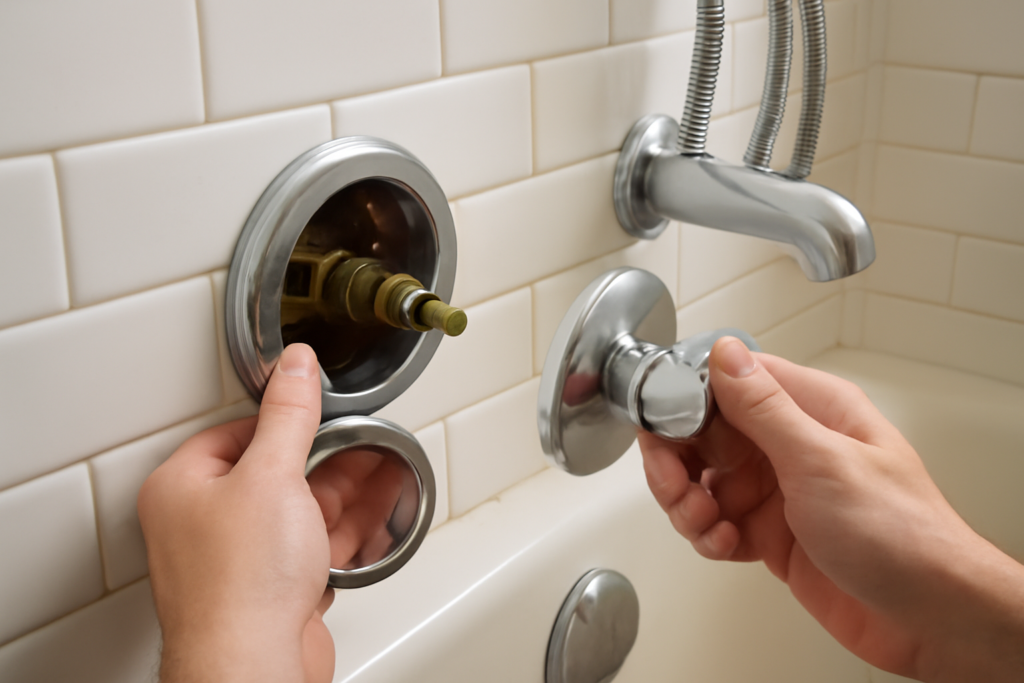
That little pull-up knob on your tub spout or the extra handle on your shower wall is doing more work than you might think. The shower diverter valve is the mechanism that redirects water from one outlet to another, most commonly sending it up from the tub spout to the showerhead. When it works, you never think about it. When it fails, you get weak shower pressure, water dribbling out of the tub spout during your shower, or a handle that spins uselessly. Understanding how it works makes diagnosing and fixing the problem far less intimidating.
Part of our Bathroom Remodeling & Flooring guide — explore the full guide →
- What a Shower Diverter Valve Does
- The Main Types of Shower Diverters
- Signs Your Diverter Valve Is Failing
- Why Diverters Fail
- Fixing a Pull-Up Tub Spout Diverter
- Fixing a Wall-Mounted Diverter Valve
- When Cleaning Solves the Problem
- Common Mistakes to Avoid
- When to Call a Plumber
- Understanding Your Faucet Brand
- Preventing Future Diverter Problems
What a Shower Diverter Valve Does
In a combined tub-and-shower setup, a single water supply feeds both the tub spout and the showerhead. The diverter is the traffic cop that decides where that water goes. Pull the knob or turn the handle and the valve blocks the path to the tub spout, forcing pressurized water up the riser pipe to the showerhead instead. Release it and water flows back to the tub. The whole system relies on the diverter creating a good seal; if it cannot fully block one path, water splits between both outlets and pressure suffers everywhere.
The Main Types of Shower Diverters
Not all diverters look or work the same. Knowing which kind you have determines how you repair it:
- Tee diverter (pull-up type): the most common, built into the tub spout itself. You pull a knob on top of the spout up to send water to the shower. When you shut off the water, it automatically drops back to tub mode. These wear out and are the easiest to fix because you simply replace the whole spout.
- Two-valve diverter: a separate handle between or below the hot and cold handles. Turning it routes water up or down. Common in older three-handle setups.
- Three-valve diverter: in a system with separate hot and cold handles, the center handle is the diverter, controlling flow direction after you have mixed your temperature.
- Single-handle integrated diverter: in modern pressure-balance valves, the diverter may be a small button, lever, or an integrated function of the cartridge.
Signs Your Diverter Valve Is Failing
- Water flows from both the tub spout and showerhead at the same time.
- Weak or reduced water pressure at the showerhead.
- Water continues dripping from the tub spout throughout your shower.
- The diverter knob or handle feels loose, stiff, or spins without engaging.
- You hear rattling or vibration when water runs.
Most of these point to worn seals, mineral buildup, or a failed diverter mechanism, all of which are repairable.
Why Diverters Fail
The usual culprits are simple. Rubber washers and seals harden and crack with age and heat. Hard water deposits scale that prevents the internal gate from seating fully. Small mineral or debris particles lodge in the mechanism. And in pull-up tee spouts, the internal plastic and metal parts simply wear out after thousands of cycles. Because the failure is almost always mechanical wear rather than a plumbing catastrophe, the fix is usually a matter of cleaning or swapping an inexpensive part.
Fixing a Pull-Up Tub Spout Diverter
This is the most common and the easiest repair, because the diverter is integral to the spout and you replace the entire spout. Spouts cost about $10 to $40.
- Identify your spout’s attachment. Look underneath: a small setscrew means a slip-on spout; no screw means a threaded spout.
- Remove the old spout. For a setscrew type, loosen the screw with a hex key and pull the spout off. For a threaded type, twist it counterclockwise (a cloth-wrapped wrench or a screwdriver inserted into the spout for leverage helps).
- Measure and match. Note the pipe type, length, and connection, then buy a matching replacement.
- Install the new spout. Apply plumber’s tape or pipe-thread sealant to threaded connections, or a bead of silicone at the wall on slip-on types, and reattach.
You usually do not even need to shut off the main water supply for a spout swap, though it does not hurt.
Fixing a Wall-Mounted Diverter Valve
A two- or three-valve diverter behind a handle requires a bit more work, and here you must shut off the water first, either at a nearby shutoff or the main.
- Turn off the water and open the faucet to relieve pressure.
- Remove the handle. Pop off the decorative cap, remove the screw, and pull the handle.
- Unscrew the escutcheon and bonnet nut to expose the diverter stem or cartridge.
- Extract the stem. Use a deep socket or a shower valve socket wrench to unthread it from the valve body.
- Inspect and replace. Look at the rubber washers and seals; often replacing a worn washer solves it. If the stem is corroded or stripped, install a matching new stem or cartridge.
- Reassemble and test. Reverse the steps, restore water, and check that the diverter fully switches flow.
Replacement stems and cartridges run $10 to $50. Bring the old part to the store to match the brand (Moen, Delta, Kohler, Price Pfister, and others use different designs).
When Cleaning Solves the Problem
Before replacing anything, try cleaning. Mineral buildup is a frequent cause of a diverter that won’t seal. Soak removable parts in white vinegar for a few hours to dissolve scale, scrub gently with an old toothbrush, and clear any debris from the passages. On a showerhead delivering weak flow, unscrew and descale it too, since a clogged head can mimic diverter problems.
Common Mistakes to Avoid
- Forgetting to shut off the water before opening a wall valve, which leads to a soaked bathroom.
- Over-tightening the new spout or stem, which can crack fittings or strip threads.
- Using the wrong replacement part. Diverters are brand- and model-specific; always match before you buy.
- Skipping plumber’s tape on threaded connections, causing leaks.
- Forcing a stuck spout and breaking the pipe nipple in the wall, which turns a simple job into a major repair.
When to Call a Plumber
Most diverter repairs are firmly DIY-friendly and cost under $50 in parts. Call a professional if the valve body itself is leaking inside the wall, if you find corroded pipes, if the stem is seized and won’t budge, or if you have an older system with no shutoff and are uncomfortable working at the main. A pro visit typically runs $100 to $300, still far cheaper than the water damage a hidden leak can cause.
Understanding Your Faucet Brand
Diverter parts are almost never universal, so knowing your faucet’s manufacturer saves a wasted trip to the store. Moen, Delta, Kohler, Price Pfister, and American Standard each use their own stem, cartridge, and seal designs, and even within a brand there are multiple generations of parts. Look for a logo on the handle or trim, or take a clear photo of the removed stem to the hardware store. Many manufacturers offer free replacement parts under lifetime warranties for the original owner, so it is worth checking the brand’s website before buying. When in doubt, bring the old part with you and match it physically; a stem that is a millimeter off in thread pitch or length will not seal and you will be right back where you started.
Preventing Future Diverter Problems
Because most diverter failures trace back to hard-water scale and worn rubber, a little prevention extends the life of the repair. If your home has hard water, a water softener dramatically reduces the mineral buildup that seizes diverter mechanisms and clogs showerheads. Periodically exercising the diverter through its full range keeps the internal parts moving freely rather than sticking from disuse. When you replace a spout or stem, a light coat of plumber’s silicone grease on the moving parts and O-rings helps them seat smoothly and resist wear. Descaling your showerhead once or twice a year keeps back-pressure low, which reduces strain on the diverter. These small habits mean the difference between a diverter that lasts a couple of years and one that runs reliably for a decade.
A shower diverter valve is a small part with an outsized effect on your daily shower. Once you know whether you have a pull-up spout or a wall-mounted valve, the repair is usually a quick, inexpensive swap of a washer, stem, or spout. Diagnose the symptom, match the part, and you can restore full, satisfying shower pressure in an afternoon without waiting on a plumber.