Most people think the only way to control shower water is the temperature handle, but there’s a small, underappreciated part that decides how much water actually reaches you, and lets you pause the spray without losing your perfect temperature. A shower flow control valve regulates the volume of water flowing through the showerhead, letting you throttle it down to save water and hot-water energy, or shut it off entirely at the head while you lather up. Whether it’s built into your faucet, integrated into the showerhead, or added as a separate inline fitting, understanding how it works helps you cut your water bill without sacrificing a satisfying shower.
Part of our Bathroom Remodeling & Flooring guide — explore the full guide →
- What a Flow Control Valve Actually Does
- The Types You'll Encounter
- Why You Might Want One
- Installing an Inline Flow Control Valve
- Flow Control vs. Pressure Balancing vs. Thermostatic
- Troubleshooting and Removing Restrictors
- Choosing the Right Valve for Your Setup
- Maintenance and Longevity
- The Bottom Line
What a Flow Control Valve Actually Does
At its core, a flow control valve restricts the cross-sectional area that water passes through, which reduces the volume delivered per minute. Your showerhead flow is measured in gallons per minute (GPM). Since 1994, federal law has capped new showerheads at 2.5 GPM, and many efficient models run at 1.8 GPM or lower. A flow control valve lets you dial the actual delivered flow below the head’s rated maximum, so you can run a 2.5 GPM head at, say, 1.5 GPM when you don’t need the full blast.
Crucially, a good flow valve reduces volume while preserving the sensation of pressure. Because water is being forced through a smaller opening, the velocity, the feel of the spray, stays strong even as the total gallons drop. That’s why a well-designed low-flow setup can feel just as good as a wide-open one.
The Types You’ll Encounter
Flow control shows up in several forms, and it helps to know which one you’re dealing with:
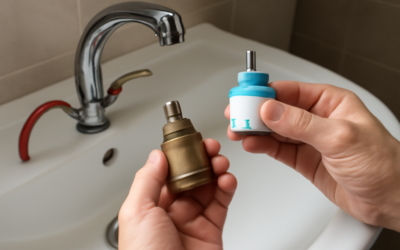
- Integrated valve cartridge: On single-handle faucets, the same cartridge that mixes temperature also controls volume by how far you rotate the lever. Some “volume control” valves separate the two so one control sets temperature and another sets flow.
- Showerhead trickle/pause button: Many handheld and fixed heads include a small lever or button that drops flow to a trickle without shutting the valve, so your temperature stays set.
- Inline flow restrictor: A washer-like disc inside the showerhead, or a threaded valve you add between the arm and head, that limits maximum GPM.
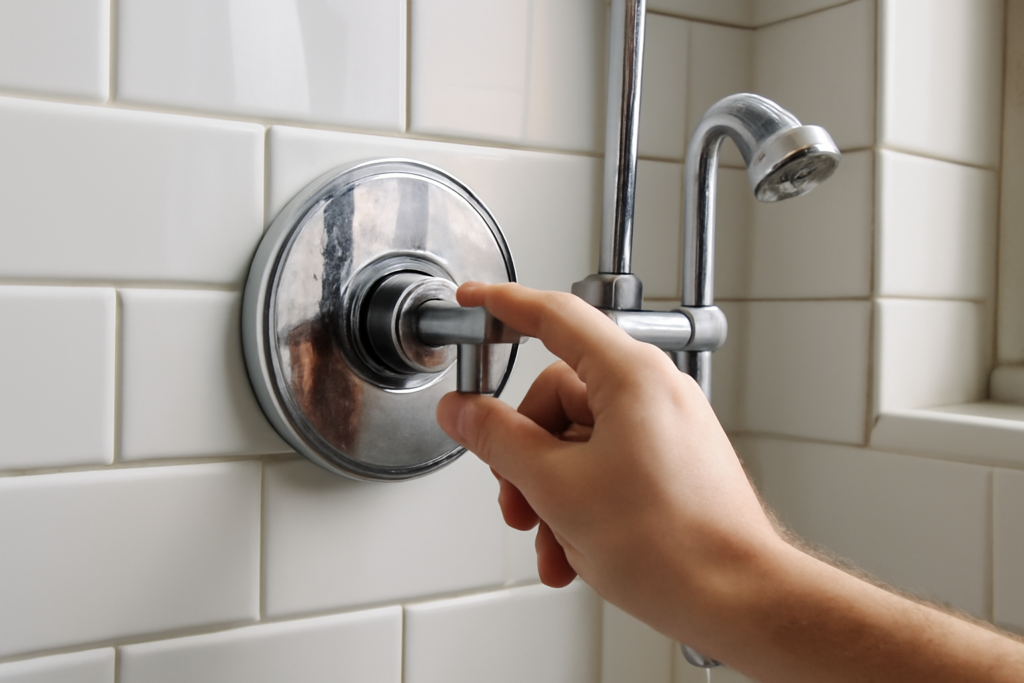
- Separate volume control valve: A dedicated in-wall valve, often paired with a thermostatic mixing valve in higher-end showers, giving independent flow control.
Why You Might Want One
The appeal is water and energy savings without a cold, weak shower. Cutting from 2.5 GPM to 1.75 GPM saves 0.75 gallons every minute, roughly 6 gallons on an 8-minute shower, and about half of that saved water is heated water, so you cut the energy bill too. Over a year, for a family of four, that can add up to thousands of gallons and a meaningful dent in the water-heating portion of your utilities. A pause valve on the head also helps: shutting the flow while you shampoo, then reopening to your exact previous temperature, avoids wasting water and the annoyance of re-mixing hot and cold.
There’s a comfort angle too. If your shower is uncomfortably forceful, or your water pressure is high enough to sting, a flow control valve tames it to a pleasant level.
Installing an Inline Flow Control Valve
Adding a separate inline shut-off or flow valve is one of the easiest plumbing upgrades there is, and it requires no wall access. The valve threads onto the shower arm between the arm and the showerhead. Here’s the process:
- Unscrew the existing showerhead from the arm by hand or with a wrench padded by a rag.
- Clean the old thread-seal tape off the arm threads.
- Wrap the arm threads with three to four turns of PTFE plumber’s tape.
- Thread the flow control valve onto the arm and hand-tighten, then snug a quarter turn with a wrench.
- Wrap the outlet threads and reattach the showerhead.
- Run the shower and check for drips at both joints; add tape if anything weeps.
An inline valve costs about $8 to $20 and the whole job takes ten minutes. The lever lets you throttle or fully stop flow at the head while leaving your mixing handle untouched.
Flow Control vs. Pressure Balancing vs. Thermostatic
Don’t confuse flow control with the safety valves in your system. A pressure-balancing valve keeps hot and cold in proportion so you aren’t scalded when another fixture draws water, it protects temperature, not volume. A thermostatic valve holds a precise set temperature regardless of supply fluctuations. Flow control is a separate function that governs how many gallons per minute come out. High-end showers often combine a thermostatic valve for temperature with a dedicated volume control valve, giving you set-and-forget temperature plus independent flow adjustment. In a basic shower, all three functions may be handled, imperfectly, by one cartridge.
Troubleshooting and Removing Restrictors
If your shower feels weak even wide open, the culprit is often a flow restrictor disc inside the head paired with low household pressure. Some homeowners remove that disc to boost flow, but that both wastes water and can be against local code, and it won’t help if your real problem is a clogged head or low incoming pressure. Before yanking anything, clean the showerhead nozzles by soaking them in white vinegar for an hour to clear mineral scale, and check that your home’s pressure isn’t the limiting factor. A flow control valve gives you a legal, reversible way to fine-tune the spray instead.
Choosing the Right Valve for Your Setup
Matching the flow control approach to your situation keeps you from overspending or under-solving. If you simply want to pause the water while you soap up without losing your temperature, a showerhead with a built-in trickle button, or a $12 inline shut-off valve threaded onto the arm, is all you need. If your shower runs uncomfortably forceful, an inline flow valve you can dial down solves it in ten minutes with no wall access. But if you’re building or fully remodeling a shower and want set-and-forget precision, invest in a thermostatic valve paired with a dedicated volume control valve, that combination lets one person set a favorite temperature and another set flow independently, and it’s the gold standard for a luxury shower.
Consider your household’s water pressure before you buy. If your home already has low incoming pressure, adding an aggressive flow restrictor can make the shower feel weak, so choose a valve you can open fully when you want it. Homes with high pressure benefit most, since there’s plenty of force to spare, and throttling flow costs you nothing in comfort while saving water.
Maintenance and Longevity
Flow control valves are simple, but hard water is their enemy. Mineral scale builds up in the small passages of a flow restrictor or a pause valve, gradually reducing flow until the shower feels weak even wide open. Once a year, unscrew the inline valve or showerhead and soak it in white vinegar for an hour to dissolve the scale, then rinse and reinstall with fresh plumber’s tape on the threads. If you notice the pause lever getting stiff or the valve dripping when closed, the internal seal or O-ring has worn; most inline valves are cheap enough, around $10 to $20, that replacement beats repair. Keeping the valve clean ensures you get the water savings you paid for without sacrificing the strong, satisfying spray that makes a shower worth taking.
The Bottom Line
A shower flow control valve is a small part with an outsized effect on comfort and cost. Whether it’s the cartridge in your handle, a pause button on the head, or a $12 inline valve you thread on in ten minutes, it gives you control over exactly how much water you use, lets you keep your temperature set while you pause the spray, and can trim both your water and energy bills. For a low-cost, high-value upgrade, it’s one of the easiest wins in the bathroom.