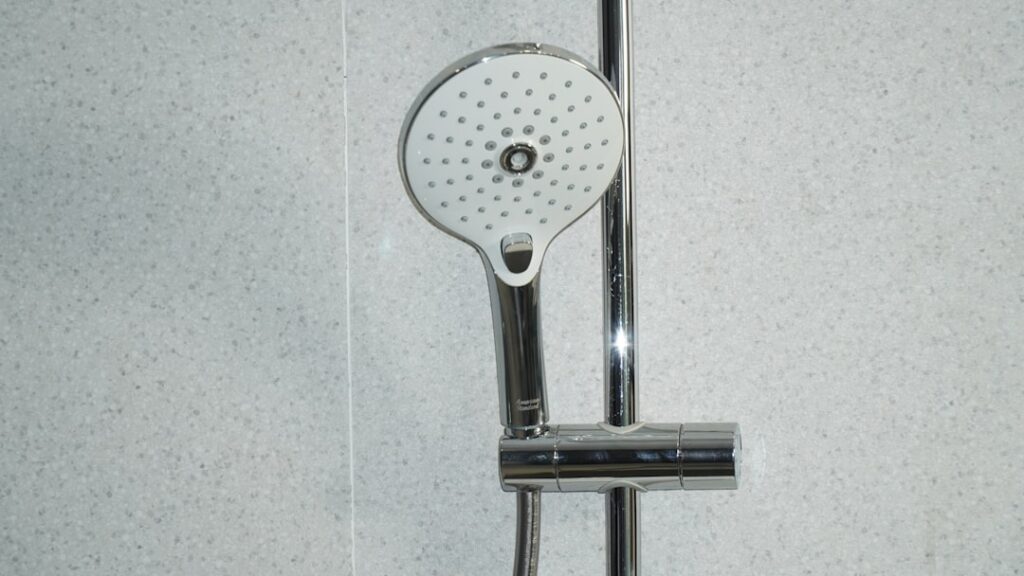
Dial 104°F on the wall and get 104°F at the showerhead — every time, regardless of who flushes what or how the water heater behaves. That is the promise of a thermostatic mixing valve shower, and unlike most plumbing marketing, the promise is mechanical fact. A thermostatic valve (TMV) senses the actual temperature of the mixed water and adjusts the hot/cold blend continuously, which is a fundamentally different and more capable technology than the pressure-balancing valves in most American showers. It costs more, does more, and makes the most sense in specific situations. This guide explains the mechanism, the trade-offs against pressure balancing, real pricing, and what to know before installing one.
How the Wax Element Actually Works
At the heart of nearly every residential TMV sits a thermostatic wax element — the same technology as a car engine thermostat. A copper capsule filled with wax sits directly in the mixed-water stream. As water warms, the wax expands with remarkable force and pushes a piston that moves a sliding sleeve, admitting more cold and less hot. As water cools, a return spring pulls the sleeve the other way. The element is calibrated so each handle position corresponds to a physical temperature, and the feedback loop settles within a second or two of any disturbance. Nothing electronic, nothing to power, nothing to program — a sealed mechanical brain that reads the one variable that matters: the temperature of the water about to hit your skin.
Because the element responds to temperature rather than pressure, a TMV corrects for everything upstream. Water heater sag as the tank depletes, a dishwasher pulling hot, seasonal cold-supply swings from 45°F winter mains to 75°F summer mains — the valve compensates for all of it. Most models also include a failsafe: if the cold supply fails outright, the element slams the hot port shut rather than passing scalding water.
Thermostatic vs. Pressure-Balancing: The Real Difference
Pressure-balancing valves — Moen Posi-Temp, Delta Monitor, Kohler Rite-Temp — hold the ratio of hot to cold steady when pressure fluctuates. They prevent the toilet-flush scald and satisfy code for ordinary showers, and they cost $80 to $200 with trim at the entry level. But they hold a ratio, not a temperature. If the heater’s output drifts 10 degrees, your shower drifts 10 degrees, and after any interruption you re-find your setting by feel.
A TMV holds the temperature itself, typically within 1°F to 2°F of the setpoint. It also decouples temperature from volume: most thermostatic trim gives you one control for how hot and a separate control for how much, so you can run the shower at half flow — or shut it while soaping, the “shower pause” trick — and reopen to the identical temperature. For multi-head custom showers, TMVs are effectively mandatory, because high-flow bodies with two or three heads exceed what a single pressure-balancing cartridge can feed and control gracefully. High-capacity thermostatic valves from Delta, Hansgrohe, and Kohler flow 6 to 18 gallons per minute versus roughly 2.5 to 6 for standard pressure-balanced valves.
What a Thermostatic Shower Costs
- Valve plus trim, entry level: $350 to $600 gets a solid thermostatic rough-in and single-outlet trim from Delta (MultiChoice with T27T-series trim), Grohe (Grohtherm), or Hansgrohe (Ecostat).
- Mid-range and luxury: $600 to $1,500 for Kohler thermostatic packages, exposed European-style bar valves, or multi-function trims with integrated diverters.
- Custom multi-head systems: $1,500 to $4,000+ in hardware once you add volume controls, diverters, body sprays, and a high-flow TMV to feed them.
- Installation: Swapping a valve in an open wall runs $300 to $600 in plumber labor; cutting a thermostatic valve into an existing tiled wall, with access and patching, commonly lands between $600 and $1,200.
Replacement thermostatic cartridges cost $60 to $150 — pricier than a $40 Moen 1222, but on similar decade-scale replacement intervals, and major brands warranty them generously.
Who Actually Benefits
Be honest about the use case before spending triple. A TMV earns its price when any of these apply: a household with young children or elderly members where scald protection and an absolute temperature ceiling matter most; a tankless water heater, whose output temperature can wander with flow changes in ways pressure balancers cannot correct; a multi-head or steam-adjacent custom shower; a deep-soak ritual where the pause function’s water savings add up — shutting flow while shampooing saves 5 to 10 gallons per shower at identical comfort; or simply a homeowner who wants the shower at exactly 103°F every morning without negotiation. For a rental unit’s basic tub/shower, a pressure-balancing valve remains the rational spec, and code is satisfied either way — US plumbing codes require anti-scald protection via ASSE 1016-listed pressure-balancing, thermostatic, or combination valves.
Installation and Setup Notes
Thermostatic rough-ins install like any valve body — 1/2-inch connections in sweat, PEX, or threaded formats, hot left, cold right — but a few particulars deserve respect. Depth tolerance matters even more than usual because thermostatic trim assemblies are thicker; dry-fit the trim against the plasterguard’s min/max lines before tile goes on. Integral service stops are near-universal on good TMVs — use them, because you will thank yourself at cartridge time. After installation, calibrate: most brands ship the valve with a settable maximum, and the commissioning step is to measure water at the head with a thermometer and set the high-limit stop to about 110°F to 115°F. Recheck the calibration whenever the water heater setpoint changes, and once a month spin the temperature control through its range to keep the element’s sleeve free of scale.
Hard-water homes should know that scale is the TMV’s only real enemy. Mineral crust on the sliding sleeve slows response and eventually pins it. A softener solves it systemically; failing that, plan on soaking or replacing the cartridge every five to eight years in 15-grain water.
Troubleshooting the Common Complaints
Water never gets hot enough: the high-limit stop is set conservatively — recalibrate it, and confirm the heater is delivering at least 10°F above your desired shower temperature, since a TMV cannot create heat, only blend it. Temperature oscillates slowly: early-stage scale on the element; soak the cartridge in warm vinegar for an hour or replace it. Flow drops over months: debris and scale in the inlet filter screens most TMVs carry — clean them at the service stops. Valve creeps cooler mid-shower: a depleting tank heater, not the valve; the element is faithfully reporting that your 40-gallon tank has 15 minutes of shower in it. Distinguishing valve faults from supply faults saves a lot of unnecessary cartridge orders.
Point-of-Use vs. Shower Valve TMVs: Don’t Confuse Them
One clarification prevents a common shopping mistake. Plumbers also use the phrase “thermostatic mixing valve” for a different device: the small under-sink or water-heater-mounted mixing valve (ASSE 1017 or 1070 rated, like the Watts LFMMV or Honeywell AM-1) that tempers hot water for a whole house or a single fixture. Those valves let you run the water heater tank at 140°F — hot enough to suppress Legionella bacteria — while delivering 120°F to the taps, and they cost $60 to $150 plus modest labor. They are excellent devices, but they are not shower controls: they have no user handle, no trim, and they do not replace the anti-scald valve your shower wall requires. A well-designed system actually uses both — a 1017-rated valve at the heater for distribution temperature, and an ASSE 1016 thermostatic or pressure-balancing valve in the shower for point-of-use control. If a search listing shows a bare brass tee with a temperature dial for $80, that is the heater-side device; shower thermostatic systems always picture a trim plate and handles.
The Verdict
A thermostatic mixing valve shower is one of the few bathroom upgrades you feel every single day. The mechanism is elegant, the scald protection is the best available, and the set-and-forget temperature turns the morning shower into a solved problem. Budget $400 to $700 installed above a comparable pressure-balanced setup for a standard shower, more for multi-head builds — and if the wall is already open for a remodel, the incremental cost is the smallest it will ever be. That is the moment to choose one.