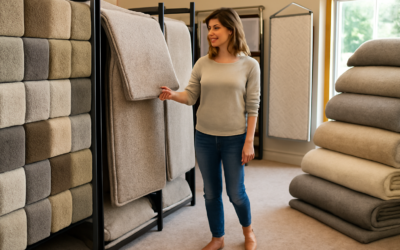
The first 90 seconds inside a flooring showroom are designed to overwhelm. Wide-plank European oak under track lighting, a wall of carpet samples in dusty pinks and slate grays, porcelain that mimics travertine to the millimeter – all of it competing for your attention while a salesperson asks what you came in for. Showroom flooring displays exist to sell you the most expensive product they have a sample of, and they do that job well. The way to win the visit is to come in with a measurement, a budget, and a list of five technical questions that flushes out the substance behind the staging.
- Why Showrooms Look So Good and Floors Look Different at Home
- Five Questions Every Salesperson Should Answer Cleanly
- Decoding the Price Tag
- Samples: Free, Cheap, and Worth Asking For
- Negotiation: What Actually Moves Price
- Installation: The Hidden Spec to Probe
- Lead Times and Inventory Reality
- The Final Walkthrough Before You Sign
Why Showrooms Look So Good and Floors Look Different at Home
Three tricks turn samples into impulse buys. First, lighting – showroom track lighting is typically 3000K to 3500K with a high CRI, the most flattering light a wood or tile sample will ever sit under. Second, sample size – a 12 x 24 inch tile sample shows almost no grout line; in a real install, you see 30 percent grout per square foot. Third, the room is staged with rugs, furniture, and accent walls that change the perceived color of the floor.
Always take the largest available sample home. Lay it on the actual floor, in the actual room, at three different times of day. Pin it next to your existing trim and adjacent flooring. The product that looked like buttery oak in the showroom can read green or pink in your dining room.
Five Questions Every Salesperson Should Answer Cleanly
Memorize these. They sort competent retailers from order-takers in 60 seconds.
- What is the wear layer thickness or AC rating?
- What is the manufacturer’s warranty and what voids it?
- What subfloor prep is required and is it included in the install quote?
- What humidity range does the product warranty cover?
- Has this exact product been installed in this region before, and can I see job photos?
A good salesperson answers all five with specifics. A weak one redirects to “everyone loves this product” or “the manufacturer covers everything.” Walk if you cannot get clean answers.
Decoding the Price Tag
Showroom price tags rarely tell the whole story. The number on the sample is usually material-only, sometimes per square foot, sometimes per square yard (carpet), and sometimes per box. Ask for an out-the-door installed price with three line items broken out:
- Material per sq ft, including waste factor
- Underlayment, adhesive, or moisture barrier required
- Labor per sq ft including subfloor prep, demo, and trim work
A $3.99 per sq ft LVP can become $9.50 installed once underlayment, demo of existing carpet, and baseboard reinstall are added. There is nothing wrong with that price – just know what you are signing.
Samples: Free, Cheap, and Worth Asking For
Most showrooms hand out 4 x 4 inch chips for free. A serious shopper asks for the full plank or full tile sample, sometimes called a “loose sample” or “sample board.” Stores will charge $5-$25 deposit, fully refundable when returned. Take three top picks home; the in-context comparison eliminates 80 percent of regret cases.
For carpet, ask for a 12 x 12 inch sample with the actual pile. The displayed boards are often pressed and brushed to look fuller than the installed product.
Negotiation: What Actually Moves Price
Flooring is one of the few home product categories where listed prices are negotiable on volume. Useful levers:
- Pay 50 percent deposit by check or ACH instead of credit card – saves the store 2-3 percent
- Schedule install in the off-season (January-March) for 5-10 percent off labor
- Buy a full pallet instead of partial coverage – cuts material 8-15 percent
- Combine product categories (hardwood + tile + carpet) for a portfolio discount
- Ask about discontinued or end-of-run inventory – often 30-50 percent off
Volume matters most. A 2,500 sq ft job has dramatically more negotiation room than a 400 sq ft kitchen.
Installation: The Hidden Spec to Probe
Most showroom flooring quotes include installation, but the actual crew quality varies by an order of magnitude. Ask three follow-ups: Are installers W-2 employees of this store or subcontractors? What is the installer’s certification (NWFA, CTEF, CFI)? Is the labor warranty separate from the manufacturer warranty, and how long?
Subcontracted installers paid per square foot have an incentive to move fast and skip prep. In-house W-2 crews are usually slower and better, and the store has direct accountability when something fails. You may pay $1-$2 more per sq ft, and it is worth every cent in callbacks avoided.
Lead Times and Inventory Reality
Custom orders for premium hardwood, imported tile, and special-color carpet routinely take 4-12 weeks in 2026. Domestic LVP usually ships in 1-3 weeks. The showroom display product is rarely in stock; it is a sample of what they can order. Confirm lead time in writing on the contract, and build a 2-week buffer for shipping issues. If the salesperson promises “it’ll be here next week” without checking the warehouse, ask for that in writing too.
The Final Walkthrough Before You Sign
Before any deposit, the contract should specify product name, color, run number if applicable, square footage with waste factor, total installed price, lead time, payment schedule, and warranty terms (both product and labor). A good showroom will email a digital copy and let you sleep on it. A pushy showroom that requires a same-day signature is selling commission, not flooring.
Take that 24 hours. Look at the samples in your home one more time. Read the warranty document – the actual PDF, not the salesperson’s summary. Showroom flooring is a five-figure decision in most homes; the time spent vetting it is the cheapest insurance you will ever buy.
Prefer to explore on your own?
See how new flooring looks in your actual room in seconds — free, no signup.
Try the free Floor Studio →