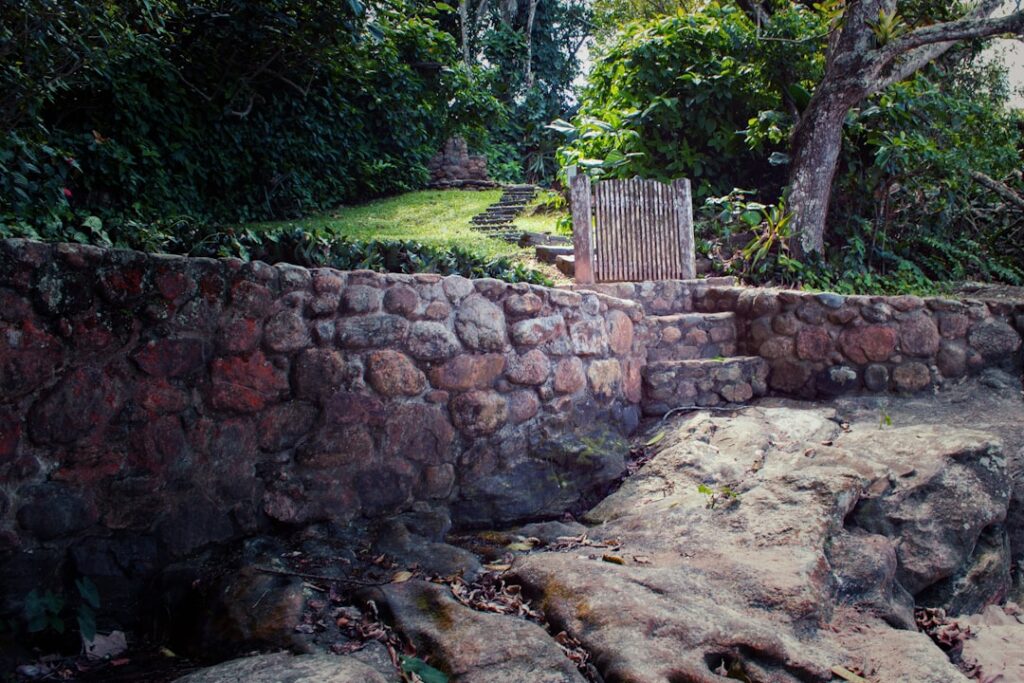
A slope steeper than about 3:1 sheds topsoil, drowns downhill beds, and turns mowing into a rodeo — but it is also the best design opportunity most yards ever get. The right sloped yard natural rock retaining wall ideas convert a problem grade into terraced garden rooms, boulder outcroppings, and stone stairways that look like they grew out of the hillside. Natural rock costs more to place than manufactured block, typically $25 to $75 per face foot installed, but nothing manufactured matches the way weathered fieldstone or granite boulders settle visually into a landscape. Below are the wall styles that work, the engineering rules that keep them standing, and the details that separate a hillside feature from a rock pile.
- Boulder Walls: Big Stone, Big Presence
- Dry-Stacked Fieldstone: The Classic Craft Wall
- Terracing: Two Short Walls Beat One Tall One
- Outcropping and Rock Garden Hybrids
- The Engineering That Keeps Rock Walls Standing
- Choosing Stone by Region and Budget
- DIY or Hire It Out?
- Planting the Wall: The Finishing Move
Boulder Walls: Big Stone, Big Presence
Boulder walls use individual stones from 12 inches to 4 feet across, machine-set in one to three courses. They suit rural and naturalistic yards where a crisp geometric wall would look imported. Glacial granite fieldstone boulders run $100 to $300 per ton delivered, and a ton builds roughly 15 to 20 face feet of low wall. The setting rule is simple but non-negotiable: every boulder leans back into the slope (a batter of 1 to 2 inches per foot of height), sits on compacted gravel rather than soil, and bears on the two stones below it rather than rocking on one point.
Design-wise, resist the urge to line up boulders like beads. Vary sizes, bury the bottom third of the largest stones so they read as bedrock emerging from the grade, and let the wall line wander. A boulder wall that curves around an existing tree or steps up the slope in irregular jogs looks decades old the day it is finished.
Dry-Stacked Fieldstone: The Classic Craft Wall
Dry-stacked walls — flat fieldstone or wallstone laid without mortar — are the New England farm look, and they remain the most forgiving natural wall for DIY builders. Because there is no mortar, the wall drains through every joint and flexes with frost instead of cracking. Wallstone costs $250 to $450 per pallet, and a pallet typically yields 20 to 25 face feet at 18 inches tall.
Height discipline matters here. Keep dry-stacked walls at 3 feet or under; most municipalities require an engineer’s stamp above 4 feet anyway, and gravity-only walls get exponentially less stable with height. The craft rules: one stone over two, two over one (staggered joints), long stones placed as “deadmen” reaching back into the backfill every 4 feet, and a batter of 2 inches per foot. Cap with the heaviest flat stones you have. A well-built dry wall will outlast every fence you will ever own — there are 200-year-old examples doing their job across Pennsylvania and Vermont.
Terracing: Two Short Walls Beat One Tall One
The single most useful idea for a steep yard is to stop thinking in terms of one wall. Two 2-foot walls with a 4-to-6-foot planting terrace between them retain the same grade as one 4-foot wall while staying under permit thresholds, costing less per foot, and creating usable flat ground. The geotechnical rule of thumb: for the upper wall not to surcharge the lower one, set it back at least twice the height of the lower wall. A 2-foot lower wall means the next wall starts 4 feet uphill.
- Garden terraces: Fill terraces with amended soil for vegetables or perennials — terraced beds drain well and warm early in spring.
- Stair-stitched terraces: Run a natural stone slab stairway up through the walls, offsetting each flight so the climb zigzags rather than marching straight up.
- Destination terraces: Make the middle terrace a gravel sitting area with a fire bowl; a slope becomes an outdoor room with a view.
Outcropping and Rock Garden Hybrids
Where the slope is gentler — say a 4-foot drop over 20 feet — you may not need a true wall at all. Outcropping stone, sold in large flat ledges 3 to 8 inches thick, can be set in staggered groups that pin the slope in place while reading as natural rock ledge. Plant creeping thyme, sedum, candytuft, and dwarf conifers in the soil pockets between stones and you have an alpine rock garden that controls erosion as effectively as a wall. Material cost is moderate ($300 to $500 per ton of outcropping, covering more area than wall stone) and no single stone bears serious structural load, which keeps this style DIY-friendly with a rented mini skid steer at about $300 per day.
The Engineering That Keeps Rock Walls Standing
Nearly every failed rock wall fails for the same two reasons: no drainage and no base. Water trapped behind a wall doubles the lateral pressure and, in freeze climates, jacks stones out of place every winter. Build every wall — boulder, stacked, or terraced — on the same skeleton:
- Excavate a trench 6 to 12 inches deep and twice the width of the stone, down to undisturbed soil.
- Compact 4 to 6 inches of 3/4-inch crushed gravel (crusher run) as the footing.
- Lay a 4-inch perforated drain pipe behind the base course, wrapped in fabric, daylighting to grade at the wall ends.
- Backfill the 12 inches behind the wall with clean crushed stone, not soil, separated from native soil by non-woven geotextile fabric.
- Slope the finished grade above the wall away from the edge so surface water never sheets over the face.
Check local rules before digging: most towns permit walls under 3 or 4 feet without engineering, but walls supporting a driveway, structure, or steep surcharge need a professional design at any height. Call 811 for utility marking — it is free and legally required in most states.
Choosing Stone by Region and Budget
Freight is the hidden cost in natural rock, often 30 to 50 percent of the delivered price, so the smart money buys whatever a quarry within 50 miles produces. In the Northeast that means granite fieldstone and bluestone; the Mid-Atlantic and Appalachians offer sandstone and Tennessee fieldstone; the Midwest runs on limestone (Fond du Lac and Chilton stone are staples); the Mountain West has moss rock and granite; the Southwest leans on sandstone and rhyolite. Moss rock — stone harvested with lichen and weathering intact — costs 20 to 40 percent more than quarried stone but makes a brand-new wall look inherited. For budget stretchers, ask suppliers about “grab pallets” or uncalibrated wallstone; irregular stone takes longer to fit but can shave a third off material cost.
DIY or Hire It Out?
Anything involving stones over about 200 pounds is machine work, and machines change the math. A landscape crew with a compact excavator can set 40 to 60 face feet of boulder wall per day; the same wall by hand is a week of grinding labor and a genuine injury risk. As a rule, dry-stacked wallstone under 3 feet and outcropping gardens are realistic DIY territory — budget a full weekend per 25 face feet including base prep. Boulder walls, anything over 3 feet, and any wall holding back a driveway or patio belong with a contractor. When you collect bids, ask specifically what base depth, drainage pipe, and backfill stone are included; the cheap bid is almost always cheap because it omits the gravel and pipe you cannot see, and that is precisely the wall that bulges in year three.
Planting the Wall: The Finishing Move
A rock wall is not finished until it is planted, because vegetation is what merges structure into slope. Tuck plants into soil pockets during construction rather than after — roots establish far better in purpose-built pockets with real soil depth. Spillers soften the wall face: creeping phlox, rock cress, trailing rosemary in warm zones, and ‘Blue Rug’ juniper for evergreen coverage. Above the wall, plant deep-rooted grasses and shrubs like little bluestem, switchgrass, or fragrant sumac to knit the retained soil together. Skip aggressive spreaders like English ivy, whose roots pry joints apart, and avoid trees within 10 feet of any wall — trunk flare and roots will eventually win that argument. Water new pocket plantings weekly for the first season; after that, a well-designed rock wall garden is among the most drought-proof plantings in the yard, and the wall itself needs nothing from you but an occasional admiring look.