Noise travels through walls more easily than most people expect, and a standard half-inch drywall partition does little to stop it. Sound proofing drywall is one of the most effective ways to quiet a home office, nursery, media room, or shared bedroom wall. The good news is that you have several approaches, from specialized soundproof panels to layering techniques you can do with ordinary materials. The key is understanding how sound moves so you treat the actual problem rather than throwing money at the wall.
Part of our Roofing guide — explore the full guide →
How Sound Moves Through Walls
Sound travels two ways: through the air and through structure. Airborne noise, like voices and music, passes through gaps and vibrates the drywall itself. Structure-borne noise, like footsteps and slamming doors, travels through the framing. Effective soundproofing addresses both, which is why a single product rarely solves everything.
Walls are rated by their Sound Transmission Class (STC). A typical interior wall rates around STC 33, where loud speech is clearly audible. A well-treated wall can reach STC 50 or higher, where most normal conversation becomes inaudible.
Soundproof Drywall Panels
Purpose-built acoustic drywall, sold under brand names like QuietRock, sandwiches a layer of viscoelastic polymer between gypsum boards. This constrained-layer damping converts sound vibration into a tiny amount of heat, dramatically reducing transmission. A single sheet of soundproof drywall can perform like several layers of standard board.
The trade-off is cost. Acoustic panels run $40 to $60 or more per sheet, compared with $12 to $18 for standard drywall. They install with normal tools, though, which makes them a clean retrofit when you are already opening a wall.
The Damping Compound Method
You can build your own constrained-layer wall for less by sandwiching a damping compound such as Green Glue between two sheets of standard drywall. You spread the compound on the back of the second sheet, then screw it over the first. The viscous layer absorbs vibration much like factory-made acoustic board.
This method costs roughly $1 to $2 per square foot in compound and turns inexpensive drywall into a high-performing assembly. It is one of the best value-for-money upgrades available to a DIYer.
Mass, Decoupling, and Insulation
The most effective walls combine several principles. Think of soundproofing as a layered strategy:
- Add mass: Heavier walls block more sound. Doubling drywall layers or adding mass-loaded vinyl (MLV) increases mass cheaply.
- Decouple the framing: Resilient channel or sound isolation clips hold the drywall slightly off the studs so vibration cannot pass straight through. This is one of the biggest improvements you can make.
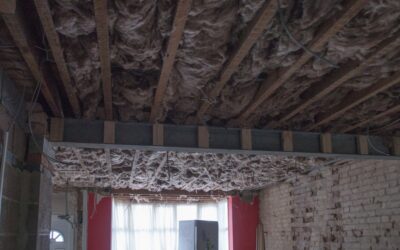
- Absorb with insulation: Mineral wool or fiberglass batts in the wall cavity dampen sound bouncing inside the void. Mineral wool performs especially well.
- Damp the panels: Use acoustic drywall or Green Glue between layers as described above.
Combining decoupling, mass, and absorption can push an ordinary wall well past STC 50.
Don’t Forget the Air Gaps
Sound behaves like water; it finds every gap. Even a perfectly built wall leaks noise through electrical outlets, the gap under a door, and the seams where drywall meets the floor and ceiling. Treat these weak points:
- Seal the perimeter with acoustic caulk before taping seams.
- Use putty pads behind electrical boxes.
- Add a door sweep and weatherstripping to interior doors.
- Avoid placing back-to-back outlets in the same stud cavity.
Acoustic caulk stays flexible and does not crack, unlike standard caulk that can break the seal over time.
What It Costs
Budget depends heavily on which methods you stack. A simple Green Glue and double-drywall upgrade might add $2 to $4 per square foot in materials. A full treatment with resilient channel, mineral wool, mass-loaded vinyl, and acoustic board can reach $8 to $15 per square foot before labor. Hiring a contractor for a full room typically lands between $1,500 and $4,500 depending on size and approach.
A Practical Approach for Most Homeowners
You rarely need every technique. For a noisy interior wall, the highest-impact, budget-friendly combination is mineral wool insulation in the cavity, a second layer of drywall with Green Glue between, and a careful acoustic-caulk seal around all edges and outlets. That stack alone can transform a paper-thin partition into a genuinely quiet wall.
If you are building new or fully renovating, add resilient channel or isolation clips while the studs are exposed, since decoupling is far harder to retrofit later. Match the effort to the noise you are fighting, and you will get the quiet you paid for.
Treating Ceilings and Floors
Walls are only one path for sound. In multi-story homes and condos, footsteps and noise travel through the ceiling and floor assembly, so the same principles apply overhead. Adding a layer of acoustic drywall to a ceiling with damping compound between, hanging it on resilient channel, and filling the joist cavity with mineral wool can dramatically cut impact noise from the room above.
For floors, the impact rating, measured as IIC, matters as much as airborne STC. Soft underlayment beneath flooring, area rugs with thick pads, and decoupled ceiling assemblies below all help quiet the thud of footsteps that drywall alone cannot stop.
Realistic Expectations
It helps to set expectations before you start. Soundproofing reduces sound; it rarely eliminates it entirely. Low-frequency bass from a subwoofer or a passing truck is the hardest to block because long sound waves pass through structure easily. High-frequency sounds like voices are much easier to control.
A well-treated wall will turn a clearly audible conversation into a muffled murmur, which is usually the goal. If you need total silence, such as for a recording studio, you are looking at a room-within-a-room build that goes well beyond drywall upgrades.
Common Mistakes to Avoid
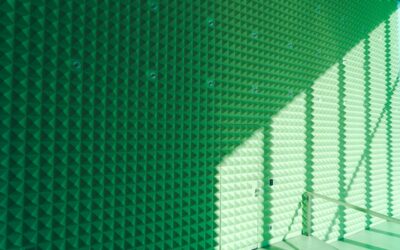
Several errors waste money and effort. The biggest is treating one element while ignoring the air gaps; an unsealed outlet or door gap can leak more sound than a whole wall transmits. Another is relying on thin foam panels marketed as soundproofing, which absorb echo inside a room but do little to block sound from passing through a wall.
Finally, do not skip the insulation step to save money, then wonder why the wall still sounds hollow. The cavity fill works together with mass and decoupling; leaving it out undercuts everything else. Plan the full assembly first, then build it as a system rather than a series of disconnected fixes.