Most condo boards in 2026 require an IIC (impact insulation class) score of at least 60 before they will sign off on a laminate install above the ground floor. That single number kills more renovation budgets than any other code requirement, and it is the reason soundproof laminate flooring is now its own category rather than a feature you bolt on with cheap foam underlayment. Done right, you can hit IIC 70 with a 10 mm AC4 plank, an attached acoustic pad, and the correct sub-layer — quiet enough that a downstairs neighbor will not hear toddler footfalls.
Part of our Roofing guide — explore the full guide →
- What “Soundproof” Actually Measures
- Laminate Lines With Attached Acoustic Pads
- Underlayment Choices That Move the Needle
- Subfloor Prep Matters More Than Brand
- Wall and Ceiling Decoupling
- Where Acoustic Laminate Falls Short
- Realistic Pricing for a Quiet Floor
- Installation Tips From the Field
- Maintenance That Preserves Acoustic Performance
What “Soundproof” Actually Measures
Two numbers run the show. IIC measures impact noise — the thud of dropped phones, dog claws, and heel strikes traveling through the floor to the unit below. STC (sound transmission class) measures airborne noise like voices and TV audio. For most multi-family buildings, IIC is the hard constraint because condo bylaws set a floor of IIC 50 to 65 depending on the build year.
A bare HDF laminate plank on a slab tests around IIC 42. Add a quality acoustic underlayment and you can push past IIC 65. The math is straightforward but every layer matters.
Laminate Lines With Attached Acoustic Pads
Several manufacturers now factory-bond a 1.5 to 2 mm IXPE or cork foam directly to the bottom of each plank, which simplifies install and locks in the rated acoustic performance.
- Pergo Outlast+ with SoundBloc — 12 mm AC4 with attached IXPE. Rated IIC 66 over 6-inch concrete with resilient channel ceiling. $4.50 to $5.50 per square foot.
- Quick-Step Majestic — 9.5 mm AC4 with attached SilentWalk pad. Tests IIC 64. $5 to $7 per square foot.
- Mohawk RevWood Plus SoundShield — 12 mm with 2 mm attached pad. IIC 67 in published tests. $4.20 to $5 per square foot.
- Mannington Restoration Collection — 12 mm AC4. Add a 3 mm cork underlayment for IIC 70+ performance. $4.50 per square foot plus $0.75 for cork.
Underlayment Choices That Move the Needle
If your laminate does not come with an attached pad, your underlayment choice will swing IIC results by 15 to 20 points. Skip the white 2 mm foam from the home center — it is rated for moisture only, not sound.
Cork at 3 to 6 mm is the gold standard for acoustic performance. QEP 72000Q is a 3 mm natural cork and runs about $0.75 per square foot. It delivers IIC 68 to 72 over a typical concrete slab with suspended ceiling below. Rubber underlayments like Acoustik from Insulayment run $1.50 per square foot but push IIC into the 70s without needing extra ceiling treatment.
Felt-rubber composites such as MP Global QuietWalk Plus split the difference at around $0.55 per square foot, delivering IIC 65 to 68 in apartment installs.
Subfloor Prep Matters More Than Brand
An expensive acoustic laminate over a hollow plywood subfloor with squeaky joists will still transmit noise to the room below. Walk every square foot of the subfloor before install. Screw down loose decking with 2.5-inch deck screws spaced 8 inches along every joist. Fill any dips greater than 3/16 inch over 10 feet with a Henry 555 self-leveler.
On concrete slabs, test for moisture per ASTM F1869 (calcium chloride) or F2170 (relative humidity probe). Moisture-driven vapor pressure does not just damage the HDF core — it changes the acoustic coupling and degrades IIC numbers over time.
Wall and Ceiling Decoupling
Soundproof laminate cannot fix flanking noise that travels through wall plates and baseboards. Leave the standard 10 mm expansion gap at every wall, but fill that gap with a backer rod and acoustic sealant like Green Glue Noiseproofing Sealant before installing baseboards. Mount baseboards to the wall, never to the floor. That single detail can recover 4 to 6 IIC points in field tests.
If you can also rework the ceiling below, hat channels with RSIC-1 isolation clips will add another 10 to 12 STC points and roughly 8 IIC points for impact noise. Most condo owners cannot touch the ceiling of the unit below, which is why getting the floor assembly right matters even more.
Where Acoustic Laminate Falls Short
Even the best soundproof laminate cannot match a fully glued-down hardwood with a 1/2-inch sound-mat assembly for high-end multi-family work. Hardwood with a Maxxon Acousti-Mat 3 system tests around IIC 76. Laminate tops out near 72.
Click-lock laminate also has a hollow-sounding tap underfoot that no underlayment fully eliminates. If your goal is a solid, dense feel that mimics hardwood acoustics, look at engineered hardwood glued over a 6 mm cork mat instead.
Realistic Pricing for a Quiet Floor
Budget tier: 8 mm AC4 plank with QuietWalk Plus underlayment runs $2.50 per square foot in materials, $4 to $5 per square foot installed. Expect IIC 60 to 64.
Mid tier: 12 mm AC4 with attached pad over 3 mm cork. Materials around $5.50 per square foot, installed $7.50 to $9. IIC 68 to 72.
Premium tier: 12 mm AC4 with attached pad plus 6 mm rubber underlayment. Materials around $7.50 per square foot, installed $10 to $12. IIC 72 to 76 — passes virtually any condo bylaw.
Installation Tips From the Field
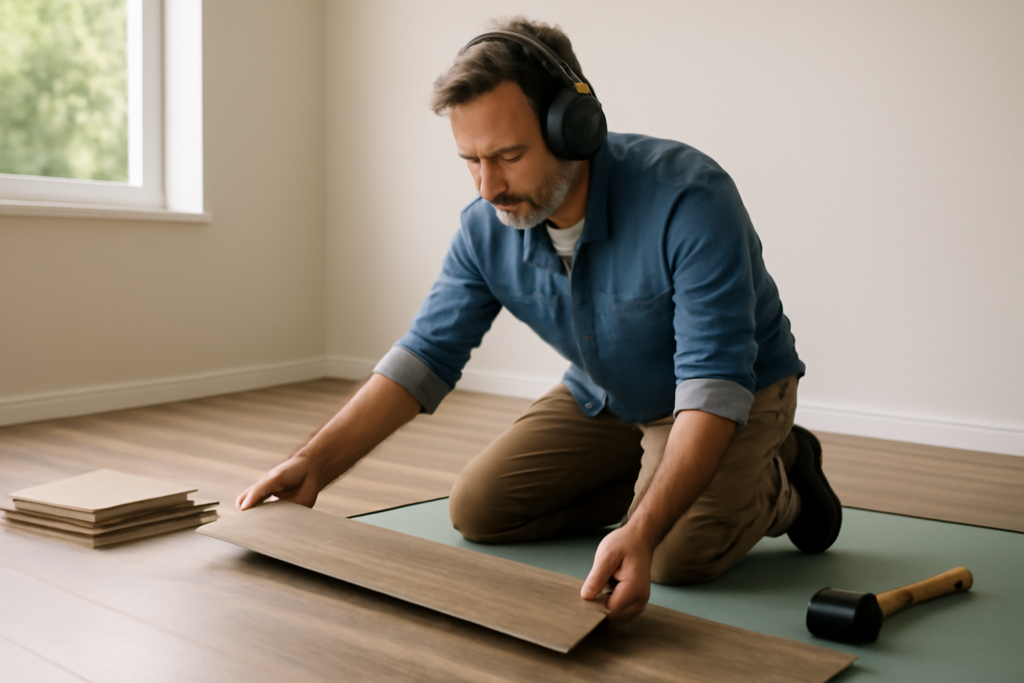
Stagger end joints at least 12 inches between adjacent rows. Use a tapping block on the tongue side, not the groove side, to avoid crushing the click joint and degrading acoustic seal at the seam. Leave T-moldings at every doorway threshold to mechanically decouple rooms from each other.
Skip the cheap rubber transition strips. Spring for a metal T-molding with an integral cork or rubber bumper. Door undercuts should clear the new floor stack by at least 3/8 inch.
Maintenance That Preserves Acoustic Performance
Acoustic underlayments do not wear out, but the click joints in laminate planks can loosen over five to ten years with seasonal movement. Inspect seams annually for visible gaps and re-tap with a tapping block if needed. Replace area rugs in high-impact zones (kids’ play areas, hallway turns) with thicker dense-pile rugs at least 1/2-inch thick. Done right, a properly engineered soundproof laminate floor stays acoustically rated for 20 years or more.
Prefer to explore on your own?
See how new flooring looks in your actual room in seconds — free, no signup.
Try the free Floor Studio →