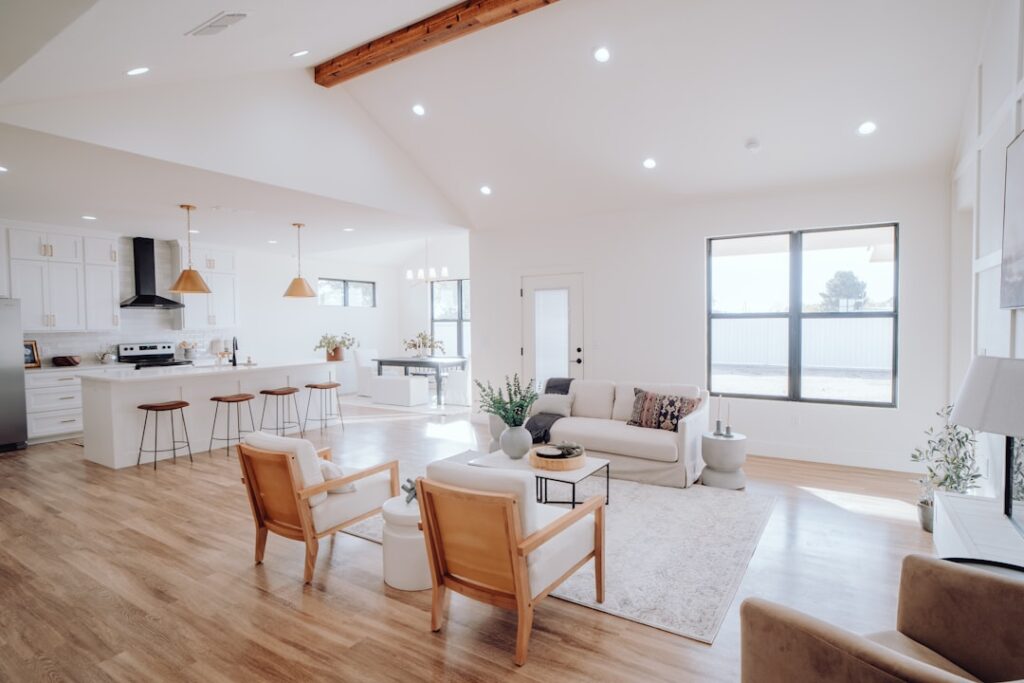
Hardwood flooring in the American South has to handle conditions that would buckle a Vermont sugar maple — summer humidity that climbs past 80 percent, winter heat that drops indoor relative humidity to 25 percent, and the constant cycle in between. The species that handle the climate best, the cuts that resist warping, and the finishes that survive subtropical UV exposure are different from what works in the Northeast or Midwest. The right southern wood flooring choice protects a five-figure investment for 50 to 100 years; the wrong one cups, gaps, and squeaks within two summers.
Here is what southern homeowners need to know before specifying a hardwood floor.
- Why Climate Drives Species Choice
- The Heart Pine Heritage
- Brand Spotlight: Southern Manufacturers
- Solid vs Engineered in Humid Climates
- Cut and Grade Matter More in the South
- Finish Choices That Handle Sun and Humidity
- Installation Conditions That Cannot Be Skipped
- Cost Comparison for Southern Markets
Why Climate Drives Species Choice
Every wood floor moves seasonally. Wide planks expand across the grain in humid weather and contract in dry weather, with the swing in Houston, Atlanta, New Orleans, or Charleston routinely hitting 12 to 15 percent equilibrium moisture content variation over a year.
Species with tight grain and lower tangential shrinkage handle this swing best. Janka hardness matters too — harder woods dent less but also tend to be more dimensionally stable.
- Longleaf heart pine: Janka 870. Native to the southeast. Stable, characterful, expensive.
- White oak: Janka 1360. Tannin-rich, rot-resistant. The current best-seller across the South.
- Red oak: Janka 1290. Slightly more open grain than white oak, more economical.
- Hickory: Janka 1820. Hardest common domestic species. Dramatic grain variation.
- Pecan: Janka 1820. Southern cousin of hickory, slightly warmer color tones.
- Southern yellow pine (new growth): Janka 870. Cheapest. Soft underfoot, dents easily.
For most southern homeowners, white oak in a quartersawn or rift-sawn cut is the best combination of beauty, hardness, and dimensional stability.
The Heart Pine Heritage
Before the Civil War, longleaf pine forests covered 90 million acres from Virginia to East Texas. By 1930, less than 5 percent remained. The dense heartwood of old-growth longleaf pine — counted by rings reaching 30 to 50 per inch — was milled for floors, beams, and decking that still survive in plantation homes and Charleston single-houses today.
New growth pine cannot match the density. The southern flooring market for heart pine therefore depends on reclaimed material — antique boards pulled from demolished mills, warehouses, and barns. Suppliers like Goodwin Heart Pine in Florida, Pioneer Millworks in New York, and Mountain Lumber in Virginia offer reclaimed longleaf in widths from 3 inches to 12 inches at $9 to $22 per square foot.
For homeowners restoring period properties or wanting a southern provenance with documented history, reclaimed heart pine has no real substitute.
Brand Spotlight: Southern Manufacturers
Several major hardwood manufacturers are headquartered in or focused on the southern market.
Mullican Flooring, based in Johnson City, TN, runs three mills across Appalachia and supplies the bulk of solid-sawn oak and hickory to southern dealers. Their Hillshire line in white oak ($5.49 to $6.99 per square foot) is a southern dealer staple.
Somerset Hardwood Flooring, based in Somerset, KY, kiln-dries lumber to a moisture content specifically targeted at the southern climate, producing floors with less acclimation drama after install. Their solid 2.25-inch and 3.25-inch oak strip runs $4.99 to $6.49 per square foot.
Bruce Hardwood Floors, owned by AHF Products (which now includes Armstrong Flooring), still mills extensively in the South. The Bruce American Originals line of red and white oak in 21 stain colors runs $4.99 to $5.99 per square foot and remains the broadest southern dealer-stocked solid oak product.
Solid vs Engineered in Humid Climates
Conventional wisdom says solid hardwood is for upstairs and engineered is for slab installations. In the South, the picture is more nuanced.
Solid 3/4-inch hardwood handles the seasonal humidity swing well when installed over a properly conditioned plywood subfloor and acclimated for 7 to 14 days before installation. Movement is real but predictable — about 1/16 inch per 8-foot strip of expansion across summer/winter.
Engineered hardwood with a 2 to 6 mm sawn-face wear layer over a plywood or HDF core moves significantly less, which makes it the better choice for slab installations (typical of southern ranch homes and Florida concrete-slab construction), for radiant heat applications, and for wide-plank (over 5 inch) installations where solid wood expansion would gap noticeably in winter.
A common southern compromise: engineered 5/8-inch product with a 4 mm white oak face. Looks identical to solid, sands and refinishes 3 to 5 times, handles humidity swings reliably. Mullican Quail Hollow and Mirage Admiration both deliver this construction at $7.99 to $11.99 per square foot installed.
Cut and Grade Matter More in the South
The way oak is sawn from the log affects movement. Plain-sawn (the most common cut) shows the classic cathedral grain but moves the most across the width — a 5-inch plank can swing 1/8 inch summer to winter. Rift-sawn (cut at 30 to 60 degrees to the growth rings) produces a tighter, straight grain and moves about 40 percent less. Quartersawn (cut at 60 to 90 degrees) is the most stable and shows characteristic medullary ray flecking but costs 30 to 50 percent more.
For wide-plank southern installs, paying the premium for rift and quartered white oak ($9 to $14 per square foot for material alone) prevents the gapping that makes plain-sawn wide planks look neglected by February.
Finish Choices That Handle Sun and Humidity
Southern light is intense. South and west-facing rooms in Florida, Texas, Louisiana, and the Carolinas receive enough UV to lighten unprotected oak finishes within 24 months. Three finish strategies hold up best.
- Site-finished with two coats of oil-modified polyurethane plus a topcoat of water-based UV-resistant poly: Combines warmth of oil with UV protection of waterborne. About $3.50 to $5 per square foot for finishing labor.
- Factory-finished aluminum oxide: Most prefinished hardwoods now use aluminum oxide topcoats that resist abrasion and UV better than site-applied finishes. 25-year wear warranties typical.
- Bona Mega ONE or Bona Traffic HD: Two-component waterborne urethane with UV inhibitors. The professional standard for site-finished floors in 2026.
Avoid oil-only finishes (Rubio Monocoat, OSMO Polyx) in heavy southern sun unless you commit to recoating every 18 to 24 months.
Installation Conditions That Cannot Be Skipped
The single most important step in a southern hardwood install is moisture conditioning. NWFA (National Wood Flooring Association) guidelines call for the building to be enclosed, conditioned, and stabilized for at least 7 days before the wood arrives, and for the wood itself to acclimate to within 4 percentage points of the subfloor moisture content before installation.
That means HVAC must be running, indoor humidity must be in the 35 to 55 percent service range, and a moisture meter must be in the installer’s kit. A pinless moisture meter like the Wagner Orion 950 ($600) reads both subfloor and flooring. Subfloor moisture above 12 percent or relative humidity in the slab above 75 percent (ASTM F2170) is a hard stop — install on top of that and the floor will fail.
Cost Comparison for Southern Markets
Installed pricing in the South runs slightly below national average thanks to lower labor costs.
- Solid red oak 2.25-inch strip, prefinished: $6.50 to $8.50 per sq ft
- Solid white oak 3.25-inch strip, site-finished: $9 to $12 per sq ft
- Engineered white oak 5-inch, prefinished: $9 to $13 per sq ft
- Engineered wide-plank 7-inch white oak: $14 to $22 per sq ft
- Reclaimed heart pine 6-inch: $18 to $28 per sq ft
For most southern homes, a 1,500 square foot main floor in 4-inch engineered white oak runs $14,000 to $19,000 installed — a 30-year investment that adds documented resale value and outlasts every flooring trend it lives through.
Prefer to explore on your own?
See how new flooring looks in your actual room in seconds — free, no signup.
Try the free Floor Studio →