Stacking a dryer on top of a washer saves almost half the floor space of a side-by-side pair, but a gas model brings requirements that an electric dryer never does. The gas supply has to reach a connection point that now sits several feet off the floor, the exhaust has to leave from the top half of the stack, and the closet has to supply combustion air. A stackable gas dryer works beautifully in a hall closet or small laundry room once those three pieces are planned before delivery day.
The short answer: you need a front-load washer and a gas dryer that the manufacturer approves for stacking, the matching stacking kit for those exact models, a gas shutoff valve and connector positioned for the dryer’s raised inlet, a rigid metal vent routed from the dryer’s high exhaust outlet, a standard 120-volt receptacle for the dryer’s controls and drum motor, and enough closet clearance and ventilation for safe combustion. Gas line work is for a licensed professional, not a weekend project.
- What Makes a Stackable Gas Dryer Install Different
- Choosing a Stackable Washer and Gas Dryer Set
- Stacking Kit Basics
- Gas Line Requirements and Safety
- Venting a Stacked Gas Dryer
- Closet Clearance, Combustion Air and CO Safety
- Troubleshooting After Installation
- Costs and When to Call a Licensed Professional
- Frequently Asked Questions
Most problems on install day come from a gas stub that was placed for a floor-level dryer, a vent hole in the wrong spot, or a closet that is a couple of inches too shallow. Sorting those out ahead of time avoids a second visit.
What Makes a Stackable Gas Dryer Install Different
With side-by-side machines, the dryer’s gas inlet and exhaust outlet sit near the floor. Stack the dryer on a washer and those same connections rise to roughly the height of the washer, plus whatever distance the dryer’s rear panel places them from its own base. In practice, that often puts the gas inlet and vent outlet somewhere around 3 to 4 feet off the floor, depending on the models.
That changes three things:
- Gas stub height. A shutoff valve sitting a few inches off the floor may be too far from the raised inlet for the appliance connector to reach without strain, and it may be hidden behind the washer where nobody can shut it off quickly.
- Vent routing. The exhaust leaves high, so the wall vent opening should be planned at that height to keep the transition duct short and straight.
- Service access. Getting behind a stacked pair means pulling the whole stack out, so valves, receptacles and the vent connection should be positioned to be reachable or disconnectable with the units slid forward.
Also confirm the pairing. Not every gas dryer can be stacked, and most can only sit on a front-load washer of matching width from an approved list. Top-load washers cannot carry a dryer. A typical full-size stacked pair is 27 inches wide; compact pairs are usually 24 inches wide.
Choosing a Stackable Washer and Gas Dryer Set
When shopping for a stackable washer and gas dryer set, check the dryer’s installation manual (most are posted online) before you buy. Look for four details: whether stacking is approved, which washer models are approved underneath it, the required stacking kit part number, and the minimum closet dimensions and clearances.
Some shoppers search for a stackable washer gas dryer combo expecting a single unit. All-in-one washer-dryer combos that wash and dry in one drum are almost always electric, and many are ventless. If you want gas drying, plan on two separate machines stacked with a kit. Single-cabinet laundry centers that combine a top-load washer with a dryer overhead do exist in gas versions, but they are a fixed unit, not a stack.
Gas dryers usually cost somewhat more to buy than the equivalent electric model, but they tend to dry faster and often cost less per load where natural gas prices are moderate. If your laundry area already has a gas line, the operating savings can make the higher purchase price worthwhile.
Stacking Kit Basics
A washer dryer stacking kit is a set of brackets, and sometimes a tray or rails, that locks the dryer to the top of the washer so it cannot slide off from vibration during a spin cycle. Kits are model-specific, and some newer pairs include the hardware in the box. Using the wrong kit, or skipping it, risks the dryer walking off the washer during a heavy spin.
General kit installation steps:
- Level the washer first, with all four feet tight on a solid floor. A washer that rocks will shake the whole stack.
- Remove the dryer’s leveling feet if the manual says to; most stacked dryers sit directly on the kit.
- Attach the brackets to the washer top or rear as directed.
- With two people (a full-size dryer is heavy and awkward), lift the dryer and set it onto the washer, lining it up with the brackets.
- Fasten the brackets to the dryer and confirm the stack does not shift when pushed.
Some households also add a strap or bracket that ties the top of the stack to the wall, especially in earthquake-prone areas or on upper floors. Follow the appliance maker’s guidance on approved methods.
Gas Line Requirements and Safety
Every gas connection, valve relocation or new gas line must be done by a licensed plumber or gas fitter, with a permit where your jurisdiction requires one, and a leak test afterward. Do not do gas connections yourself, even if the parts look simple.
What the pro will typically handle:
- Raising or relocating the shutoff valve so it sits within reach of the dryer’s raised inlet and remains accessible when the stack is in place.
- Installing a new appliance connector of an approved type and length. Old connectors should not be reused, and connectors should not be run through walls, floors or cabinets.
- Adding a sediment trap if local code or the dryer manual calls for one.
- Checking the fuel type. Dryers ship set for natural gas or need a conversion kit for propane. Conversion is pro work.
- Leak testing every joint after the connection.
If you ever smell gas in the laundry area, do not operate switches or appliances. Leave the house and call your gas utility or 911 from outside.
A gas dryer still needs electricity. Most require a standard 120-volt grounded receptacle for the motor, controls and igniter, rather than the 240-volt outlet an electric dryer uses. Plug the dryer directly into the wall receptacle, never into an extension cord. Many current codes call for GFCI protection on laundry-area receptacles; a licensed electrician should add any new outlet or circuit and can confirm the protection you need. If you ever work on a receptacle, turn off the breaker and confirm power is off with a non-contact voltage tester first.
Venting a Stacked Gas Dryer
Gas dryer exhaust carries moisture, lint and combustion byproducts, including carbon monoxide. It must vent to the outdoors. Ventless operation is not an option for gas dryers.
For a clean vent setup:
- Locate the wall vent opening close to the dryer’s raised exhaust outlet so the connection from dryer to wall is short and as straight as possible.
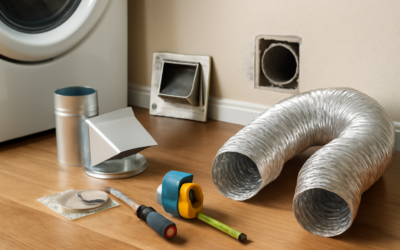
- Use rigid metal duct inside walls and ceilings, and only a short section of approved metal transition duct between the dryer and the wall. Avoid plastic flex hose and foil accordion duct.
- Keep the total equivalent length within the dryer manual’s venting table, counting each elbow.
- Seal joints with foil tape, not screws that protrude into the duct.
- Terminate outdoors with a hood that has a damper and no screen.
A recessed dryer vent box in the wall helps a lot in shallow closets. It lets the transition duct tuck into the wall instead of taking up several inches behind the stack.
Closet Clearance, Combustion Air and CO Safety
Closet installs are where stackable gas dryer projects most often stall. The manual lists minimum clearances on the sides, top, front and rear, plus minimum openings for air. Typical figures are small at the sides and top, with more space needed behind the stack for the gas connector and vent. Measure the closet depth from the back wall to the inside of the door, not just to the door frame.
Gas dryers burn air to make heat, so a closed closet must let fresh air in. Manufacturers usually require louvered doors or vent openings at the top and bottom of the door with a stated minimum open area. A solid door on a tight closet starves the burner, lengthens drying times and can increase carbon monoxide production.
Safety basics for any gas laundry space:
- Install CO alarms on every level of the home and near sleeping areas. A hall-closet laundry next to bedrooms makes the nearby alarm especially important.
- Keep flammable products (solvents, paint thinner, aerosol cans) away from the dryer and out of the closet.
- Clean the lint screen after every load and clean the vent duct at least yearly.
- Have the vent and gas connection inspected if drying slows down, the closet smells of exhaust, or the burner flame looks irregular.
Check the total stack height against ceiling height and any shelving. A stacked full-size pair often stands well over 6 feet, and the dryer controls end up at eye level or higher, which can be hard to reach for shorter users.
Troubleshooting After Installation
The stack vibrates or walks during spin
Relevel the washer, confirm all shipping bolts were removed from the washer, and check that the stacking kit brackets are tight.
The dryer runs but does not heat
Confirm the gas valve is fully open and the dryer is set for the correct fuel. If the igniter glows but the burner will not light, or you notice any gas odor, stop and call a licensed technician.
Long drying times
Check for a crushed transition duct behind the stack, a clogged vent, a stuck outside damper, or a closet without enough combustion air.
Costs and When to Call a Licensed Professional
Stacking kits are inexpensive, often under one hundred dollars, and sometimes included. Relocating or raising a gas shutoff typically costs in the low hundreds of dollars when the line is easy to reach, more if walls must be opened. Moving a dryer vent, adding a recessed vent box or installing a new receptacle each add their own trade cost.
Call a licensed plumber or gas fitter for every gas connection, valve move, propane conversion and leak test. Call a licensed electrician for new receptacles or circuits. Pull permits where required, and have the HVAC or appliance installer verify venting and combustion air before the first load.
Frequently Asked Questions
Can any gas dryer be stacked on a washer?
No. Only dryers the manufacturer approves for stacking can be stacked, and only on approved front-load washers using the specified stacking kit.
Does a stackable gas dryer need a 240-volt outlet?
Usually not. Most gas dryers use a standard 120-volt grounded receptacle for the motor and controls. Electric dryers are the ones that need 240 volts.
Do I need to move my gas line to stack the dryer?
Often yes. The dryer’s gas inlet rises several feet when stacked, so a licensed pro may need to raise or relocate the shutoff valve so the connector fits properly and the valve stays reachable.
Can a stacked gas dryer go in a closet with a solid door?
Usually not. Gas dryers need combustion air, so manufacturers typically require louvered doors or openings with a minimum free area. Check the installation manual.
Is there a ventless gas dryer?
No. Gas dryers produce combustion gases and must always vent outdoors. Ventless dryers are electric.