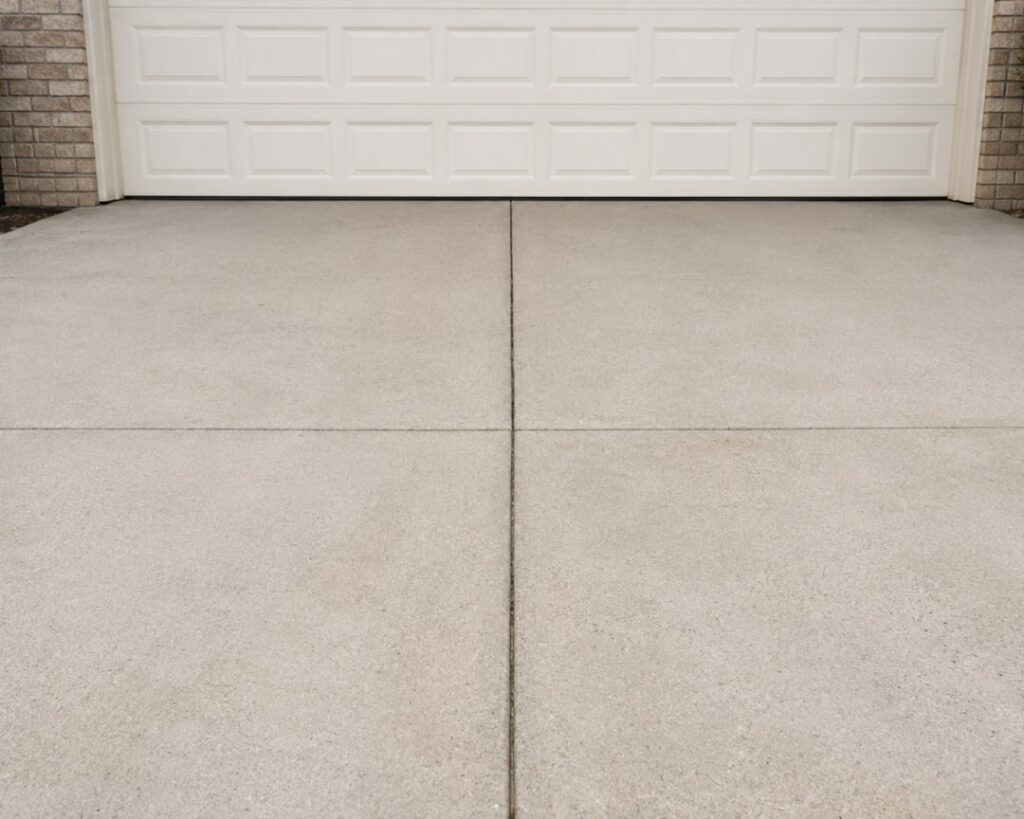
A driveway is the largest hardscape surface most homes have, and plain gray broom-finish concrete treats it as pure utility. A stamped concrete driveway upgrades that same slab into something that reads as cobblestone, slate, or flagstone — for roughly half the installed price of the real materials — while keeping concrete’s monolithic strength under vehicle loads. But driveways are the hardest duty stamped concrete ever sees: 4,000-pound vehicles, turning tires, hot engines, and in northern states, freeze-thaw cycles and deicing salt. Whether the finish stays beautiful for 25 years or spalls in five comes down to the mix, the details under the stamp, and a sealing schedule most owners neglect. Here is what to know before signing a contract.
- What Stamping Involves on a Driveway Pour
- Patterns That Work on Driveways (and Ones That Do Not)
- Durability Under Vehicles: The Spec Sheet That Matters
- What a Stamped Concrete Driveway Costs
- Sealing: The Schedule That Decides Everything
- Choosing Colors That Age Well
- Living With It: Winter and Everyday Care
What Stamping Involves on a Driveway Pour
The process is standard concrete work with a decorative window at the end. The crew pours a 4-inch (better: 5-inch for driveways) slab, screeds and floats it, broadcasts a base color hardener across the surface, then a contrasting powdered release agent, and presses large polyurethane stamp mats into the concrete during the narrow plastic window before it sets. After curing, the release is washed off, control joints are cut, and the surface is sealed. The color layering — base tone plus darker release in the recesses — is what gives good stamped work its convincing stone-like depth. If you want the full rundown of mat styles and how the tools themselves work, see our guides to stamped concrete patterns and concrete stamps; this article stays on the driveway-specific decisions.
Patterns That Work on Driveways (and Ones That Do Not)
Driveways favor patterns with shallow texture and busy, non-directional layouts:
- Ashlar slate — the driveway king. Rectangular stones in mixed sizes with a subtle slate texture; hides tire marks and repairs well, suits nearly every architecture.
- Random stone / fieldstone — organic joint lines that camouflage the control joints a driveway must have.
- Cobblestone with a border — a classic look for traditional homes; often used as a border-and-field combination with a plainer center to control cost.
- Wood plank — striking, but the long directional lines telegraph any slab movement and read oddly under parked cars; better on patios.
Deeply textured patterns feel authentic underfoot but create high points that tires abrade and snow shovels catch. On a driveway, ask the contractor for medium-depth mats — and insist the stamped joint lines coordinate with the sawcut control joints, hiding structural joints inside pattern grout lines wherever the layout allows.
Durability Under Vehicles: The Spec Sheet That Matters
Stamped concrete is exactly as strong as the concrete beneath the texture, so the driveway conversation is a structural one:
- Mix strength of 4,000 PSI or better, and in freeze-thaw states, air entrainment of 5-7 percent. This is the line item that resists salt scaling.
- Thickness: 4 inches minimum for cars, 5 inches where pickups and delivery trucks live. Reinforce with fiber plus welded wire or #3 rebar on chairs.
- Base: 4-6 inches of compacted gravel over compacted subgrade — identical to any quality driveway slab.
- Color hardener over integral color alone: shake-on hardener densifies the top 1/8 inch, roughly doubling surface abrasion resistance right where tires work. On driveways it is worth the upcharge.
Handled this way, a stamped driveway carries the same 25-30+ year structural life as plain concrete. The honest caveats: like all concrete it can crack (control joints manage where), color can wear in tight turning zones after many years, and repairs — though possible with color-matched patching — never disappear as invisibly as they do on plain gray. The full pour-to-cure process, joint spacing math, and thickness details are covered in our companion guide to concrete driveway installation, and everything there applies underneath the stamping.
What a Stamped Concrete Driveway Costs
Nationally, stamped concrete runs $12-18 per square foot installed for a single pattern and color, and $18-28 for premium jobs with borders, multiple colors, or hand-applied accent staining. A typical 16×40-foot two-car driveway (640 square feet) therefore lands between $7,700 and $14,000, versus roughly $4,000-6,500 for quality plain concrete and $12,000-20,000 for natural stone or high-end pavers over the same footprint. Regional labor swings this 20-30 percent either way. Two budget levers worth knowing: a stamped border with a broom-finished field captures most of the curb appeal at 60-70 percent of the cost, and pouring the stamped work at the same time as other flatwork (walkways, a patio) shares mobilization costs.
Sealing: The Schedule That Decides Everything
Sealer is not cosmetic on a stamped driveway — it is the wear layer protecting the color from tires, UV, and salt. The standard product is a solvent- or water-based acrylic, applied thin at roughly 200-300 square feet per gallon. The schedule:
- Initial seal at installation, once the slab has cured about 28 days.
- Reseal every 2-3 years — annually in heavy-salt climates or where tires turn sharply. The visual cue: when water stops beading and the color looks dry and chalky, you are overdue.
- Wash, dry, thin coats. Over-applied sealer whitens, bubbles, and peels; two thin coats beat one heavy one every time.
Add a non-slip additive (fine polymer grit stirred into the sealer, $10-15 per gallon dose) on any driveway with slope — glossy sealed concrete is slick when wet. Budget $150-300 in materials for a DIY reseal or $0.50-1.00 per square foot professionally. Owners who keep this schedule have 20-year-old driveways that still photograph well; owners who skip it watch the color fade to ghost within five to seven years, and color restoration costs far more than the missed sealer ever would have.
Choosing Colors That Age Well
Driveway color is a 25-year decision viewed from the street, so the successful palette is conservative: warm grays, buff/sandstone, and soft tan-brown blends dominate for a reason. Earth tones hide tire dust, pollen, and the inevitable oil shadow far better than light cream (shows everything) or deep charcoal (shows salt bloom and fades most visibly in sun). The standard system uses a base color hardener with a darker “antique” release in the pattern recesses — ask to see the contractor’s color chart as sealed samples, because sealer deepens every tone dramatically, and an unsealed chip is a lie. Photograph houses in your area whose driveways you like and note the sun exposure: south-facing slabs fade fastest, and mid-tone colors weather that most gracefully.
Match direction matters too. Pull tones from the house’s roof and masonry rather than its siding — a driveway that echoes the roof color anchors the whole elevation, while one matched to paint looks wrong the first time the house is repainted. If in doubt, go one shade lighter than your instinct: large horizontal surfaces read darker outdoors than a hand sample suggests, and lighter slabs run cooler underfoot in summer by a measurable 15-20°F.
Living With It: Winter and Everyday Care
On resale, stamped driveways photograph like a landscape upgrade and appraise as one — real estate agents in competitive markets treat decorative concrete curb appeal as a meaningful listing asset, and unlike interior finishes, it never goes out of style faster than it wears out.
Skip deicing salts entirely for the first two winters and use sand for traction; after that, plain rock salt sparingly on a well-sealed surface is tolerable, but avoid magnesium chloride blends, which aggressively attack concrete surfaces. Shovel with a plastic-edged blade, hose off oil drips promptly (the sealer buys you time), and rinse the surface a few times a season. That modest routine, plus the reseal calendar, is the entire maintenance load — a fair trade for a driveway that looks like laid stone, behaves like a single structural slab, and greets every visitor before the front door does.