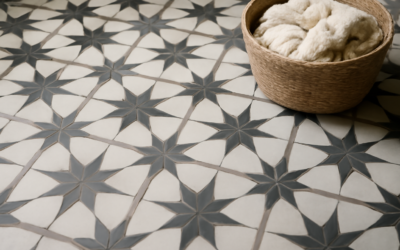
Some floors are meant to disappear, and some are meant to be the reason you walk into a room. A star tile floor firmly belongs to the second group, built from the interlocking star-and-cross pattern that has decorated Moroccan riads, Spanish courtyards, and Persian palaces for centuries. The geometry is deceptively simple: eight-pointed star tiles fit together with cross-shaped pieces to form a continuous, mesmerizing field with no straight grid in sight. It is one of the most striking patterns you can lay, and with modern materials it is more practical to install and own than its historic pedigree suggests.
Part of our Tile & Grout guide — explore the full guide →
Understanding the Star-and-Cross Pattern
The classic layout pairs two shapes: an eight-pointed star and a small cross that fills the gaps between the stars. Set together, they tessellate perfectly, meaning they tile a surface with no leftover space, creating the flowing, interlocking look associated with Islamic and Mediterranean design. The pattern traces back over a thousand years to Persian and Moorish architecture, where it symbolized harmony and infinity.
Today you will find the design sold two ways. The traditional version uses two separately cut tile shapes, the star and the cross, often in contrasting colors. The modern shortcut prints or scores the entire star-and-cross motif onto a single square tile, so installers set simple squares that assemble into the pattern automatically. The single-tile version is far easier to install and is the reason the look has become accessible to ordinary homeowners rather than only artisans.
Materials You Can Choose From
The star tile floor comes in several materials, each shifting the cost, durability, and feel of the finished floor.
- Porcelain: the most practical, offering the pattern printed on a dense, water-resistant, no-seal body ideal for kitchens and baths.
- Cement (encaustic) tile: the most authentic, with matte pigment running deep into the tile, though it is porous and needs sealing.
- Terracotta with glazed accents: the traditional Mediterranean combination, warm and earthy but requiring sealing.
- Ceramic: a budget option for walls and low-traffic floors, softer and more porous than porcelain.
- Natural stone star-and-cross: premium marble or limestone versions for a high-end, formal look with higher maintenance.
For a floor that will see daily traffic, porcelain wins on durability and low upkeep. For a period-authentic project where you want genuine depth of color, cement tile is worth the extra care it demands.
Where a Star Tile Floor Belongs
This is a statement floor, so it works best where you want the eye to land. Entryways and foyers are ideal, greeting guests with pattern the moment they walk in. Powder rooms and small bathrooms are another sweet spot, because the enclosed space lets a bold floor shine without overwhelming a whole house.
Kitchens, mudrooms, and covered patios all suit the pattern too, particularly in porcelain or sealed cement. The one caution is scale and busyness: in a very large open room, a high-contrast star-and-cross can become overwhelming, so many designers use it to define a zone, an entry, a breakfast nook, a bathroom, rather than blanketing an entire main floor. Pair a busy floor with calm walls and simple furnishings so the pattern has room to breathe.
What a Star Tile Floor Costs
Pricing depends heavily on material and whether you buy the single-tile or two-piece version. Porcelain star-and-cross tile typically runs $4 to $10 per square foot. Cement encaustic versions climb to $8 to $25 per square foot because much of it is still handmade and pigment-poured. Ceramic sits lower at $3 to $7, while natural stone versions can exceed $20.
Installation is where this floor differs from a plain field. The two-piece traditional layout and any contrasting-color scheme take more time to set, raising labor to $8 to $16 per square foot, versus the lower end for single-tile porcelain that installs like ordinary squares. Order at least 15 percent extra tile, more for the two-piece version, because the pattern produces more cuts at the room’s edges and any mistake in a patterned floor is highly visible. Buying from one dye lot is essential so colors stay consistent.
Installation Considerations
A patterned floor is less forgiving than a plain one, so preparation matters more. Start from a precise center line and dry-lay a section before you spread thinset, because the interlocking geometry means a small drift compounds into an obviously crooked pattern by the far wall. With the two-piece star-and-cross, keep the stars and crosses in strict alignment; even a slight rotation breaks the illusion.
Use a modified thinset suited to your tile, back-butter larger pieces, and keep grout joints uniform, since inconsistent lines are glaring in a geometric design. Porous materials like cement tile and terracotta must be sealed before grouting so the grout does not stain the face, then sealed again afterward. Because cuts at the perimeter are numerous and visible, this is a project where hiring an experienced tile setter often pays for itself, particularly if you chose the authentic two-piece layout.
Color Schemes That Make the Pattern Sing
The star-and-cross pattern lives or dies by its color contrast. The most traditional approach uses two tones: a field of stars in one color and the small crosses in a contrasting shade, which sharpens the geometry and gives the floor its classic Moroccan or Andalusian punch. Blue-and-white, terracotta-and-cream, and charcoal-and-gray are all time-tested combinations that read as authentic rather than trendy.
If a high-contrast floor feels too bold for your space, a tonal scheme keeps the pattern subtle. Stars and crosses in two close shades of the same color, say a soft taupe and a slightly deeper greige, let the geometry emerge quietly without dominating the room. This muted approach works well when you want the texture of the pattern but plan to layer in colorful rugs, furniture, or artwork. Whatever palette you choose, view large samples together in the actual room light, because contrast that looks crisp in a showroom can feel harsh or washed out once it is on your own floor.
Pros and Cons at a Glance
The strengths of a star tile floor are obvious the moment you see one. It delivers instant character and a designer, old-world look that a plain floor never will, it draws on a genuine centuries-old tradition, and in porcelain it combines that drama with modern durability and easy care. It also raises the perceived value of a space, making a small entry or powder room feel considered and custom.
The trade-offs are equally clear. The pattern is bold and can overwhelm a large or busy room, it is harder and more expensive to install than a simple grid, and authentic cement or terracotta versions demand sealing and gentle cleaning. Because the design is so distinctive, it also commits you to a strong aesthetic that is harder to change your mind about than a neutral field tile. This is a floor you choose deliberately, not one you fall into.
Is a Star Tile Floor Right for You?
If you crave a floor with genuine personality and a sense of history, the star-and-cross pattern is one of the most rewarding choices in tile. Pick porcelain if you want the look with minimal maintenance and a friendlier install, or step up to cement or terracotta if authenticity is worth the sealing routine. Use the pattern where it can be a focal point, an entry, a powder room, a defined nook, rather than sprawling it across a whole house, and invest in careful layout and an experienced installer so the geometry lands crisp and true. Do that, and a star tile floor becomes the detail people remember long after they leave the room.
Prefer to explore on your own?
See how new flooring looks in your actual room in seconds — free, no signup.
Try the free Floor Studio →