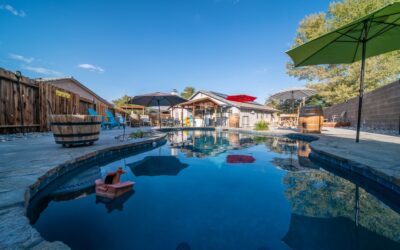
A pool deck has the hardest job of any surface at your house: it must grip wet bare feet, stay cool under July sun, and survive years of chlorinated splash-out, sunscreen, and freeze-thaw cycles. Picking the right swimming pool deck flooring is less about looks than about physics, because surface temperature and wet traction are what your family actually feels every single swim day. Plenty of gorgeous materials fail this job badly. This guide compares the surfaces that genuinely work poolside, with realistic installed costs, heat and slip performance, and the maintenance each one commits you to.
Part of our Decks & Outdoor guide — explore the full guide →
- The Three Tests Every Pool Deck Must Pass
- Acrylic Cool-Deck Coatings Over Concrete
- Travertine and Other Natural Stone
- Porcelain Pavers Built for Pool Surrounds
- Rubber Surfacing and Composite Decking
- Cost Comparison at a Glance
- Drainage, Slope, and the Details That Prevent Problems
- Matching the Deck to Your Situation
The Three Tests Every Pool Deck Must Pass
Judge any candidate surface against three measurable criteria. First, wet barefoot traction: look for tile and paver products carrying a DCOF of 0.55 or higher, an R11 rating, or a barefoot wet classification of B or C. A surface that is safe in sneakers can be treacherous with pool water and sunscreen on it.
Second, surface temperature. Dark, dense materials routinely reach 140 to 160°F in full sun, hot enough to blister feet, while light-colored, slightly porous surfaces like travertine or acrylic cool-deck coatings typically stay 20 to 40 degrees cooler. Color choice matters as much as material: a white-cream paver and a charcoal paver of the same product line can differ by 30°F at 3 p.m.
Third, chemical and water resistance. Chlorinated and salt-system splash-out is mildly corrosive and relentlessly repetitive. Salt pools in particular chew up low-grade concrete finishes and some natural stones through salt crystallization, so every surface within about 4 feet of the waterline needs to be either inherently non-porous or conscientiously sealed.
After the flooring is sorted, the right furniture makes all the difference. A set of poolside lounge chairs and a gazebo for shade can turn a basic pool deck into something that actually feels like a backyard retreat.
We may earn a commission when you purchase through our links.
Acrylic Cool-Deck Coatings Over Concrete
Textured acrylic cement coatings, the category most people know by decades-old brand nicknames, remain the most popular pool deck surface in the Sun Belt for good reason. Applied as a knock-down texture over new or existing concrete, they reflect heat, add real traction, and come in light custom colors. A quality acrylic topping keeps surface temperatures manageable for bare feet in conditions where plain gray concrete would be painful.
Installed cost runs $4 to $9 per square foot over sound existing concrete, making this the best value resurfacing route for a tired deck. The honest downsides: coatings are only as good as the slab beneath them, so existing cracks telegraph through and return; expect recoating every 7 to 12 years at a few dollars per square foot; and application is genuinely skill-dependent, so this is a hire-it-out product, not a weekend DIY.
Travertine and Other Natural Stone
Tumbled travertine is the benchmark barefoot pool surface. Its lightly pitted texture grips wet feet, its light tones and porous structure keep it among the coolest walking surfaces available, and its French-pattern layouts read high-end. Sand-set travertine pavers, 1 1/4 inches thick, run $8 to $16 per square foot installed in most markets; mortared installations over a slab cost more.
Commit to the maintenance before you commit to the stone. Travertine wants a penetrating (never glossy) sealer every one to two years at roughly $0.30 to $0.60 per square foot in materials, and salt-system pools accelerate surface wear on unsealed stone. Marble and polished granite have no business around a pool regardless of budget; if you want granite, it must be thermal-flamed. Other workable stones include sandblasted bluestone in northern climates, though its darker tones run hotter than travertine.
Porcelain Pavers Built for Pool Surrounds
Structural 3/4 inch (2 cm) porcelain pavers rated R11 have surged around pools because they solve the staining problem permanently: with under 0.5 percent absorption, chlorine, salt, sunscreen, and red wine simply do not penetrate. Freeze-thaw durability is effectively total, which makes porcelain the premium choice for northern pools, and stone-look formats let you get a travertine appearance with zero sealing forever.
Budget $10 to $22 per square foot installed depending on whether pavers are dry-laid on compacted base or mortared. Two cautions: choose light colors, because porcelain is dense and dark versions get genuinely hot; and insist on matching bullnose or drop-edge coping pieces from the same line so the pool edge is finished, not field-cut. Verify the specific SKU’s wet barefoot rating, since the same decor often ships in multiple surface grades.
Rubber Surfacing and Composite Decking
Poured-in-place rubber and interlocking rubber pavers are the safety-first options, common around above-ground pools, swim spas, and anywhere kids launch themselves out of the water. Traction wet or dry is unmatched, falls land soft, and installation over an existing slab is fast. Costs run $6 to $14 per square foot for poured systems and $3 to $8 for tiles. Choose light EPDM colors over black crumb rubber, which bakes in sun, and accept that the look is functional rather than luxurious.
Composite decking earns its place around above-ground pools and on elevated decks that step down to a pool. Enhanced-texture boards in light gray or sand tones perform reasonably wet, never splinter, and ignore moisture. A complete composite deck runs $12 to $30 per square foot with framing. Keep dark boards out of the sun zone, hose off pollen film that turns slick, and use grit-strip nosings on any stairs into the pool area.
Cost Comparison at a Glance
- Acrylic cool-deck coating over existing concrete: $4 to $9 per sq ft; coolest budget option; recoat every 7 to 12 years.
- Broom-finished new concrete: $6 to $12 per sq ft; durable and grippy but hot in dark finishes and prone to cracking.
- Rubber tiles or poured rubber: $3 to $14 per sq ft; safest landing, utilitarian look.
- Travertine pavers: $8 to $16 per sq ft; coolest premium surface; needs periodic sealing.
- Porcelain pavers (R11, 2 cm): $10 to $22 per sq ft; zero maintenance and stain-proof; pick light colors.
- Composite decking: $12 to $30 per sq ft as a full deck; best for elevated and above-ground installations.
Drainage, Slope, and the Details That Prevent Problems
Whatever the surface, water management decides how long it stays safe and intact. Decks should slope about 1/4 inch per foot away from the pool (or to deck drains), so splash-out sheets away instead of ponding into algae film, and expansion joints between deck and coping need flexible sealant, not rigid mortar, or winter movement will crack the bond beam area. On paver decks, polymeric sand in the joints resists chlorinated washout far better than plain sand.
Around salt-system pools, rinse decks with fresh water every few weeks during swim season; salt crystallizing in pores is what degrades concrete finishes and unsealed stone. And regardless of material, keep a deck brush and a bottle of oxygen-bleach cleaner on hand, because the biofilm that grows on any shaded, damp deck surface is the number one real-world cause of poolside slips.
Matching the Deck to Your Situation
For a Sun Belt backyard with sound existing concrete, an acrylic cool-deck coating is the smart money. For a premium in-ground pool where barefoot comfort tops the list, tumbled travertine wins south of the frost line and R11 porcelain pavers win north of it. Above-ground pools and swim spas pair naturally with composite decks or rubber surfacing. The best swimming pool deck flooring for your project is the one that passes the traction, temperature, and chemistry tests for your climate first, and matches your patio furniture second.
Prefer to explore on your own?
See how new flooring looks in your actual room in seconds — free, no signup.
Try the free Floor Studio →