A dim corner can make even a beautifully floored room feel unfinished. Tall floor lamps solve that problem by drawing the eye upward, filling vertical space, and layering light where ceiling fixtures fall short. The trick is matching height, style, and brightness to the room rather than grabbing the first model that looks tall on a screen. Get those three right and a single lamp can transform how a space feels after dark.
How Tall Is “Tall” for a Floor Lamp?
Standard floor lamps run roughly 58 to 64 inches from base to top. Anything over 65 inches starts to read as a statement piece, and arc or tree lamps can reach 70 to 81 inches at their highest point. For rooms with 9-foot or 10-foot ceilings, a 65-to-72-inch lamp keeps proportions balanced. In a standard 8-foot room, stay closer to 60 to 65 inches so the shade does not crowd the ceiling.
Measure your seating before you commit. The bottom of a reading lamp’s shade should sit around 40 to 42 inches from the floor when you are seated, which puts light near eye level without glare. Ambient and uplight models can ride higher because they bounce light off the ceiling rather than aiming it at your face.
Main Styles Worth Knowing
Floor lamps split into a handful of functional categories, and the right one depends on the job you need it to do.
- Torchiere lamps: A single upward-facing shade washes the ceiling with soft ambient light. Great for general brightness in living rooms, usually 70 to 72 inches tall.
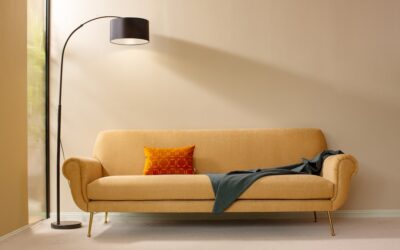
- Arc lamps: A long curved arm reaches over a sofa or table, delivering downlight without a base in the way. These are among the tallest at 75 to 81 inches.
- Reading lamps: An adjustable head or swing arm directs focused task light beside a chair. Look for a head that pivots.
- Tree or multi-head lamps: Several adjustable spotlights on one pole light multiple zones at once.
- Tripod lamps: A wide three-legged base adds mid-century or industrial style and extra stability on uneven flooring.
Bulbs, Brightness, and Color Temperature
LED bulbs have made floor lamps far more efficient than the halogen torchieres of the past, which ran hot enough to be a fire risk. For a primary light source, aim for 800 to 1,600 lumens. A dedicated reading lamp can get by with 450 to 800 lumens because the light sits close to the page.
Color temperature matters as much as output. Warm white around 2,700K to 3,000K flatters living and bedroom spaces, while 3,500K to 4,000K reads cleaner for an office corner or craft area. Many newer lamps include built-in dimmers or support smart bulbs, which lets one fixture shift from bright task lighting to a soft evening glow.
Choosing a Base That Suits Your Floor
The base does double duty: it keeps the lamp upright and protects your flooring. On hardwood or vinyl, a heavy round or square base prevents tipping but can scratch if dragged, so add felt pads underneath. On plush carpet, a wide tripod or flat disc base spreads the weight and resists wobble better than a narrow stem.
Weight is your friend with tall lamps. A top-heavy fixture with a light base tips easily, especially in homes with kids or pets. Check that the lamp lists a weighted or cast-metal base, and route the cord toward the nearest outlet so it does not become a trip hazard across a walkway.
Where to Place a Tall Floor Lamp
Corners are the classic spot because a tall lamp fills dead vertical space and bounces light into the room. Beside a sofa or armchair, an arc or reading lamp earns its keep as task lighting you can actually use. Flanking a console or behind a sectional, a torchiere adds height that balances tall bookcases or artwork.
Avoid placing a floor lamp directly in front of a television, where glare washes out the screen, or in a tight traffic path where the cord and base get bumped. In open-plan rooms, two matching lamps at opposite corners create symmetry and even coverage that a single ceiling fixture rarely manages.
What You Should Expect to Spend
Budget floor lamps start around $30 to $60 and cover basic torchiere or single-pole designs. Mid-range options with quality shades, dimmers, and sturdier bases generally run $80 to $200. Designer arc lamps, solid-metal tripods, and smart-integrated models can climb to $300 or more. For most homeowners, the $80-to-$150 range buys a lamp that looks intentional and lasts for years without feeling disposable.
Spend a little extra on the switch and the base rather than the shade, which is the easiest part to swap later. A foot-pedal or in-line dimmer is far more convenient than reaching up under a 70-inch shade every time you want to change the light.
Materials and Finishes
The frame material shapes both the look and the durability of a tall floor lamp. Brushed nickel and matte black metal poles suit modern and industrial rooms, while brass and bronze finishes lean warm and traditional. Wood-accented poles bridge mid-century and farmhouse styles. Avoid lightweight hollow plastic poles on tall models, since they flex and feel unstable; a solid metal or weighted composite pole stands straighter and lasts longer.
Shade material affects the quality of light as much as the look. Linen and fabric shades diffuse light into a soft, even glow that flatters living spaces. Metal and drum shades direct light up or down more sharply, which suits task lighting. Frosted or seeded glass shades on torchiere lamps soften glare while still pushing light toward the ceiling.
Smart Features Worth Having
Modern floor lamps increasingly include features that justify a slightly higher price. Built-in USB ports let you charge a phone without hunting for an outlet. Integrated dimmers, whether a rotary knob, an in-line slider, or a foot switch, give you control over mood without swapping bulbs. Smart-bulb compatibility means you can pair the lamp with a voice assistant or a phone app to schedule lighting and adjust brightness and color from across the room.
For a reading corner, look for a lamp with a flexible gooseneck or an adjustable swing arm so you can aim light precisely onto a page. For an ambient corner, a three-way switch that steps through low, medium, and high output adds flexibility a single-brightness lamp cannot match.
Care and Longevity
Dust the shade and pole monthly with a microfiber cloth, and unplug the lamp before wiping near the socket. Fabric shades collect dust that dims output over time, so a quick vacuum with a brush attachment keeps light levels high. If the lamp wobbles, check the threaded joints where pole sections connect and tighten them by hand. With LED bulbs rated for 15,000 to 25,000 hours, a well-built floor lamp can serve a decade or more before anything but a bulb needs replacing.
The right tall floor lamp is equal parts function and furniture. Match the height to your ceiling, pick a style that fits the task, choose warm efficient bulbs, and anchor it on a base suited to your flooring. Do that, and you get a light source that earns its corner every single evening.
Prefer to explore on your own?
See how new flooring looks in your actual room in seconds — free, no signup.
Try the free Floor Studio →