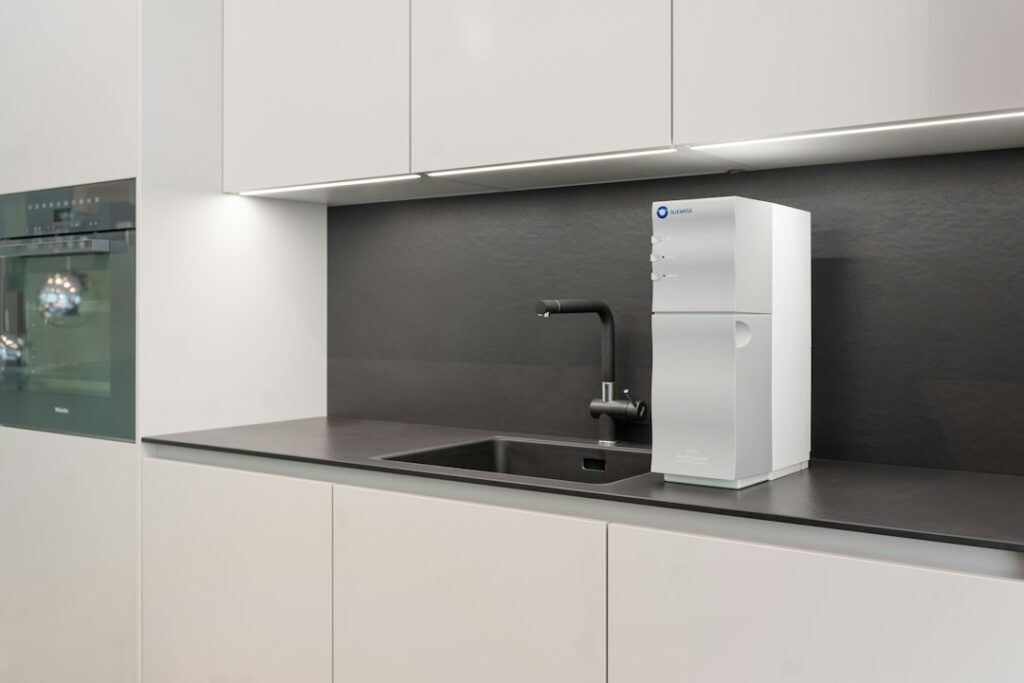
Traditional under-sink reverse osmosis units store filtered water in a pressurized tank that takes up half the cabinet and slowly refills after you use it. A tankless water filtration system filters on demand instead, pushing water through membranes and cartridges only when you open the faucet. The result is a slimmer unit, fresher water, and no stale storage tank to sanitize. Before you buy, though, it helps to understand the trade-offs in flow rate, electricity, drain connections, and filter costs.
What a Tankless Water Filtration System Actually Is
In residential terms, “tankless” almost always describes a point-of-use filter, usually installed under the kitchen sink, that delivers purified water directly to a dedicated faucet without a holding tank. Most tankless models use reverse osmosis (RO), where water is forced through a semi-permeable membrane with pores around 0.0001 microns. Conventional RO relies on household pressure alone and produces water too slowly to serve a faucet directly, so it needs a tank. Tankless RO adds a small electric booster pump that raises pressure to 80 to 100 psi and produces 400 to 1,200 gallons per day.
The term also shows up on non-RO filters. Multi-stage carbon systems that screw under the sink with no tank, and whole-house cartridge filters mounted at the main line, are technically tankless as well. They do not need a pump or a drain, but they remove a narrower list of contaminants. Knowing which category you are shopping in prevents a mismatch between expectations and results.
How Tankless Filtration Works Step by Step
Most tankless RO units combine several stages in one or two twist-off cartridges. A sediment layer catches sand, rust, and silt. Activated carbon then reduces chlorine, chloramine, and many taste and odor compounds, which also protects the membrane from chlorine damage. The RO membrane removes dissolved solids, including lead, arsenic, fluoride, nitrate, and many PFAS compounds. A final carbon polish, and sometimes a remineralization stage, conditions the water before it reaches the faucet.
- You open the dedicated faucet, and a pressure sensor signals the pump to start.
- Water passes through sediment and carbon pre-filtration.
- The pump pushes water across the RO membrane; purified water continues, and concentrate goes to the drain.
- Post-filters polish taste and, on some models, add calcium and magnesium back.
- When you close the faucet, the pump stops and many units run a brief membrane flush.
Because the membrane is always wet and water does not sit in a tank, many owners notice cleaner-tasting water, especially if they previously had a tank older than five years. Some models include a TDS (total dissolved solids) display and filter-life indicator, which takes the guesswork out of maintenance.
Tankless vs. Tank-Style Reverse Osmosis
| Feature | Tankless RO | Tank RO |
|---|---|---|
| Cabinet space | Compact, about 5 to 6 inches wide | Filters plus 3- to 4-gallon tank |
| Flow at faucet | 0.3 to 0.8 gallons per minute | Fast at first, slows as tank empties |
| Waste ratio | Often 2:1 to 3:1 pure to drain | Often 1:3 to 1:4 pure to drain |
| Power needed | Yes, 120V outlet | No, unless a booster pump is added |
| Typical unit price | $300 to $1,000 | $150 to $500 |
The efficiency advantage is real. Older tank systems could send 3 to 4 gallons down the drain for every gallon of purified water, while many current tankless designs waste one gallon or less for every two they produce. If you live in a drought-prone area or pay high water rates, that difference adds up over years of daily use. The trade-off is that a tankless unit needs a GFCI-protected outlet under the sink and stops working during a power outage.
Choosing the Right Tankless System for Your Home
Start with a water test. Municipal customers can read their annual Consumer Confidence Report; well owners should send a sample to a state-certified lab for $50 to $250 depending on the panel. Testing tells you whether you actually need RO or whether a carbon-only tankless filter will do the job. There is no point paying for a membrane if your only complaint is chlorine taste.
Key Specs to Compare
- Gallons per day (GPD): 400 GPD fills a glass in about 12 seconds; 800 to 1,200 GPD fills it in roughly 5 to 7 seconds and handles pots and pitchers comfortably.
- Certifications: Look for NSF/ANSI 58 for RO performance, NSF/ANSI 42 and 53 for carbon claims, and NSF/ANSI 401 or P473 for emerging contaminants and PFAS.
- Filter cost and lifespan: Carbon cartridges typically last 6 to 12 months; membranes last 2 to 3 years. Annual filter spend commonly runs $80 to $200.
- Feed water limits: Check maximum TDS, hardness, and temperature ratings; very hard water can shorten membrane life unless you also have a softener.
- Remineralization: Optional, but many people prefer the taste of RO water with minerals added back.
Also measure the cabinet. Most units need 16 to 18 inches of height and clearance in front to twist out cartridges. Garbage disposals, pull-out trash bins, and dishwasher lines can crowd the space, so sketch the layout before ordering.
Installation: What to Expect
A handy homeowner can install most under-sink tankless units in two to three hours. The basic tasks are tapping the cold water supply with an angle-stop adapter, drilling a 1/2-inch hole in the sink deck or countertop for the dedicated faucet (unless your sink has a spare hole), and connecting the waste line to the drain with a drain saddle above the P-trap. Quartz and granite counters need a diamond core bit and water to cool it; a countertop fabricator or plumber can drill the hole for $50 to $150 if you are nervous about chipping stone.
Professional installation typically runs $150 to $400. Add more if an electrician must install a new GFCI outlet in the sink base, which is common in older kitchens. Some local codes require an air gap faucet or a specific drain connection to prevent backflow, so check requirements before you install.
When to Call a Licensed Professional
Call a licensed plumber if your shutoff valves are corroded or will not close fully, if you have galvanized or polybutylene supply lines, or if you are adding a whole-house filter that requires cutting into the main water line. Call a licensed electrician for any new outlet or circuit under the sink; water and electricity in the same cabinet is not the place to improvise. A small leak inside a cabinet can soak subfloor and nearby hardwood or laminate flooring for weeks before you notice, so a leak detector or automatic shutoff valve is inexpensive insurance.
Maintenance and Long-Term Costs
Maintenance is simpler than with tank systems because there is no tank to sanitize. Most tankless cartridges twist out in under a minute with no tools. Follow the filter-life light or a calendar reminder, and replace the pre-filter on schedule, because a clogged carbon stage lets chlorine reach the membrane and ruins it early. Run the faucet for 30 seconds after returning from vacation to flush water that has sat in the lines.
- Every 6 to 12 months: Replace sediment and carbon cartridges.
- Every 24 to 36 months: Replace the RO membrane, or sooner if TDS readings climb.
- Yearly: Inspect fittings and drain saddle for drips, and check the faucet aerator.
Over five years, a mid-range unit usually costs $900 to $1,600 including purchase, installation, filters, and electricity. Electricity use is minimal, often only a few dollars a year, since the pump runs only while water flows. Compared with buying bottled water for a family of four, most households recover the cost within two to three years.
Pros and Cons at a Glance
Tankless systems shine in compact kitchens, for households that care about water waste, and for anyone who dislikes the taste of tank-stored water. They are less ideal where power outages are frequent, where there is no easy outlet, or where you want to feed a refrigerator ice maker far across the kitchen, since some tankless pumps are not designed for long remote runs.
- Pros: Space savings, lower waste, fresher water, quick filter swaps, digital monitoring
- Cons: Higher upfront price, needs electricity, slower flow than an open tap, proprietary cartridges
Frequently Asked Questions
Does a tankless water filtration system need electricity?
Tankless reverse osmosis units do, because a small pump creates the pressure the membrane needs. Carbon-only tankless filters and whole-house cartridge filters generally work on water pressure alone.
Can a tankless RO system connect to a refrigerator?
Many can, using a tee on the output line, but check the manufacturer’s maximum run length and whether the pump activates on low-flow ice maker demand. Some brands sell a specific refrigerator kit.
Does tankless RO remove minerals?
Yes. RO removes most dissolved minerals along with contaminants. If you prefer a mineral taste, choose a model with a remineralization cartridge.
How long does a tankless filter membrane last?
Most membranes last two to three years with regular pre-filter changes. Hard water, high TDS, and skipped carbon changes can shorten that lifespan.
A tankless filter is one of the most practical kitchen upgrades you can make: it frees cabinet space, cuts waste, and delivers consistently clean water. Test your water first, match certifications to the contaminants you actually have, confirm power and drain access, and budget for filters. With those boxes checked, you will enjoy better water every time you fill a glass.