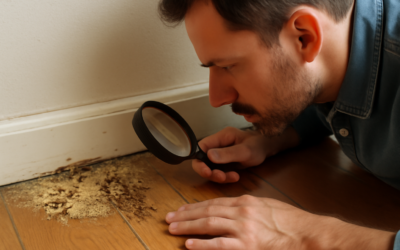
Finding gritty pellets on a windowsill or a faint sag in the drywall overhead is how most homeowners first discover termites in ceiling framing — and by then, the colony has usually been feeding for two to five years. Ceiling infestations are different from the wall and slab problems most termite articles cover: they are dominated by drywood termites that fly straight into the attic, they hide in rafters and top plates you never see, and they can hollow structural lumber to a paper shell before a single visible sign appears. Here is how to confirm what you are dealing with, what treatment actually works overhead, and what the repair bill looks like.
Why Ceilings Get Hit: Two Different Termites, Two Different Routes
Drywood termites (Incisitermes and Cryptotermes species) need no soil contact. Winged swarmers launch on warm afternoons — typically late summer through fall in the Gulf states, California, Arizona, and Hawaii — and land on roof edges, gable vents, fascia, and shingle gaps. A mated pair squeezes into a crack as thin as a business card, seals itself into a rafter or ceiling joist, and starts a colony that lives entirely inside the wood. Because the colony is small (a few thousand insects versus millions for subterraneans) it eats slowly, which is exactly why it goes unnoticed for years.
Subterranean termites reach ceilings the long way. They tunnel up from soil through foundation gaps, build mud shelter tubes inside wall cavities, and follow studs to the top plate and into ceiling joists — most often around plumbing walls, chimneys, and porch attachments where moisture helps them. If you find ceiling damage plus mud tubes anywhere on the foundation or in the garage, assume subterranean and treat the whole structure, not just the attic.
Signs of Termites in Ceiling Framing
- Frass (drywood droppings): the number-one giveaway. Drywood termites push six-sided fecal pellets out of kick-out holes about 1-2 mm wide. The pellets look like coarse sand or ground pepper, uniform in size, often in small conical piles on floors, sills, attic insulation, or ceiling fan blades. New piles reappearing days after you vacuum them mean an active colony directly above.
- Sagging or rippled drywall: joists that have lost cross-section deflect under the drywall’s weight. A dip line across a ceiling, nail pops in a row, or tape seams cracking along one joist bay deserve an attic inspection.
- Hollow-sounding rafters: tap suspect lumber with a screwdriver handle. Sound wood thuds; infested wood clicks papery. Probe gently — a screwdriver tip sinking 1/4″ into a rafter face confirms galleries.
- Swarmers and wings at ceiling fixtures: reproductives emerge inside the house and fly to light. Piles of shed wings in a light fixture globe, around skylights, or on window sills below ceiling level point to an interior colony overhead. Termite wings are equal-length and translucent; ant wings are unequal pairs.
- Faint clicking or rustling: in quiet rooms, soldiers banging heads against gallery walls are occasionally audible through drywall — rare, but real in heavy infestations.
- Mud tubes on chimney chases or wall corners reaching upward: subterranean sign, and it means the problem starts at the soil, not the roof.
Inspecting the Attic Without Wrecking It
Go up with a bright headlamp, a flat-bar, an awl or screwdriver, and a dust mask. Walk the joists — never the drywall — and work systematically: eaves and rafter tails first (closest to entry points), then ridge board, top plates, and around every penetration (chimney, plumbing vents, skylight curbs, bath fan housings). Look for kick-out holes, pellet piles on top of insulation, and blistered or wavy wood surfaces where galleries run just under the skin. Pull back insulation along the top plates on exterior walls; that is where subterranean tubes surface. Photograph everything before disturbing it — the pattern of damage tells a pro which species and how widespread. If there is no attic access above the damaged area (vaulted or furred-down ceilings), a pro can use a borescope through a 1/2″ hole, or infrared imaging to find moisture-associated activity.
Treatment: Local Spot Treatment vs. Tent Fumigation
For drywood colonies, the decision is scope. Localized treatment works when inspection can pin down one or two discrete colonies: a technician drills 1/8″ holes into the galleries every few inches and injects termiticide foam or dust — Termidor Foam (fipronil), Tim-bor or Bora-Care (borates), or Premise Foam (imidacloprid). Expect $300-$1,200 per treatment area. The honest limitation: local treatment only kills what the injections reach. Miss a satellite colony three rafters over and you are re-treating in a year. Reputable companies warranty local drywood work for one to three years on the treated members only.
Whole-structure fumigation (tenting with sulfuryl fluoride, sold as Vikane) is the only method certified to kill every drywood colony in the building, including ones no inspector found. The house is tented for two to three days; typical cost runs $1-$4 per cubic foot, so $2,500-$4,500 for an average 2,000 sq ft single-story and $6,000+ for large two-stories. Fumigation leaves no residue and no residual protection — pair it with attic borate spray (Bora-Care diluted 1:1, about $95 per gallon covering 800 sq ft of framing) so new swarmers landing next fall hit treated wood. For subterranean termites reaching the ceiling, fumigation is the wrong tool: they retreat to soil. Those infestations need a soil perimeter treatment with a non-repellent (Termidor SC trench-and-rod, $800-$2,500) or a baiting system (Sentricon, $1,200-$3,000 installed plus $300-$500 annual monitoring).
Repair Scope and Costs
Treatment kills termites; it does not restore lumber. After the colony is dead, assess each member. Cosmetic galleries confined to the outer 1/4″ can be left or hardened with a borate-glycol treatment. Joists or rafters with more than roughly a third of their cross-section eaten need sistering — a matching 2x lumber member glued and through-bolted alongside, typically $150-$400 per joist installed. Fully compromised rafter tails or top plates require cut-and-replace framing work at $500-$1,500 per section, more if roof loads must be temporarily shored. Drywall repair, texture, and paint for a bedroom-sized ceiling runs $400-$900. A typical caught-it-mid-stage drywood repair bill lands between $1,000 and $3,500; ceilings ignored for a decade can run well past $10,000 once structural engineers get involved. Homeowners insurance almost never covers termite damage — it is classified as preventable maintenance.
Keeping Them Out of the Attic
Prevention for ceiling infestations happens at the roofline. Screen gable and eave vents with 20-mesh (1/20″) stainless screen — standard 1/4″ hardware cloth stops birds, not swarmers. Caulk fascia gaps, rafter tail checks, and the joint where roof planes meet walls. Keep paint film intact on exposed eave wood; drywood termites exploit weathered, checked lumber far more readily than sealed surfaces. Fix roof leaks and bath-fan condensation fast, since damp framing invites both subterranean extensions and dampwood species in coastal climates. In heavy drywood regions (Southern California, Florida, coastal Texas, Hawaii), a preventive borate treatment of accessible attic framing during any re-roof or remodel is cheap insurance, and an annual professional inspection — $75-$150, often free from firms hoping to win treatment work — catches the next colony while it is still a $400 spot treatment instead of a tenting job.
Ruling Out the Look-Alikes
Not every pellet pile or ceiling stain is termites, and misdiagnosis wastes treatment money in both directions. Carpenter ants also nest in ceiling voids — especially over bathrooms and around skylights where framing stays damp — but their debris is coarse sawdust-like frass mixed with insect parts, not the uniform six-sided pellets drywood termites produce, and ants are visible foragers where termites almost never are. Powderpost beetles leave talc-fine flour dust and pinholes smaller than 1/16″, typically in hardwood trim rather than softwood framing. Water stains with sagging can mimic termite damage from below; probe the wood — leak-softened lumber crushes spongy and uniform, while termite galleries are clean-walled tunnels with intact wood between them. When in doubt, bag a sample of the droppings and get two professional inspections. Reputable operators inspect free or for under $150, and because the treatment recommendation ranges from a $400 spot injection to a $4,000 tenting, a second opinion on species and extent is the cheapest insurance in the whole process. Ask each inspector to show you the evidence directly — active galleries, live insects, or fresh pellet accumulation — rather than accepting a verdict based on age of the home and region alone.