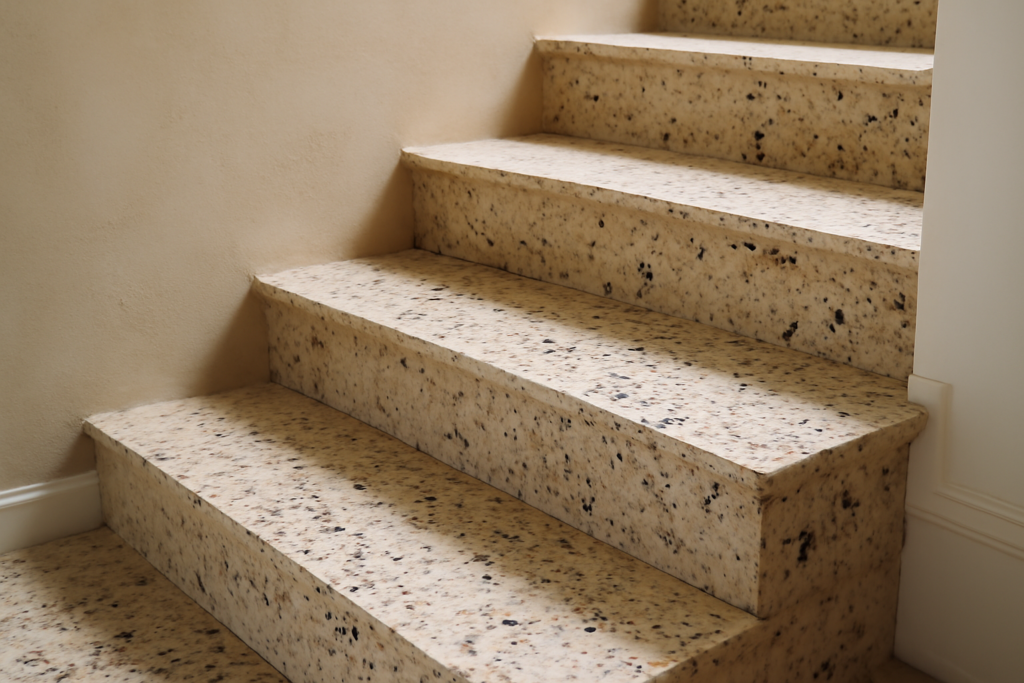
Most stair materials show wear on the front edge within a decade, but terrazzo in 1950s school stairwells still looks crisp after millions of footsteps. That durability is exactly why terrazzo stair treads are moving out of commercial lobbies and into homes. They combine marble, glass, or granite chips set in a cement or epoxy binder, then ground and polished to a smooth, speckled face. The catch is that terrazzo is heavy, unforgiving of poor substrate prep, and slippery if you order the wrong finish. Here is what you need to know before you commit.
Part of our Stairs & Stair Flooring guide — explore the full guide →
- What Terrazzo Stair Treads Are and How They Are Made
- Precast vs Poured-in-Place Stairs
- Slip Resistance and Safety Details
- How Much Terrazzo Stair Treads Cost
- Installing Terrazzo Stair Treads Step by Step
- Design Choices: Chips, Colors, and Nosing Profiles
- Cleaning, Sealing, and Long-Term Care
- Is Terrazzo Right for Your Staircase?
- Frequently Asked Questions
What Terrazzo Stair Treads Are and How They Are Made
Terrazzo stair treads are individual slabs, usually 1 1/4 to 2 inches thick, that sit on top of a stair’s structural frame. Manufacturers blend aggregate chips with a binder, cast the mix in molds shaped like a tread with a bullnose or square nosing, cure it, and then grind the face with progressively finer diamond abrasives. The final step is a hone or polish plus a penetrating sealer.
Two binder families dominate. Cementitious terrazzo uses Portland cement and produces a traditional, slightly more porous surface with chip sizes up to about 1/2 inch. Epoxy terrazzo uses a resin matrix, allows thinner sections and brighter colors, and resists staining better, but it is less tolerant of UV exposure on exterior steps. For indoor residential stairs, both work; for an outdoor entry, cement-based precast is the safer pick.
You can also buy matching risers and landing slabs from the same pour, which keeps the chip pattern and color consistent from the bottom step to the top.
Precast vs Poured-in-Place Stairs
Homeowners almost always use precast treads. A fabricator makes them in a shop, ships them on pallets, and an installer sets them on the existing stringers or concrete stairs. Poured-in-place terrazzo, where a crew builds forms on site and grinds the stairs where they sit, is reserved for large commercial jobs and runs far more expensive because of the labor and the dust containment involved.
Why precast wins for homes
- Quality control happens in the factory, so you get consistent thickness and flat faces.
- Installation takes one to three days instead of one to three weeks.
- Abrasive strips and nosing profiles can be cast in during manufacturing.
- Damaged treads can be replaced individually if you order a spare or two.
Precast pieces are made to your measurements, so accurate field dimensions matter. Most shops want tread depth, width, nosing overhang, and whether the ends are open or butt into a wall on each side.
Slip Resistance and Safety Details
A polished terrazzo floor can feel like glass under wet socks. On stairs, that is a real hazard. Ask the fabricator for a honed finish rather than a high polish, and specify cast-in abrasive strips near the nosing. These strips are typically 1 to 2 inches wide and contain silicon carbide or aluminum oxide grit, set 1 inch back from the edge.
Look for a wet dynamic coefficient of friction (DCOF) of at least 0.42, the common benchmark in the ANSI A326.3 standard for level interior surfaces that may get wet. Stairs deserve even more grip, so many installers add a contrasting nosing strip that also helps people see the edge of each step. That visual contrast is especially useful for older family members or anyone with low vision.
Keep in mind building code dimensions too. Most US residential codes cap riser height at 7 3/4 inches and require a minimum tread depth of 10 inches, with nosing projections between 3/4 and 1 1/4 inches. Adding a 1 1/2-inch terrazzo tread over an existing stair can change the height of the first and last riser, so plan for that before ordering.
How Much Terrazzo Stair Treads Cost
Pricing varies with thickness, aggregate, binder, and finishing, but these ranges reflect typical 2026 residential quotes for a standard 36-inch-wide straight stair.
| Item | Typical Cost | Notes |
|---|---|---|
| Precast cement tread | $150 to $300 each | Standard gray or white base, stock chips |
| Precast epoxy tread | $250 to $450 each | Custom colors, glass or mother-of-pearl chips |
| Matching riser | $80 to $180 each | Usually 3/4 to 1 inch thick |
| Installation labor | $75 to $150 per step | Higher for curved or open stairs |
For a 13-step staircase, you are looking at roughly $3,500 to $10,000 all in. Curved stairs, winders, and landings add fabrication time because each piece becomes a unique template. Freight also matters; a single tread can weigh 60 to 90 pounds, so shipping a full set across the country can add $400 to $900.
Compared with oak treads at $60 to $150 each, terrazzo costs more upfront. The payoff is a surface that rarely needs refinishing and holds its appearance for decades with basic care.
Installing Terrazzo Stair Treads Step by Step
Installation is doable for a skilled DIYer on concrete stairs, but the weight and precision needed push most homeowners toward a stone or tile installer. Either way, understanding the process helps you judge a contractor’s quote.
- Check the structure. Wood stringers must be sound and stiff. Terrazzo adds significant dead load, so an engineer or experienced carpenter should confirm framing can carry it. Concrete stairs need to be free of cracks wider than 1/8 inch.
- Remove old coverings. Pull carpet, tack strip, and old treads. Grind high spots and fill low spots on concrete with a cement patching compound.
- Dry-fit every piece. Lay each tread and riser in position without adhesive, number them, and mark any trimming needed at walls.
- Set risers first. Back-butter with a polymer-modified thinset or a construction-grade adhesive recommended by the fabricator.
- Bed the treads. Apply a full bed of thinset or mortar using a 1/2-inch notched trowel, press the tread down, and check level front to back with a slight forward slope of no more than 1/8 inch for drainage on exterior steps.
- Cure and seal. Keep traffic off for 24 to 72 hours depending on the setting material, then fill joints with grout or color-matched caulk and apply a penetrating sealer.
On wood stairs, many installers first screw down a 3/4-inch plywood subtread and add a cement backer or uncoupling membrane. That prevents deflection from cracking the tread along its length, which is the most common failure on residential installs.
Design Choices: Chips, Colors, and Nosing Profiles
Terrazzo is one of the few stair materials where you control nearly every visual detail. Aggregate options include white Carrara marble, black basalt, recycled glass, mirror flakes, and even brass divider strips. Small chips (size 0 to 1) read as a subtle speckle, while larger chips (size 2 to 4) create the bold look seen in mid-century lobbies.
Popular residential combinations
- White cement base with gray and black marble chips for a clean modern look.
- Warm beige base with brown and cream chips to pair with oak railings.
- Charcoal base with white glass chips for dramatic contrast on a floating stair.
Nosing shape changes both style and feel. A full bullnose softens the edge and suits traditional homes. A square nosing with a small eased edge looks sharper and works on contemporary open-riser stairs. If small children are in the house, a rounded profile reduces the sting of an accidental fall against the edge.
Coordinate the stair with the floor at the top and bottom. Terrazzo treads look best when they either match a terrazzo floor or contrast deliberately with wood, polished concrete, or large-format porcelain.
Cleaning, Sealing, and Long-Term Care
Daily care is simple. Sweep or vacuum grit off each tread, because sand acts like sandpaper on a honed face. Damp mop weekly with a pH-neutral stone cleaner diluted in warm water. Avoid vinegar, lemon-based products, and bleach; acids etch the marble chips and dull the finish, while harsh alkalis can attack the cement matrix.
Reseal cement terrazzo every 12 to 24 months on interior stairs and every year on exterior steps. A simple water-drop test tells you when: if droplets darken the surface within five minutes instead of beading, the sealer has worn through. Epoxy terrazzo needs less sealing but benefits from a periodic buff with a fine diamond pad to restore sheen in high-traffic zones.
Chips and small cracks can be repaired with color-matched epoxy filler, then honed flush. A professional restoration crew can regrind and repolish an entire staircase for roughly $20 to $45 per step, bringing decades-old treads back to near-new condition.
Is Terrazzo Right for Your Staircase?
Terrazzo makes the most sense when you want a staircase that lasts as long as the house and you are willing to pay for it upfront. It suits concrete basement stairs, modern open stairs with steel stringers, and entry steps that take a beating from weather and foot traffic. It is less ideal on older wood stairs with bounce, in homes where occupants want a warm, soft feel underfoot, or on tight budgets.
Before you order, gather three quotes that spell out thickness, binder type, finish, abrasive inserts, freight, and installation. Ask to see a physical sample under your own lighting, since chip colors can look very different in a showroom. Chosen carefully and installed on a solid base, terrazzo stair treads will outlast nearly any other finish on your stairs and keep looking sharp for generations.
Frequently Asked Questions
Are terrazzo stair treads slippery?
A high-polish finish can be slippery when wet. Ordering a honed finish with cast-in abrasive strips near the nosing gives reliable grip for indoor and outdoor stairs.
Can terrazzo treads go over existing wood stairs?
Yes, if the framing is stiff enough to carry the extra weight. Installers usually add a plywood subtread and a membrane to limit flex and prevent cracking.
How long do terrazzo stair treads last?
With routine sweeping and periodic sealing, terrazzo treads commonly last 50 years or more, and worn surfaces can be reground rather than replaced.