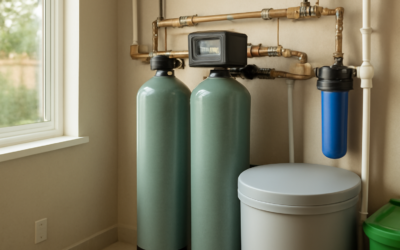
If hard water is coating your fixtures in scale, spotting your dishes, and leaving your skin dry, a water softener is the permanent fix. But the market is crowded and confusing, and the difference between a great unit and a frustrating one often comes down to a few components you cannot see. The top rated water softener systems share a handful of traits — smart regeneration, quality valves, proper sizing, and solid warranties — that separate them from the cheap units that clog and fail. This guide explains what to look for and how to choose the right system for your household.
- How Water Softeners Work
- The Traits of Top-Rated Systems
- Types of Systems and Who They Suit
- Sizing: The Step Most People Skip
- Comparing Value, Not Just Price
- Installation Considerations
- Maintenance for Long Life
- Understanding Grain Capacity Ratings
- Well Water vs. City Water Considerations
- The Bottom Line
How Water Softeners Work
Most softeners use ion exchange. Hard water flows through a tank of resin beads that grab the calcium and magnesium ions and release sodium in their place. Periodically the system flushes the resin with a concentrated salt brine to recharge it — a process called regeneration. The result is water that lathers easily, rinses clean, and stops depositing scale in your pipes, water heater, and fixtures.
The quality of the resin, the valve controlling regeneration, and how well the system is sized to your water all determine whether you get years of trouble-free soft water or a headache.
The Traits of Top-Rated Systems
Sift through thousands of owner reviews and the highest-rated softeners consistently share these features:
- Metered (demand-initiated) regeneration: The system regenerates based on actual water usage, not a fixed clock. This saves salt, water, and money compared to timer-only units.
- Quality control valve: The Fleck 5600SXT and Clack WS1 valves dominate the top tier because they are reliable, rebuildable, and widely serviced.
- High salt efficiency: The best systems remove more grains of hardness per pound of salt, lowering running costs.
- NSF/ANSI certification: Independent validation that the unit performs as claimed and uses safe materials.
- Strong warranty: Look for 10 years on the tank and 5-plus on the valve.
- Correct sizing: Even a great valve fails to satisfy if the resin volume is too small for the home.
Types of Systems and Who They Suit
Salt-Based Ion Exchange
These are the top performers for genuine softening and make up most highly rated systems. They deliver the classic soft-water feel, protect plumbing completely, and cost $500 to $1,500. Best for homes with moderate to very hard water where the full soft-water benefit is the goal.
Salt-Free Conditioners
Template-assisted crystallization units reduce scale without removing minerals or using salt. They rate well among owners focused on plumbing protection and low maintenance, and among those on septic systems or sodium-restricted diets. They do not produce the slick soft-water feel. Prices run $400 to $1,200.
Dual-Tank Systems
Two resin tanks provide uninterrupted soft water because one regenerates while the other works. Top-rated among large families and heavy users who cannot tolerate a soft-water gap. Expect $1,000 to $2,500.
Sizing: The Step Most People Skip
The best-reviewed system in the world underperforms if it is the wrong size. To size correctly, get a water test for hardness in grains per gallon (gpg), then estimate daily use at about 75 gallons per person.
Multiply the two for your daily grain load. A four-person household with 20-gpg water uses roughly 6,000 grains per day. You want a system that regenerates about once a week, so multiply the daily load by 7 and choose a grain capacity above that — pointing this household toward a 48,000-grain unit. Undersizing forces frequent regeneration that wastes salt and shortens resin life; grossly oversizing wastes money and can reduce efficiency.
Comparing Value, Not Just Price
The cheapest softener is rarely the best value. A $300 timer-based unit that regenerates every night wastes salt and water and often uses a proprietary valve you cannot service. A $700 metered system on a Fleck or Clack valve costs more upfront but runs cheaper for a decade and can be rebuilt rather than replaced. When comparing systems, weigh:
- Total cost over 10 years, including salt and water use, not just sticker price.
- Whether the valve is serviceable and parts are available.
- Resin quality and quantity (10% cross-linked resin outlasts standard 8%).
- Warranty length and what it actually covers.
Installation Considerations
A confident DIYer can install a softener in three to five hours. It ties into the main line after the meter and before the water heater, needs a drain for the brine discharge, and a 120-volt outlet nearby. Budget $150 to $300 for a bypass valve, fittings, and flexible connectors. Hire a plumber ($300 to $700) if soldering copper, if a permit is required, or if no drain is close at hand. Many owner complaints trace back to a botched install — a kinked drain line or a bypass left in the wrong position — rather than the softener itself.
Maintenance for Long Life
Top-rated systems still need basic care. Keep the brine tank at least a third full of salt, use a clean pellet or solar salt to reduce residue, and break up any salt “bridge” that forms and floats above the water — a bridged tank is the top cause of a softener that suddenly stops softening. Set the valve hardness to match your water test, and check the resin every 10 to 15 years, replacing the bed when softening quality declines.
Understanding Grain Capacity Ratings
Grain capacity is the number that confuses shoppers most, so it is worth unpacking. A softener rated at 32,000 grains does not deliver that many grains before every regeneration in real-world use — running a resin bed to its absolute maximum wastes salt inefficiently. The sweet spot is regenerating at roughly 75 percent of the rated capacity, which is why sizing math builds in headroom.
Common residential sizes are 32,000, 40,000, 48,000, and 64,000 grains. A couple with average water often does well with a 32,000-grain unit, a family of four typically wants 40,000 to 48,000 grains, and larger households or very hard water push toward 64,000. Buying one size up from the minimum gives you weekly regeneration and longer resin life, but going drastically oversized wastes money and can actually reduce efficiency because the bed regenerates too infrequently to stay clean. Match the capacity to a real calculation, not a guess.
Well Water vs. City Water Considerations
Where your water comes from changes what softener features you need. City (municipal) water is treated and predictable, so a standard salt-based softener sized to the utility’s published hardness usually does the job. Chlorine in city water can slowly degrade resin, so a system with a carbon pre-filter or chlorine-resistant resin extends the bed’s life.
Well water is a different animal. It often carries iron, manganese, sediment, and sometimes hydrogen sulfide (rotten-egg smell) alongside hardness. Iron in particular fouls standard softener resin and shortens its life, so well owners frequently need a softener rated for iron removal, a dedicated iron filter ahead of the softener, or a sediment pre-filter. Always test well water for iron, pH, and hardness before choosing a system — a softener sized only for hardness will underperform and clog on high-iron well water.
The Bottom Line
The top rated water softener systems are not defined by the flashiest marketing but by the fundamentals: a metered valve from a trusted maker like Fleck or Clack, adequate resin sized to a real water test, NSF certification, and a warranty that backs it all up. Test your water first, size the system to your household, and favor a serviceable metered unit over a cheap timer model. Do that and you will get years of spot-free glasses, scale-free pipes, and water that finally feels the way it should.
As a final checklist before you buy, confirm four things: you have a recent water test showing hardness and, for wells, iron and pH; the grain capacity matches your household size with a little headroom; the valve is a serviceable metered model from a trusted maker; and the warranty and support reputation give you confidence for the decade-plus you will own it. Softeners are not glamorous purchases, but they quietly improve daily life in dozens of small ways. Choose carefully once, install it correctly, and it will pay you back every time you wash your hands, run the dishwasher, or step into the shower.