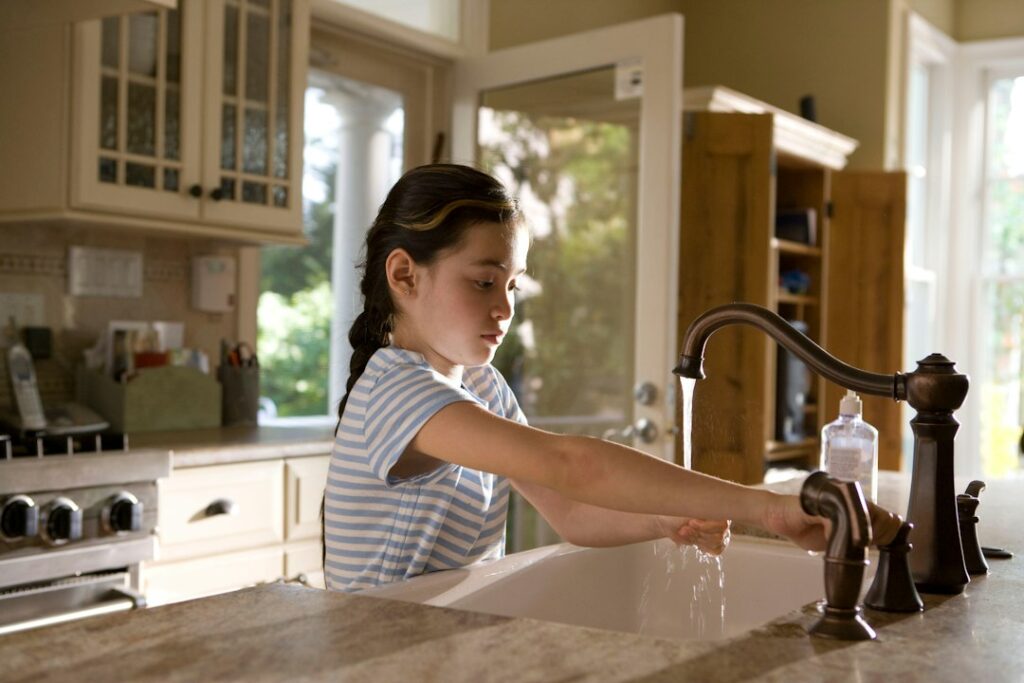
Raw chicken on your hands and a faucet handle you’d rather not touch, that everyday moment is exactly why the touchless kitchen sink faucet has become one of the most popular upgrades in modern kitchens. A wave or a hand near the spout turns the water on and off, keeping the faucet clean and saving water in the process. But not all touchless faucets are equal, and understanding the sensors, power, and features helps you avoid the frustrating models. This guide covers how they work and how to choose a good one.
Part of our Kitchen Remodeling guide — explore the full guide →
- How Touchless Faucets Work
- Key Benefits
- Power Options: Battery vs. AC
- Features Worth Looking For
- Installation Overview
- Common Concerns Addressed
- What to Budget
- Touchless vs. Touch-Activated: The Difference
- Maintenance and Care
- Compatibility and What to Check Before Buying
- Best Situations for a Touchless Faucet
- Is It Worth It?
How Touchless Faucets Work
A touchless faucet uses a motion sensor, usually infrared, mounted near the base or spout. When your hand or an object breaks the sensor’s field, a small solenoid valve inside opens to start the flow; move away or wave again, and it shuts off. Water temperature and flow are pre-set with a traditional handle, so you set warm or cold once and then operate hands-free.
Most models offer both touchless (wave-to-activate) and touch (tap anywhere on the spout or handle) activation, plus the manual handle. That flexibility means you can fill a pot the old way or trigger a quick rinse with a wave, whichever suits the moment.
Key Benefits
- Hygiene: no touching the faucet with raw-meat, dough-covered, or dirty hands, so you don’t spread germs to the handle and back.
- Water savings: the water runs only when your hands are under it, cutting waste while you scrub dishes or lather up.
- Convenience: hands full of a heavy pot or a fistful of vegetables? A wave starts the flow.
- Cleaner faucet: fewer fingerprints and grime on the handle and spout.
- Accessibility: easier for kids, older adults, or anyone with limited grip strength.
Power Options: Battery vs. AC
Touchless faucets need power for the sensor and solenoid, and how they get it matters for maintenance:
- Battery-powered: typically four to six AA or C batteries in a pack under the sink. Easy to install with no electrician, but you’ll replace batteries every one to two years depending on use.
- AC-powered (plug-in): plugs into an outlet under the sink, so no batteries to change. Requires an available outlet in the cabinet, and the faucet won’t work during a power outage.
- Dual-power models use AC with a battery backup, the best of both worlds if you have an outlet.
Battery models are the most common and simplest to install. Just make sure you can reach the battery pack easily for changes.
Features Worth Looking For
Beyond the basic sensor, several features separate a great faucet from a frustrating one:
- Pull-down sprayer with multiple spray modes (stream, spray, and often a powerful “boost”) for rinsing and filling.
- Good sensor design that responds reliably without false triggers, poorly placed sensors that activate when you reach into the sink are a top complaint.
- Auto shut-off that stops the water after a few minutes if left running, preventing waste and floods.
- Spot-resistant or stainless finishes that hide fingerprints and water spots.
- MagneTite or magnetic docking that snaps the sprayer head firmly back into place.
- High-arc spout for clearance to fill tall pots.
Installation Overview
Installing a touchless faucet is similar to a standard faucet, with a couple of extra connections for the electronics. A confident DIYer can do it in an hour or two.
- Shut off the water at the supply valves under the sink and disconnect the old faucet.
- Mount the new faucet through the sink or countertop hole and secure it from below.
- Connect the supply lines to hot and cold, and attach the pull-down hose and weight if included.
- Wire the sensor box and solenoid, then connect the battery pack or plug in the AC adapter, these snap together with keyed connectors.
- Turn the water back on, check for leaks, and test both touchless and manual operation.
The one extra step versus a regular faucet is finding a spot for the battery pack or reaching an outlet, so plan cabinet space accordingly.
Common Concerns Addressed
Some buyers worry about reliability, and a few concerns come up often. False activation, the water turning on when you don’t want it, usually traces to a sensor mounted too low or a spout position that reads normal sink activity as a “wave.” Choosing a well-reviewed model with a thoughtfully placed sensor avoids most of this. Battery life is another worry, but quality faucets sip power and last a year or more per set. And if the electronics ever fail, the manual handle still works, so you’re never left without water.
What to Budget
Touchless faucets range widely. Entry-level models start around $150 to $200, solid mid-range options from trusted brands run $250 to $400, and premium designer or high-flow professional-style faucets can exceed $500. As with most fixtures, the middle tier usually offers the best balance of reliable sensors, good finishes, and useful spray features without paying for a name alone.
Touchless vs. Touch-Activated: The Difference
The terms get used interchangeably, but they describe two different technologies, and many faucets offer both. Touchless (motion-activated) faucets turn on when you wave a hand near the sensor, with no contact at all, ideal when your hands are dirty or full. Touch-activated faucets turn on when you tap anywhere on the spout or handle, using a capacitance sensor that reads your touch. Touch faucets require a light tap, which some people find more deliberate and less prone to accidental activation.
The best models combine both: wave to activate hands-free, tap for quick on/off, and use the manual handle to set temperature or fill a pot the traditional way. If false triggering worries you, a touch-plus-manual model gives fewer surprises, while a wave-activated model is the most hygienic. Decide which behavior matters most in your kitchen.
Maintenance and Care
Touchless faucets need a little more attention than a basic fixture, but not much. Wipe the sensor area occasionally, since a buildup of grime or hard-water film can dull its responsiveness. In hard-water areas, periodically clean the aerator and spray head by soaking them in vinegar to dissolve mineral deposits that weaken the flow. For battery models, note when you install fresh batteries so you can anticipate the next change before the faucet slows down.
If the faucet starts responding erratically, the fix is usually simple: replace the batteries, clean the sensor, or reset the unit per the manual. The solenoid valve and sensor are generally reliable for years, and quality brands back them with solid warranties on both the finish and the electronics.
Compatibility and What to Check Before Buying
Before ordering, confirm a few compatibility points. Check how many mounting holes your sink or countertop has, some faucets need one hole, others need a separate hole for a soap dispenser or the manual handle, and a deck plate can cover extras. Verify the spout height and reach clear your sink and any window behind it. And confirm your under-sink space can accommodate the battery pack or that you have a nearby outlet for an AC model. A few minutes measuring saves a frustrating return.
Best Situations for a Touchless Faucet
Certain kitchens benefit more than others. If you cook a lot with raw meat, dough, or messy ingredients, the hygiene payoff is immediate, no more smearing the handle with contaminated hands. Households with kids appreciate the easy hands-free operation and the auto shut-off that prevents a running faucet from being left on. Anyone with limited grip strength or mobility finds a wave far easier than twisting a stiff handle.
Busy families also gain from the water savings, since the faucet runs only when hands or dishes are actually under it rather than the whole time you’re scrubbing. In short, the more your kitchen sees heavy, hands-full use, the more a touchless faucet earns its keep. In a rarely used guest kitchen, the benefit is smaller and a standard faucet may make more sense.
Is It Worth It?
For most kitchens, a touchless kitchen sink faucet is a genuinely practical upgrade, not just a gadget. The hygiene benefit during cooking, the water savings, and the convenience of hands-free operation add up to something you’ll appreciate daily. Choose a model with a reliable sensor, a spray mode you’ll use, and a power setup that fits your cabinet, and keep the manual handle in mind as the reliable backup. Done right, it’s one of those upgrades that quietly makes the kitchen easier every single day.