
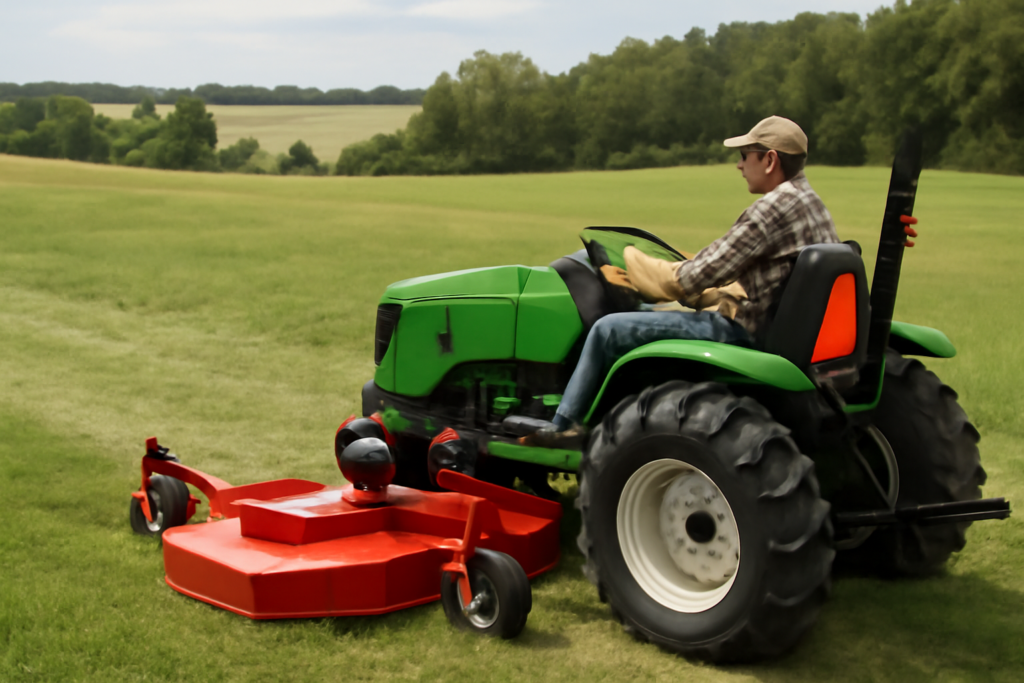
Owners of a compact tractor often discover that a riding mower takes all Saturday on 3 acres, while a tractor finish mower can knock it out in a couple of hours. A finish mower is a PTO-driven deck that hangs on the 3-point hitch and cuts grass to a lawn-quality finish with multiple blades and gauge wheels. Getting a good result depends on matching deck width to your tractor, leveling it properly, and keeping the blades and gearbox in shape.
The short version: pick a deck roughly as wide as your rear tire track or a little wider, confirm your tractor has enough PTO horsepower for that width, and choose rear or side discharge based on how you mow. Level the deck side to side and front to back before your first pass, grease the driveline often, and never approach the deck or shaft until the PTO is off, the engine is stopped and you have pulled the key.
What a Tractor Finish Mower Does
A tractor finish mower is built for maintained turf: yards, orchards, paddocks and parklike acreage. It typically has three blades under a single deck, driven through a gearbox and belts from the tractor’s rear PTO at 540 rpm. Caster or gauge wheels ride the ground so the deck follows contours and holds a steady cutting height, usually adjustable from about 1 to 4 1/2 inches.
Owners sometimes call it a tractor grass cutter, but it is a very different tool from a rotary cutter. A finish mower gives a clean, even lawn cut on grass mowed regularly. A rotary cutter (the heavy single or twin blade brush cutter many people use on fields) handles tall grass, weeds and saplings but leaves a rougher finish.
Finish Mower vs Rotary Cutter
| Feature | Finish mower | Rotary cutter |
|---|---|---|
| Best for | Lawns, maintained turf | Pasture, brush, tall weeds |
| Cut quality | Even, lawn-like | Rough, chopped |
| Blades | Three thin, sharp blades | One or two heavy swinging blades |
| Height range | About 1 to 4.5 inches | About 2 to 12 inches |
If you mow the same grass weekly, a finish mower is the right tool. If grass gets knee-high between cuts or you are clearing overgrown ground, start with a rotary cutter and switch to a finish mower once the area is under control. Running a finish mower through brush bends blades, strains the gearbox and throws debris.
Sizing Deck Width to Horsepower and Tractor
Deck width depends on PTO horsepower, tractor weight and rear tire width. A deck narrower than the rear tires leaves tire tracks on uncut grass, so aim for a deck at least as wide as the outside of the rear tires.
- Sub-compact tractors (about 18 to 25 hp): usually 48 to 60 inch decks.
- Compact tractors (about 25 to 35 hp): usually 60 to 72 inch decks.
- Larger compact tractors (about 35 to 50 hp): 72 to 84 inch decks, sometimes wider.
Check PTO horsepower, not engine horsepower, and look at the mower maker’s minimum PTO rating. Also confirm the hitch category (most compact tractors use Category 1 or Limited Category 1) and the tractor’s lift capacity at 24 inches behind the lift points, since a larger deck can weigh 400 to 700 pounds.
Think about the ground too. Wide decks cover acreage fast but scalp more on rolling terrain. On bumpy or sloped ground, a slightly narrower deck with good gauge wheels often leaves a better finish. On slopes, follow your tractor’s operator manual limits and mow up and down rather than across when the manual recommends it.
Rear Discharge vs Side Discharge
Rear-discharge decks spread clippings evenly behind the tractor and let you mow in either direction, which suits tight areas and trimming close on both sides. Side-discharge decks throw clippings to one side in a windrow and handle heavier grass, but you need to plan mowing patterns so clippings go onto cut grass and away from people, buildings, windows and vehicles. For most acreage lawns, rear discharge is the easier choice.
Hookup and Leveling the Deck
Tools you will want: a socket and wrench set, tape measure, grease gun, tire gauge and a level surface such as a flat driveway or shop floor.
- Set tire pressure. Uneven rear tires tilt the deck. Set both to the operator manual spec before leveling.
- Attach the lower lift arms, then the top link, with the correct pins and lynch pins in place.
- Connect the PTO shaft. With the engine off and key out, slide the shaft onto the tractor PTO until the locking collar clicks. Check that the shaft length is correct so it neither bottoms out nor pulls apart at full lift.
- Level side to side. Lower the deck to its wheels, measure from the floor to the deck edge on the left and right, and adjust the lift arm leveling link until they match.
- Set front to back pitch. Most finish mowers cut best with the front 1/4 to 1/2 inch lower than the rear. Adjust with the top link.
- Set cutting height with the gauge wheel spacers or pins, making all wheels match.
- Adjust the 3-point lowering stop so the tractor carries a little weight of the deck and the wheels float instead of dragging.
Blade, Belt and Gearbox Maintenance
Regular care keeps the cut clean and the driveline alive:
- Grease the PTO shaft U-joints and slip tubes, spindles and gauge wheel pivots every 8 hours of use or per the manual.
- Check gearbox oil before each season and every 50 hours or so; top up with the gear oil the manual specifies and watch for leaks at seals.
- Sharpen blades when the grass tips look shredded. Remove them with the deck raised and blocked securely, sharpen to the original angle, and balance each blade before reinstalling.
- Inspect belts for cracks and glazing, and set tension per the manual.
- Clean the deck underside after mowing wet grass so buildup does not hold moisture and rust the steel.
- Check the slip clutch or shear bolt on the driveline, which protects the gearbox from sudden impacts.
Never work under a deck held only by the hydraulics. Lower it onto sturdy blocks or jack stands, shut off the engine and remove the key first.
PTO, Fuel and Fire Safety
The PTO shaft is one of the most dangerous parts of any tractor. Keep all shields and guards in place, wear close-fitting clothing, tie back long hair, and never step over or reach near a turning shaft. Disengage the PTO, set the parking brake, shut off the engine and remove the key before you dismount to clear clogs or adjust anything. Keep children, pets and bystanders well away while mowing, since blades can throw stones long distances.
Fuel and heat need care too. Refuel outdoors with the engine off and cool, wipe up spills and never smoke nearby. Clear grass, chaff and leaves off the engine, exhaust and deck regularly, because dry buildup near a hot muffler can ignite. Keep a fire extinguisher on the tractor or in the shop.
Carbon monoxide is a real hazard with any gas or diesel engine. Never run a tractor or gas mower inside a garage, barn or shed, even with the door open. Start and warm up engines outside, and install CO alarms in attached garages and on every level of the home.
Costs and When to Call a Pro
New 3-point finish mowers generally run about $1,500 to $5,000 depending on width and build. Used decks are common and often a good value if the gearbox is quiet and the spindles spin smoothly. Blades usually cost $20 to $60 per set, and a gearbox rebuild at a dealer can run several hundred dollars.
Take the mower to an equipment dealer or small-engine shop for gearbox leaks, noisy spindles, bent deck shells or driveline damage. A dealer can also confirm hitch fit and PTO capacity before you buy, which saves returning a deck that your tractor cannot lift or drive.
Frequently Asked Questions
What size tractor finish mower do I need?
Match the deck to your PTO horsepower and make it at least as wide as the rear tires. Sub-compacts usually run 48 to 60 inch decks; compact tractors 60 to 72 inches.
Can a finish mower cut tall pasture grass?
Not well. Use a rotary cutter on tall grass and brush, then maintain the area with a finish mower once it is regularly mowed.
Why does my finish mower leave uneven stripes?
The deck is usually out of level, blades are dull, or tire pressures differ. Level side to side, set a slight forward pitch and sharpen blades.
How often should I grease a 3-point mower?
Every 8 hours of use is a common interval for the PTO shaft and spindles, but follow the manual for your mower.
Is it safe to run a tractor in the barn to warm it up?
No. Engines produce carbon monoxide, so start and warm up tractors and mowers outdoors, never in a closed building.


