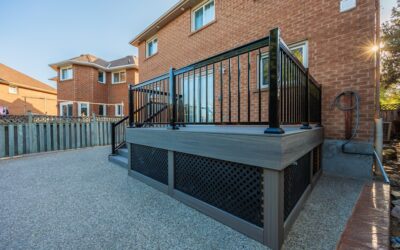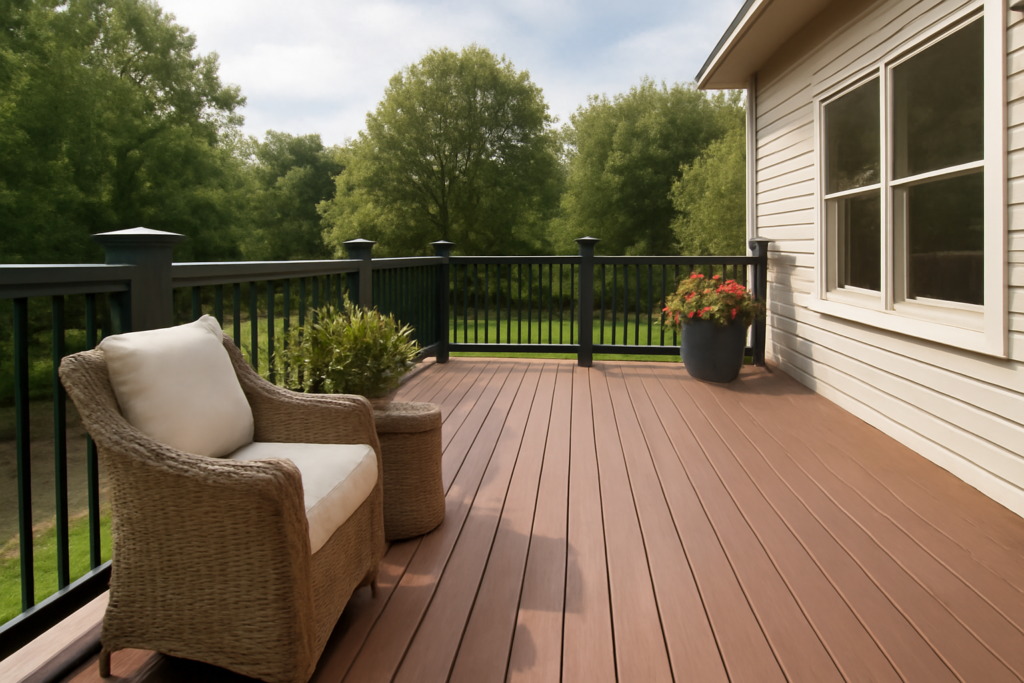
The railing often costs more than people expect, sometimes rivaling the deck boards themselves, but it is also the part you touch every day and see from the yard. Trex deck railing systems have become the default upgrade for composite decks because they resist rot, never need painting, and match the color and grain of Trex boards. If you have already committed to a low-maintenance composite deck, matching it with a coordinated Trex railing keeps the whole thing looking finished for decades.
Part of our Decks & Outdoor guide — explore the full guide →
Trex sells several distinct railing lines at different price points, and the right one depends on your view, your budget, and how much assembly you want to tackle. Here is how they compare.
- The Trex Railing Lineup
- Infill Options: Choosing What Fills the Space
- Code Requirements You Cannot Skip
- Post Spacing and Structure
- Installation: DIY or Hire Out
- Matching Railing to Your Decking
- Stair Railing Considerations
- Cleaning and Maintenance
- Warranty and Long-Term Value
- Trex Composite Railing vs Aluminum and Cable: Choosing Among Trex Railing Options
The Trex Railing Lineup
Trex organizes its railings into a handful of families, from premium to value:
Trex Transcend
The flagship line. Transcend offers the widest color range, the beefiest components, and options for composite balusters, round or square aluminum balusters, or glass and cable infill. It carries a substantial look with a large top rail and pairs seamlessly with Transcend decking. This is the premium choice at roughly $50 to $70 per linear foot installed.
Trex Select
A streamlined mid-tier system with fewer color choices but the same durability. Select uses a cleaner, slightly smaller profile and is a popular value-to-quality sweet spot at about $40 to $55 per linear foot installed.
Trex Enhance
The budget-friendly composite line, designed to coordinate with Enhance Basics and Naturals decking. It keeps costs down while still delivering the no-paint, no-rot benefits, generally $30 to $45 per linear foot installed.
Trex Signature
An all-aluminum premium system built for maximizing views. Signature has the thinnest, strongest posts and rails, allowing wide spans and unobstructed sightlines, and it accepts cable, glass, or mesh infill. It is the top of the range, often $60 to $90 per linear foot installed, and is favored for decks with a lake, mountain, or ocean view.
Infill Options: Choosing What Fills the Space
The infill, the part between the top and bottom rails, sets the look and the price:
- Composite balusters: The most traditional and affordable, matching the deck color. Solid and private-feeling but block the view most.
- Round or square aluminum balusters: Slimmer than composite, they open up the view a bit while staying low maintenance and are the most popular upgrade.
- Cable rail (with Signature): Horizontal stainless cables nearly disappear, maximizing a view. More expensive and requires periodic tension checks.
- Glass: Tempered glass panels give the most unobstructed view and best wind block, at the highest cost and with regular cleaning to stay clear.
Code Requirements You Cannot Skip
Railings are life-safety components, and inspectors check them closely. The core rules under the International Residential Code:
- Height: Guardrails must be at least 36 inches tall on residential decks (some jurisdictions require 42 inches; commercial is 42).
- Baluster spacing: A 4-inch sphere must not pass through, so balusters sit no more than 4 inches apart on center.
- Load resistance: The railing must withstand a 200-pound concentrated load applied in any direction at the top rail.
- Required when: A guardrail is needed anywhere the deck surface sits more than 30 inches above grade.
Trex systems are engineered and tested to meet these loads when installed with the correct post spacing, which is why following the manufacturer’s post layout is not optional.
Post Spacing and Structure
Railing strength depends entirely on how the posts attach to the deck frame. Trex composite posts and aluminum posts must be mounted to solid blocking or the rim joist, not just the decking surface. The maximum span between posts is typically 6 feet for composite rail sections and can be wider for the aluminum Signature line, but always confirm against the specific product’s installation guide.
Trex offers post-mount hardware kits and sleeves that slide over a structural 4×4 or attach to a metal post base. Skipping proper blocking is the number one cause of a wobbly railing that fails inspection or, worse, gives way under a load.
Installation: DIY or Hire Out
A handy homeowner can install a Trex railing system, since the components are pre-engineered and mostly bolt or bracket together. The general sequence:
- Set and secure the posts to blocked rim joists, spaced per the guide and checked for plumb.
- Cut the top and bottom rails to length between posts.
- Install baluster spacers or infill brackets, then insert balusters.
- Secure rails to posts with the provided brackets and add post caps.
Plan on a full weekend for an average deck. The tricky parts are cutting rails square on angled or stair sections and keeping every post perfectly plumb. Stair rails, in particular, require careful angle cuts and are where many DIYers call in a pro.
Matching Railing to Your Decking
One of the biggest advantages of staying within the Trex family is color and profile coordination. Trex designs its railing lines to complement specific decking collections, so a Transcend railing in Classic White or Charcoal Black pairs cleanly with Transcend boards, and Select railing coordinates with Select decking. Mixing brands or lines can leave you with railing that clashes slightly in tone or texture against the deck surface.
Consider contrast as a design tool. A white railing against dark boards creates a crisp, traditional look, while a matched dark-on-dark scheme feels modern and recedes to emphasize the view. Aluminum balusters in black or bronze pair with almost any deck color and are the most popular upgrade because they slim down the sightlines. If you are unsure, order sample pieces; Trex and its dealers provide swatches so you can see finishes in your own daylight before committing to a full order.
Stair Railing Considerations
Stairs are where railing projects get complicated, and where many DIYers decide to hire out. Stair rails must follow the angle of the stringer, which means cutting rails and baluster connectors on a bevel and setting posts at the top and bottom of every run. Code requires a graspable handrail on stairs with four or more risers, and that handrail has its own height rule, generally 34 to 38 inches measured from the stair nosing.
Trex offers stair-rail kits and adjustable baluster brackets designed to pivot to the stair angle, which simplifies the geometry, but precise measuring is still essential. The posts at the bottom of a stair take significant load, so they must be blocked and bolted to the framing just like the deck-level posts. If your deck has multiple stair runs or an angled landing, budgeting for professional installation of the stairs alone, while you DIY the straight runs, is a sensible compromise.
Cleaning and Maintenance
The whole point of a composite or aluminum railing is escaping the sand-and-stain cycle of wood, but low maintenance is not no maintenance. Wash the railing once or twice a year with warm water, mild soap, and a soft brush to remove pollen, dirt, and the gray film that airborne grime leaves behind. For composite railing, avoid pressure washing above the manufacturer’s recommended PSI, since too much pressure can mar the surface and may void the warranty.
Aluminum railing simply needs a wipe-down, and its powder-coat finish resists fading for decades. Check the brackets and post connections annually and snug any hardware that has loosened through seasonal expansion and contraction. For cable-rail systems, inspect and adjust cable tension periodically, since cables can relax slightly over time and a sagging cable both looks bad and can fail the 4-inch-gap code check. This light upkeep keeps the railing looking new and code-compliant for the length of its warranty.
Warranty and Long-Term Value
Trex railing carries a 25-year limited residential warranty covering material defects and, on many lines, fade and stain resistance. That matches the decking warranty, so the whole assembly ages together. Unlike wood railing, which needs sanding, staining, or painting every two to three years, Trex railing asks only for an occasional wash with soap and water.
Weigh the upfront premium against decades of skipped maintenance. Over 15 years, a wood railing can eat hundreds of dollars in stain, brushes, and weekends; a Trex system just sits there looking the same. Choosing among the Trex deck railing systems comes down to how much you value your view, your finish preference, and your budget, but any of the four delivers the low-maintenance, code-compliant safety a good deck deserves.
Trex Composite Railing vs Aluminum and Cable: Choosing Among Trex Railing Options
Trex composite railing is offered across three tiers, Enhance, Select, and Transcend, while the cable, glass, and rod infill styles sit in the aluminum Signature family. If you want a railing that matches composite deck boards in color and texture, a composite line is the natural fit; if the priority is the view, the metal Signature options are the better route.
How the Composite Lines Differ
Trex Enhance railing is the entry point and is built to keep costs down and installation simple, which makes it a common choice for ground-level decks and rental properties. Select adds more profile choices, including a T-top rail and a classic rail style. Transcend is the most customizable composite line, with the heaviest-looking rails and the widest choice of finishes. Trex currently lists longer warranty coverage on Transcend than on Enhance and Select, so check the maker’s current warranty page for the exact term on the line you buy.
| Railing option | Material | Best suited to |
|---|---|---|
| Enhance composite | Composite | Budget builds, simple straight runs |
| Select composite | Composite | Mid-range decks wanting a cleaner rail profile |
| Transcend composite | Composite | Premium decks matched to high-end boards |
| Signature aluminum | Aluminum | Slim sightlines, wider post spans |
| Signature cable | Aluminum posts with stainless cable | Decks with a view worth preserving |
Is Trex Cable Railing Right for Your Deck?
Trex cable railing runs horizontal cables between aluminum posts, so it nearly disappears from a seated position. It suits elevated decks facing water, hills, or open yards. It is less suited to homes with young children who might treat horizontal cables as a ladder, and some local inspectors look closely at cable deflection, so confirm the system is accepted in your area before ordering.
Mixing Composite and Metal
A popular middle ground is a composite top and bottom rail with slim aluminum balusters, which keeps the warm composite look at hand height while opening up the view. Whatever combination you choose, buy posts, rails, brackets, and infill from the same line, because components are engineered and load-tested as a system and parts from different lines may not fit or meet the same rating.
- Pick composite if matching the deck boards matters most.
- Pick aluminum or cable if the view matters most.
- Order samples to compare colors in your own daylight.