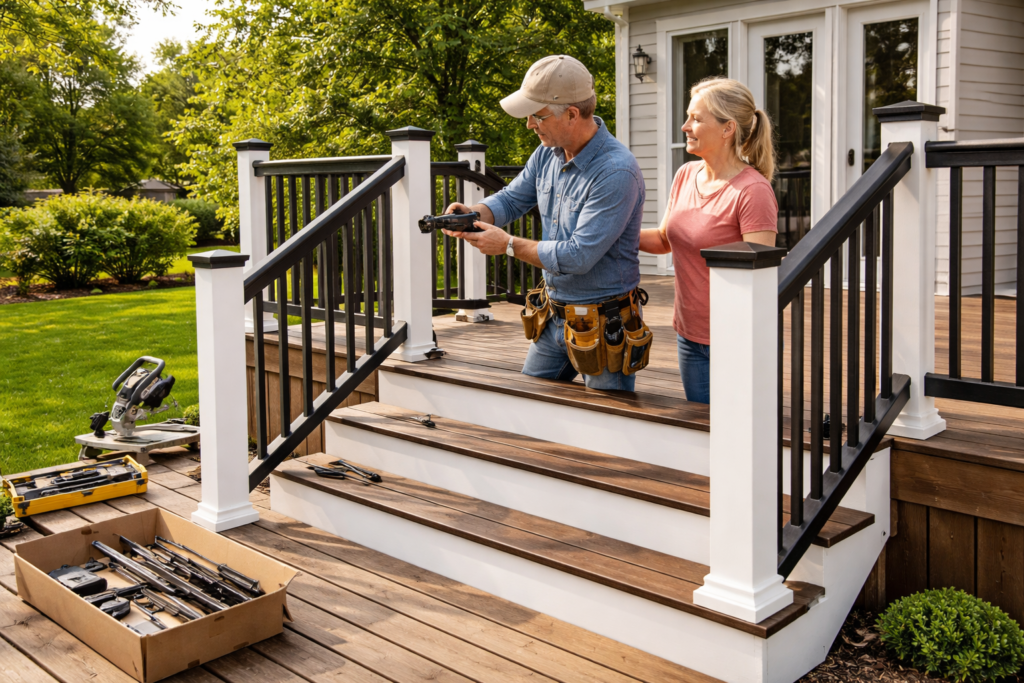
Stairs are where most composite railing jobs go wrong. Rails that fit perfectly on a level deck come up short on a slope, posts end up at the wrong height, and the finished top rail may not satisfy the inspector as a handrail. Trex stair railing solves most of this with dedicated stair kits and stair brackets, but you still need to plan post spacing around the stair angle rather than the nominal 6 or 8 foot kit length.
Part of our Stairs & Stair Flooring guide — explore the full guide →
The short version: the brand sells stair versions of its Transcend, Select and Enhance railing, plus stair adapters for cut rails and a separate aluminum ADA-compliant handrail for places where a graspable rail is required. The Transcend installation instructions call for rails set at an angle of 32 to 37 degrees, and they warn against spacing stair posts at a full 6 or 8 feet because the rail will be too short.
- Trex Stair Railing Options at a Glance
- Understanding Stair Angles
- Graspable Handrails and Code Height Notes
- Choosing a Trex Stair Railing Line
- Tools and Materials
- Installation Notes Step by Step
- Safety on Stairs and Ladders
- Troubleshooting
- General Cost Ranges
- When to Call a Pro
- Frequently Asked Questions
Trex Stair Railing Options at a Glance
These details come from the manufacturer’s railing product pages and installation guide. Kit names, colors and availability can change by year and retailer, so confirm with the current catalog before ordering.
| Line | Stair options | Heights | Warranty |
|---|---|---|---|
| Transcend (composite) | 6 ft and 8 ft stair kits; composite square or round aluminum balusters | 36 in and 42 in | 35-year limited residential |
| Select (composite and aluminum) | Classic and T-Rail kits sold as horizontal/stair; separate mesh stair kits | 36 in and 42 in | 25-year limited residential |
| Enhance (composite and steel) | Cut rails with stair bracket adapters | Check retailer listing | 25-year composite, 15-year steel |
| Signature (aluminum, glass, mesh, rod rail) | 6 ft and 8 ft stair rail kits, stair mesh and rod rail kits, stair brackets | Per system | 50-year |
| ADA-compliant handrail (aluminum) | Graspable rail with angled elbows for stairs | Mounted per local code | See product documentation |
Transcend Stair Kit Details
- Rail lengths: the 6 ft kit has an actual rail length of 67.5 inches and the 8 ft kit 91.5 inches.
- Balusters per stair kit (per the installation guide): 6 ft uses 11 composite or 13 round aluminum balusters; 8 ft uses 15 composite or 17 round aluminum.
- Colors: Classic White, Charcoal Black and Vintage Lantern, though the manufacturer lists the 6 ft composite stair kit in Classic White only.
- Top rail profiles: Crown Top Rail, or the Universal Top/Bottom Rail.
Understanding Stair Angles
The Transcend installation instructions specify a rail angle of 32 to 37 degrees. That range matches typical residential deck stairs: a 7 inch rise over an 11 inch run produces roughly 32 degrees, and a 7.5 inch rise over a 10 inch run produces about 37 degrees. Steeper stairs fall outside the range, and the brackets may not seat correctly.
How to Check Your Stair Angle
- Measure the rise (height) and run (depth) of a typical step.
- Divide rise by run. A ratio of 0.62 to 0.75 falls roughly within 32 to 37 degrees.
- Or hold a digital angle finder or a post level with an angle gauge on a straightedge laid across the stair nosings.
- Check several steps; uneven risers are a code issue in their own right and should be fixed before railing goes on.
Why Post Spacing Is Shorter on Stairs
A rail kit is cut to length along the slope, but posts are measured horizontally. On a 35 degree stair, a 91.5 inch rail covers only about 75 inches of horizontal distance. If you set posts 8 feet apart horizontally, the rail cannot reach. Calculate the horizontal post-to-post span from the rail length and your measured angle before you set any posts: horizontal span equals rail length multiplied by the cosine of the angle, minus the bracket and post allowances in the instructions.
Graspable Handrails and Code Height Notes
Many people search for trex hand railing because their inspector said the deck rail on the stairs is not a handrail. Guards and handrails are different things in residential codes:
- Guard: the railing that keeps people from falling off the side. On stairs it commonly needs to be at least 34 inches high measured vertically from the line of the nosings, with openings small enough to stop a 4 inch sphere (stair triangles have their own allowance).
- Handrail: the rail you actually grip. Codes commonly require it between 34 and 38 inches above the nosings, continuous for the flight, and with a graspable shape and size.
A wide composite top rail can serve as the guard but may not meet graspability rules for the handrail. That is where the brand’s aluminum ADA-compliant handrail comes in. The manufacturer lists it in Charcoal Black, Bronze and Classic White, with wall mounts, inside corner mounts, end caps and angled elbows (including 31, 34 and 36 degree and an adjustable 90 degree) for stair transitions. It is designed to work with Signature, Transcend and Select railing. Your local building department decides what counts as compliant, so ask before you buy.
Choosing a Trex Stair Railing Line
The right line depends on your budget, how the stairs will be used and what is already on the deck. If the level deck railing is Transcend, keep the stairs in Transcend so the top rail profile, colors and balusters match. Select is the mid-priced choice with fewer color combinations, and its Classic and T-Rail kits are sold for both level and stair use, which keeps ordering simple. Enhance is the budget composite and steel option, handled on stairs with cut rails and stair bracket adapters. Signature aluminum suits modern homes, glass, mesh or rod infill, and the longest warranty in the lineup.
- Matching an existing deck: stay in the same line and color.
- Short stair runs of three to five steps: a single stair kit between two posts often covers it.
- Long flights: plan an intermediate post and possibly a landing; codes limit how tall one flight can be.
- Kids, older adults or heavy traffic: add the graspable handrail even where it is not strictly required.
Whatever you choose, trex stair railing parts are line-specific. Brackets, gaskets and adapters from one line generally do not fit another, so order everything for the stairs from the same system.
Tools and Materials
- Stair rail kit(s) in the correct height and baluster style
- Post sleeves long enough for stair posts (the instructions note that a post and sleeve longer than 39 inches is often needed at the lower stair post)
- Stair mounting hardware or stair bracket adapters for cut rails
- Pressure-treated 4×4 posts, structural screws or bolts rated for treated lumber
- Post level, angle finder, tape measure, speed square
- Miter saw with a fine-tooth blade for composite
- Drill/driver, clamps, pencil and a helper
Installation Notes Step by Step
- Read the current installation guide for your exact line. Bracket designs differ between Transcend, Select and Enhance.
- Measure the stair angle and confirm it falls within the range the guide allows.
- Calculate post spacing along the horizontal, never using the nominal 6 or 8 ft length.
- Install posts securely to the stringers or framing with blocking as the instructions show. A wobbly stair post is the most common failure point.
- Set post heights so the top of the PT post and the post sleeve end flush, as the guide calls for.
- Plumb each sleeve with a post level on two adjacent faces.
- Cut rails to length at the stair angle. Make a test cut on scrap and dry-fit before cutting the real rail.
- Attach brackets and stair adapters, then set the rails and balusters with the spacers provided, using the correct spacers for round aluminum balusters.
- Add the graspable handrail if your code or inspector requires one.
- Check every rail by pushing firmly at the middle and the top of each post.
Safety on Stairs and Ladders
Stair railing work means kneeling and leaning on slopes, often with an unprotected edge. Keep the work area clear, wear shoes with good grip, and never lean on a partly installed rail. If you use a step ladder on or beside the stairs, place it on firm, level ground, never on a stair tread, and keep three points of contact. For stairs that rise more than one story, or decks on second-floor levels, use scaffolding or hire a pro.
Troubleshooting
Rail too short between posts. Posts were spaced using the nominal kit length. Move the lower post or add an intermediate post; do not splice rails.
Balusters not plumb. The rail angle and stair angle do not match. Re-measure and adjust bracket positions.
Lower post too short. Use a longer post and sleeve. The 39 inch sleeves sold for level runs often are not enough at the bottom of a stair.
Inspector rejected the handrail. Add a separate graspable handrail, mounted at the required height along the full flight.
Rail flexes. Check post attachment first. Most flex comes from the post connection, not the rail.
General Cost Ranges
Stair rail kits usually cost more per foot than level kits because of extra brackets and hardware. As a rough national guide, composite stair railing materials often run about $30 to $90 per linear foot, and professionally installed composite railing commonly falls around $60 to $150 per linear foot depending on line, height and baluster style. Graspable aluminum handrail, post sleeves and lighting add to that.
When to Call a Pro
Call a licensed deck builder for new stairs, rebuilt stringers, raised decks, or any job where a permit is required. A pro can also handle the angle math and post blocking, and will know what your local inspector expects for handrail height and graspability.
Frequently Asked Questions
What stair angle do Trex stair rail kits fit?
The Transcend installation instructions call for rails set at 32 to 37 degrees. Check the guide for your specific line, since bracket designs differ.
Can I space stair posts 8 feet apart?
No. The manufacturer warns that stair posts set at a 6 or 8 ft span leave the rail too short. Calculate horizontal span from the rail length and stair angle.
Is the composite top rail a code-compliant handrail?
Often not. Many jurisdictions require a separate graspable handrail. The brand’s aluminum ADA-compliant handrail is designed for that purpose.
What height should a stair handrail be?
Codes commonly require 34 to 38 inches measured vertically from the stair nosings. Confirm with your local building department.
Do stair kits come in every color?
Not always. For example, the 6 ft Transcend composite stair kit is listed in Classic White only, while other kits come in more colors.