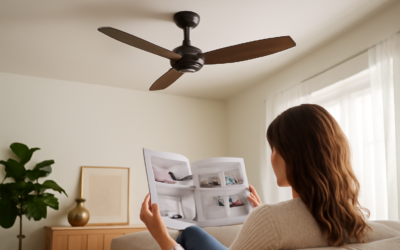
Walk into a lighting showroom and the sleek two blade fans catch your eye, but the first question everyone asks is whether they move enough air. A two blade ceiling fan looks modern and minimal, and thanks to today’s motors it can push serious airflow despite having fewer blades than a traditional four or five blade model. Understanding what a two blade ceiling fan does well, and where it falls short, helps you decide if it fits your room. This guide covers airflow, motor types, room fit, and what to look for.
How Blade Count Affects Airflow
The old assumption that more blades mean more air is only half true. Airflow is measured in cubic feet per minute, or CFM, and it depends on blade pitch, motor power, blade shape, and RPM far more than on the raw number of blades. A well-designed two blade fan with an efficient motor can match or beat a cheap five blade fan.
Fewer blades create less drag on the motor, so a two blade fan can spin faster and often uses less energy for the same air movement. The tradeoff is that fewer blades can move air in a more concentrated stream rather than a broad, gentle wash, which changes how the breeze feels beneath it. Blade count is a design and feel choice as much as a performance one.
The Motor Makes the Difference
With only two blades, the motor carries more of the workload, so the motor type matters even more than usual. Most premium two blade fans use a DC motor rather than the older AC style. DC motors are the reason modern low-blade fans perform:
- Energy use: a DC motor draws up to 70 percent less power than a comparable AC motor.
- Speed range: DC fans typically offer six speeds versus three on AC, so you can dial in a whisper or a strong breeze.
- Quiet operation: DC motors run smoother and quieter, which suits bedrooms.
- Reverse function: most DC fans reverse at the push of a button for winter updraft mode.
If you are shopping for a two blade fan, prioritize a DC motor. It is the single feature that lets fewer blades deliver comfortable airflow without noise or high energy bills.
Where a Two Blade Fan Fits Best
Two blade fans shine in the right setting. Their clean, propeller-like profile suits modern and contemporary rooms where a bulky five blade fan would clash. They work especially well in bedrooms, home offices, and living rooms with a minimalist design where the fan is meant to be a visual statement as much as a cooling tool.
Room size still matters. For a small to medium room up to about 225 square feet, a two blade fan with a 44 to 52 inch span moves plenty of air. In a large great room or an open-concept space, you want a larger diameter or higher CFM rating, and you should check that the specific fan is rated for the square footage rather than assuming two blades will keep up in a big room.
Reading the Airflow Rating
Do not shop on blade count; shop on CFM. The CFM figure tells you how much air the fan actually moves, and it is printed on the box and spec sheet. As a rough benchmark, a good fan moves 4,000 to 5,000 CFM on high for a medium room, and strong performers exceed 6,000 CFM.
Also look at the efficiency rating, listed as CFM per watt, which tells you how much air you get per unit of energy. A two blade DC fan often scores well here because the motor sips power. If a two blade fan you are considering lists a low CFM under 3,000, it may be built more for looks than for real cooling, so match the number to your room rather than the styling. Blade pitch is part of that story too, since a steeper pitch of 12 to 15 degrees moves more air per rotation than a shallow, flat blade, and the best two blade fans pair a strong motor with a well-pitched airfoil rather than relying on speed alone.
Sizing and Placement
Getting the size and mounting height right determines how the fan performs and feels. Blade span should scale with the room. A general guide:
- Up to 75 sq ft: 29 to 36 inch span.
- 76 to 144 sq ft: 36 to 44 inch span.
- 145 to 225 sq ft: 44 to 52 inch span.
- Over 225 sq ft: 52 inches or larger, or consider two fans.
Mount the fan so the blades sit at least 7 feet above the floor for safety and 8 to 9 feet for the best airflow, with a minimum of 18 inches from the blade tips to the nearest wall. On a high or sloped ceiling, use a downrod to bring the fan into that ideal height range rather than hugging it to the ceiling.
Balance and Wobble
A common worry with two blade fans is wobble, since there are fewer blades to distribute weight. Quality two blade fans are precision-balanced at the factory and run smoothly, but any fan can develop a wobble from a loose mount or dust buildup. A wobbling fan is usually a mounting or balance issue, not a design flaw.
To keep it steady, mount the fan to a fan-rated electrical box anchored to a joist or brace, never to a standard light box. Tighten all connections, keep the blades clean, and use a balancing kit if a slight wobble appears over time. Because the fan hangs overhead and involves wiring, if your ceiling box is not rated to support a fan, have an electrician install a proper fan brace before mounting.
Pros, Cons, and Cost
Two blade fans carry clear advantages and a few tradeoffs. On the plus side they look striking, often run quieter and more efficiently with a DC motor, and can move air in a focused stream. On the downside, the concentrated airflow can feel less like a broad breeze, and cheaper models without a strong motor genuinely underperform.
Price ranges widely. A budget two blade fan runs about 100 to 200 dollars, a solid DC-motor model with a remote and light kit lands around 250 to 500 dollars, and designer fans climb past 600 dollars. Spend the extra for the DC motor and a verified CFM rating rather than the lowest sticker, since that is where the real performance lives.
Is It Right for You?
A two blade ceiling fan is a strong choice if you want a modern look and you buy one with a capable DC motor sized correctly for your room. It is not the pick if you need maximum air movement in a very large space on a tight budget, where a larger multi-blade fan gives more airflow per dollar. Match the CFM to your square footage, prioritize the motor, and confirm the fan model’s specs on the manufacturer’s page before you buy, since blade design and ratings vary by model.
Handled that way, a two blade fan delivers real comfort and a clean design statement at the same time. The days when fewer blades automatically meant weaker performance are behind us, thanks to the motors doing the work above those two sleek blades.
Do not overlook the winter side of the equation, since a good ceiling fan works year-round. Most quality two blade fans reverse direction, and running the blades clockwise on low in winter pushes the warm air that collects near the ceiling gently back down along the walls without creating a chill. That simple switch can make a room with high ceilings feel warmer and let you ease off the thermostat a degree or two. Look for a fan with an easy reverse control, ideally on the remote or wall unit rather than a hard-to-reach switch on the motor housing, so you actually use the feature when the seasons change.
Controls and lighting round out the buying decision. Many two blade fans include an integrated LED light kit, which suits a bedroom or living room that needs ambient light, though a purist minimalist look sometimes skips the light for a cleaner profile. Decide whether you want a pull chain, a wall control, a handheld remote, or smart-home integration that ties the fan into an app or voice assistant. A DC-motor fan almost always comes with a remote because the six-speed motor needs electronic control, which is a nice convenience but also means keeping track of the remote or wiring in a compatible wall unit. Confirm the specific model’s features on the manufacturer’s page before buying, since blade design, CFM, and included controls all vary from one fan to the next.