The difference between an epoxy bond that holds for years and one that stays gummy forever usually comes down to one thing: the mix ratio. A two part epoxy dispenser takes the guesswork out of combining resin and hardener, delivering both components at the exact proportion the chemistry demands so the epoxy cures hard, strong, and predictable. Whether you are gluing a loose stair tread, filling a crack in a concrete floor, or repairing subfloor damage, the right dispenser saves epoxy, prevents mixing errors, and keeps waste to a minimum. Here is how the different systems work and which one fits your job.
Part of our Epoxy, Concrete & Garage Floors guide — explore the full guide →
Why Ratio Accuracy Matters
Two-part epoxies cure through a chemical reaction between the resin and the hardener. If the ratio is off, the reaction is incomplete: too much hardener and the epoxy gets brittle, too little and it stays soft or tacky and never reaches full strength. Some epoxies mix 1:1 by volume, others 2:1, 4:1, or even 5:1, and the tighter the required ratio, the more a dispenser pays off. Hand-measuring a 5:1 structural epoxy with cups invites error; a proper dispenser meters it automatically every pull.
The Main Types of Dispensers
Dispensers scale with the size of the job, from a single dab of adhesive to gallons of coating. These are the systems you will run into:
- Dual-barrel syringe: the familiar plunger-style applicator seen with products like J-B Weld and Gorilla two-part epoxy. Press the plunger and both parts extrude side by side. Best for small repairs and household bonding.
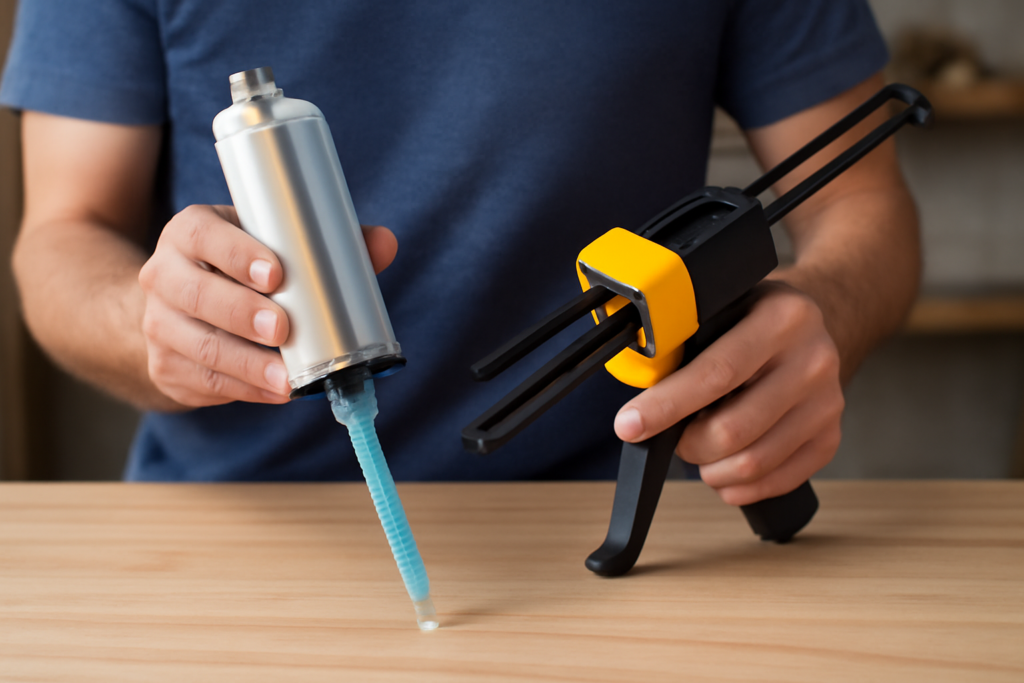
- Static mixing nozzle cartridge: a dual cartridge loaded into a manual or pneumatic caulk-style gun, topped with a helical mixing nozzle that blends the two parts as they pass through. No hand mixing needed. Common for structural adhesives and crack injection.
- Manual pump dispensers: paired push-down pumps on gallon and quart kits that dispense a metered shot of resin and hardener per stroke. Popular with coating and casting epoxies.
- Meter-mix machines: shop-grade equipment that pumps, ratios, and mixes large volumes continuously for production work and large floor coatings.
Dual Syringes for Small Repairs
For most homeowners, the dual-barrel syringe is the workhorse. Both chambers empty at the same rate, so squeezing out a bead gives you a perfect 1:1 mix that you then blend on a scrap surface. These are ideal for reattaching a loose baseboard, filling a small gouge, or bonding metal to concrete. The catch is that the tip can clog between uses as leftover epoxy cures in the nozzle, so wipe it clean and cap it. A syringe kit costs $5 to $12 and handles dozens of small jobs.
Cartridge Guns and Mixing Nozzles
For flooring repairs that need volume and strength, the dual-cartridge system with a static mixing nozzle is the pro choice. You load a side-by-side cartridge into a dispensing gun, thread on a disposable helical nozzle, and squeeze; the resin and hardener spiral through the nozzle’s internal baffles and come out fully mixed. This is how contractors inject epoxy into concrete cracks and set anchor bolts. The system eliminates hand mixing and its mess, though nozzles are single-use once epoxy sets inside them. Keep spare nozzles on hand, because you replace one every time the epoxy cures mid-job or you pause too long.
Using a Dispenser Correctly
- Read the working time. Every epoxy has a pot life, from five minutes to over an hour. Match your dispensing speed to it and only mix what you can place in time.
- Prime the dispenser. Extrude a small amount onto scrap first to purge air pockets and confirm both parts are flowing evenly.
- For nozzle systems, discard the first inch or two, since the initial pass may not be fully blended.
- Dispense steadily and apply within the pot life; do not stop and restart a cartridge repeatedly, as epoxy will cure in the nozzle.
- Clean the tip immediately on reusable syringes, or leave the used nozzle on a cartridge as a temporary cap until the next job.
Common Mistakes
The most frequent error is ignoring pot life and mixing far more than you can use, so half the batch hardens in the cup. Another is failing to purge the syringe, which lets an air gap throw off the ratio at the start of the bead. People also reuse a mixing nozzle that has already set, which delivers unmixed or partially cured epoxy. And storing dispensers uncapped invites clogging. A quick habit of extruding a test bead before every use catches ratio problems before they ruin a repair.
Storage, Shelf Life, and Safety
Epoxy is only reliable if the components are still good, so storage matters more than most people realize. Keep resin and hardener tightly capped in a cool, dry place out of direct sunlight, ideally between about 60°F and 80°F. Cold thickens the components and makes them hard to dispense evenly, while heat can shorten shelf life and, in dual cartridges, cause slow curing inside the tube. Most two-part epoxies carry a shelf life of one to two years unopened; once opened, use them within the window the manufacturer states, since moisture and air slowly degrade the hardener.
Watch for warning signs of expired product. Resin that has crystallized, hardener that has turned dark amber or cloudy, or a mix that will not cure fully all point to material that is past its prime. When in doubt, do a small test bond on scrap and let it cure before trusting it on a real repair. For dispensers, store dual syringes with the cap on and cartridges with a used nozzle left in place as a plug so the tips do not harden shut.
Safety deserves attention too. Uncured epoxy resin and hardeners can irritate skin and cause sensitization with repeated exposure, so wear nitrile gloves, work in a ventilated space, and avoid skin contact even when the material seems harmless, because sensitivity builds over time. Keep isopropyl alcohol or the manufacturer’s recommended cleaner on hand to wipe up uncured spills, and never use solvents on skin. Dispose of mixed leftovers only after they have fully cured into a solid, inert block, which is safe for normal trash.
Choosing the Right One for Your Project
Match the dispenser to the volume and the ratio. For occasional household fixes and small bonds, a 1:1 dual syringe is cheap and foolproof. For repeated structural repairs, crack injection, or anchoring, invest in a cartridge gun and keep a box of nozzles. For coating a whole garage floor, use the manufacturer’s metered pump kit or rent a meter-mix unit rather than fighting with syringes. Always confirm the dispenser matches your epoxy’s ratio, since a 1:1 tool cannot correctly meter a 2:1 product.
A quality two part epoxy dispenser is a small investment that pays back in stronger bonds, less wasted product, and cleaner work. Pick the type that matches your job size, respect the pot life, and purge before you apply, and you will get the full engineered strength the epoxy is capable of every single time.