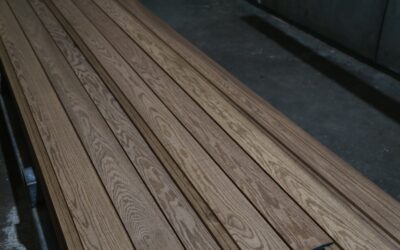
The most common laminate flooring failures, hollow clicking sounds, peaking seams, and buckled boards, almost never start with the laminate itself. They start with what’s under laminate: the subfloor, the moisture barrier, and the underlayment pad. Get those layers right and a click-together floor feels solid and quiet for 20 years. Get them wrong and even premium planks will telegraph every flaw beneath them.
The Layers Beneath a Laminate Floor
Laminate is a floating floor, which means the planks lock to each other but not to the subfloor. That design only works when the layers underneath are flat, dry, and properly cushioned. From the bottom up you have the subfloor, often a vapor barrier, then underlayment, and finally the laminate. Each layer does a specific job, and skipping one is where homeowners get into trouble.
Subfloor Prep Comes First
No underlayment can fix a bad subfloor. The single most important spec is flatness: most laminate manufacturers require the floor to be within 3/16 inch over a 10-foot span. Lay a long straightedge across the room and mark the high and low spots.
- Low spots: fill with a cementitious self-leveling compound.
- High spots: grind down concrete or sand high plywood seams.
- Squeaks and movement: screw loose subfloor panels down to the joists before you start.
The subfloor also has to be clean and dry. Sweep and vacuum thoroughly, because even small debris under a floating floor creates lumps you’ll feel through your socks for years.
The Moisture Barrier Question
Moisture is laminate’s enemy, and the rules depend on your subfloor. Over a concrete slab, including any below-grade basement, you almost always need a 6-mil polyethylene vapor barrier to stop slab moisture from wicking up and swelling the planks. Tape the seams and run the film a few inches up the wall.
Over wood subfloors on the main or upper floors, a vapor barrier is usually unnecessary and can even trap moisture in the wrong direction. Always run a calcium chloride or moisture-meter test on concrete first; if readings are high, address the source before flooring goes down.
Choosing the Right Underlayment
Underlayment is the thin foam or felt pad that goes directly under the planks. It cushions footsteps, smooths minor imperfections, dampens sound, and gives the click-lock system room to flex. Common types include:
- Standard foam: the budget choice, usually 2 to 3mm thick. Fine for upper-floor wood subfloors in dry rooms. Roughly $0.20 to $0.40 per sq ft.
- Combination foam with attached vapor barrier: a 3-in-1 product that adds a film layer, ideal over concrete. Around $0.30 to $0.60 per sq ft.
- Cork: excellent sound absorption and a firmer feel underfoot. Naturally antimicrobial, but pricier at $0.50 to $1.00 per sq ft.
- Premium acoustic pads: rated for high IIC and STC sound scores, important in condos and second floors.
A critical rule: never double up underlayment to make a floor feel softer. Too much cushion overflexes the locking joints and causes them to fail.
Attached Pad vs. Separate Roll
Many mid- and high-end laminates ship with a pre-attached pad on the back of each plank. If yours does, do not add a second separate underlayment, except sometimes a standalone vapor barrier over concrete. Stacking pads is one of the most common DIY mistakes and voids many warranties. Check the box; the manufacturer spells out exactly what’s allowed underneath.
Installation Tips for the Under Layers
When you roll out underlayment, butt the edges together rather than overlapping them, and tape the seams with the manufacturer’s recommended tape. Overlapped seams create ridges. Work in sections just ahead of your laminate so you don’t crush or shift the pad as you go.
Leave a 1/4 to 3/8 inch expansion gap around the entire perimeter of the room, including doorways and pipes. Laminate expands and contracts with humidity, and crowding it against the wall is the leading cause of buckling. Cover the gap later with baseboard or quarter-round.
Acclimation Matters Too
Before anything goes under laminate and the planks lock together, let the flooring sit in the room for 48 hours, still in its boxes, so it adjusts to your home’s temperature and humidity. Installing cold or freshly delivered planks invites gapping in winter and peaking in summer. Keep the room between 60°F and 80°F during install and for the first few days after.
Going Over Existing Floors
One of laminate’s appeals is that it can often float over an existing hard floor, saving you a tear-out. You can usually install over vinyl, tile, or hardwood as long as the surface is flat, solid, and clean. Never install laminate over carpet, though; the soft, uneven backing flexes the locking joints and destroys them. Over existing tile, fill any deep grout lines that exceed the flatness tolerance so the planks don’t dip into them. When going over an old floor, you still need the correct underlayment, and over a slab you still need the vapor barrier underneath.
Underlayment for Sound Control
If you’re installing laminate on an upper floor or in a condo, sound transmission to the room below matters, and the right pad makes a real difference. Look for underlayment with high IIC (impact insulation class) and STC (sound transmission class) ratings, which measure how well it muffles footsteps and noise. Cork and premium acoustic foams outperform basic foam here. Some condo associations actually require a minimum acoustic rating, so check your building’s rules before you buy. The pad that quiets the floor also makes it feel more solid and comfortable underfoot.
Final Thoughts
A laminate floor is only as good as the layers you can’t see. Flatten and dry the subfloor, add a vapor barrier over concrete, choose the right single underlayment, and respect the expansion gap. Those unglamorous steps are exactly what separate a floor that feels solid and silent from one that clicks, peaks, and disappoints. Spend your attention down low, and the surface takes care of itself.
Prefer to explore on your own?
See how new flooring looks in your actual room in seconds — free, no signup.
Try the free Floor Studio →