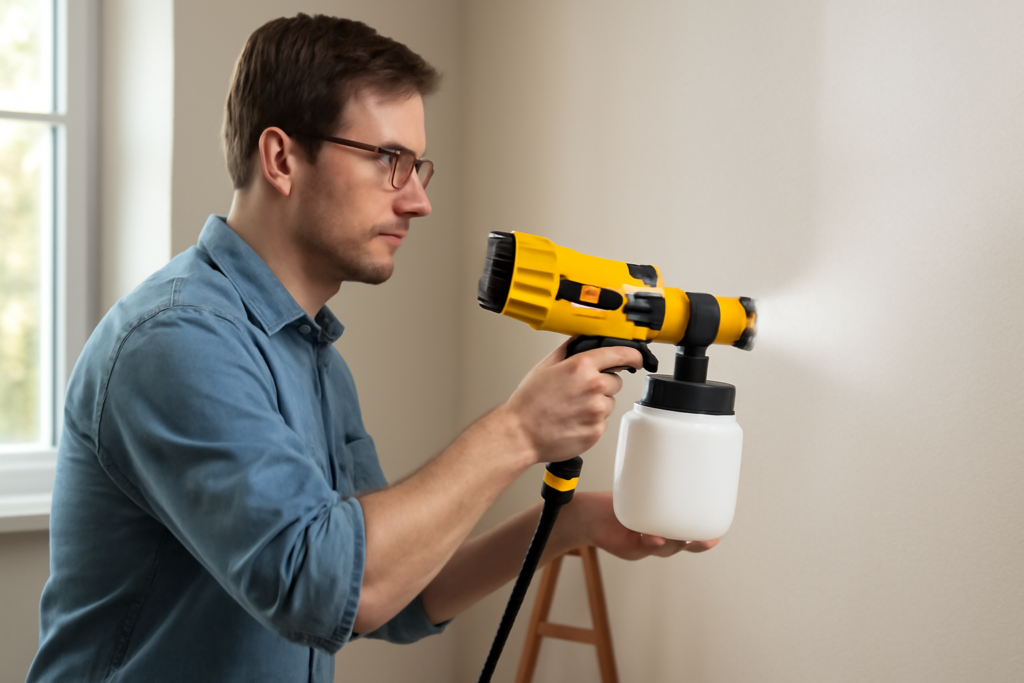
If you’ve priced out a Graco or Titan and choked on the sticker, a Vevor paint sprayer is the budget alternative that keeps showing up in cart comparisons. Vevor undercuts the big names by a wide margin — you can get into an airless unit for $130 to $300 where the premium brands start north of $400. The question every DIYer asks is whether the cheaper sprayer actually lays down a decent finish. Having run a few of these on fences, cabinets, and interior walls, I’ll tell you exactly where they shine and where they don’t.
What Vevor Sells
Vevor is a Chinese direct-to-consumer brand that stocks tools across dozens of categories, and their paint sprayers fall into three families:
- Airless sprayers: A piston pump pushes paint through a tip at high pressure (up to about 3,000 PSI) with no air needed. Best for large areas — fences, siding, walls, decks. Flow rates typically run 0.24 to 0.32 gallons per minute (GPM).
- HVLP sprayers: High-volume, low-pressure units that atomize paint with a turbine. Gentler, more controllable, less overspray — the choice for cabinets, doors, and trim where finish quality matters most.
- Handheld electric sprayers: Cheap all-in-one guns with a built-in cup, good for small projects and touch-ups.
For most homeowners the decision is airless for big square footage, HVLP for fine finish work. Vevor makes both at roughly half the price of the premium brands.
Airless Models and Specs
Vevor’s airless lineup centers on units in the 1/2 HP to 1 HP range. A common mid-tier model pushes around 0.30 GPM at up to 3,000 PSI, supports tips up to about 0.021 inches, and can handle a 50-foot hose so you spray without dragging the machine around. Some feed directly from a 5-gallon bucket, which is a real convenience on a full-house exterior.
At 3,000 PSI these will spray unthinned latex, which HVLP units struggle with. Expect to cover a standard exterior wall two to three times faster than with a brush and roller. The trade-off is overspray — airless throws a lot of paint into the air, so mask aggressively and don’t spray on a windy day.
HVLP Models and When to Use Them
The HVLP turbine units run 400 to 700 watts and atomize at low pressure, which means far less bounce-back and a glass-smooth finish on the right material. This is what you want for kitchen cabinets, interior doors, and furniture where a flawless coat justifies slower work.
HVLP guns are pickier about viscosity. Thick latex often needs thinning 10 to 20 percent with water to flow through the smaller nozzle, and even then it’s slower than airless. Use HVLP for stain, lacquer, thinned latex, and enamel — not for blasting a whole fence.
Choosing the Right Tip
Tip size decides your finish more than horsepower does. The tip number tells you two things: fan width and orifice size. On a 517 tip, the “5” means a 10-inch fan at 12 inches from the surface, and “17” means a 0.017-inch orifice.
- 0.011 to 0.013: Stains, lacquers, thin finishes.
- 0.015 to 0.017: Interior latex, trim, cabinets.
- 0.019 to 0.021: Thick exterior latex, elastomeric, primers.
Match the tip to the coating. Too small and thick paint clogs; too large and you flood thin coatings into runs. Vevor sprayers accept standard reversible tips, so you can buy Graco-pattern tips if the included ones wear out — a genuine advantage, since tips are consumables that dull after 40 to 60 gallons.
Thinning and Prep
Good spraying is mostly good prep. Strain your paint through a mesh filter every time — a single dried fleck will clog the tip mid-pass and ruin a wall. For airless with the right tip you usually spray latex straight from the can, but if the pump strains or the fan pattern tails off, thin 5 to 10 percent with water.
Test your pattern on cardboard before you touch the wall. You want an even, cigar-shaped fan with no heavy edges or fingers. Fingers at the ends of the pattern mean the tip is worn or pressure is too low. Hold the gun 10 to 12 inches from the surface, keep it perpendicular, and move at a steady pace — arcing your wrist puts thick paint in the middle and thin at the edges.
Getting a Professional Finish
Technique separates a smooth wall from an orange-peel mess:
- Keep the gun parallel to the surface and move your whole arm, not just your wrist.
- Overlap each pass by 50 percent so you never leave a light stripe.
- Trigger the gun just before the pass starts and release just after it ends — never start or stop over the surface.
- Two thin coats beat one thick coat every time; thick coats sag and run.
- Back-roll the first coat on porous surfaces like fresh drywall to work paint into the texture.
A Vevor paint sprayer can absolutely deliver a finish that rivals the premium brands once you’ve dialed in pressure and tip. The machine isn’t the limiting factor at this level — your prep and hand speed are.
Cleaning and Maintenance
This is where cheap sprayers die young, and it’s entirely preventable. Flush the pump immediately after every job — dried paint in the piston or hose is what kills these units. For latex, run clean water through until it runs clear, then pump a storage fluid or mineral-spirits substitute through to lubricate the seals. For oil-based coatings, flush with mineral spirits.
Pull and clean the tip and the inlet screen each time. Once a season, check the packing seals and O-rings; Vevor sells replacement seal kits cheaply, and swapping a worn seal beats buying a new pump. Store the unit with fluid in the pump, not air, so the seals don’t dry and crack.
Troubleshooting Common Problems
Budget airless sprayers throw the same handful of problems, and every one has a quick fix:
- Spitting or pulsing: Air in the pump. Re-prime the unit, check the inlet screen for a clog, and make sure the suction tube isn’t sucking air at a cracked seal.
- Won’t build pressure: Usually a stuck inlet or outlet check valve. Tap the valve gently while priming, or open and clean the valve seat — dried paint is almost always the culprit.
- Tailing pattern (heavy at the ends): Worn tip or pressure set too low. Turn the pressure up first; if that doesn’t fix it, the tip is done.
- Sputtering mid-pass: Paint too thick or a partially clogged tip. Reverse the reversible tip to blow out the clog, or thin the paint 5 to 10 percent.
- Motor runs but no paint: Lost prime or a blocked filter. Cycle the prime valve and check every filter in the line.
Ninety percent of field failures on these machines trace to a clog or air leak, both of which you fix in minutes without tools.
Safety and Setup
Airless sprayers operate at up to 3,000 PSI, which is enough to inject paint straight through your skin — a genuine medical emergency, not a scrape. Never point the gun at your hand or anyone else, always engage the trigger lock when you set it down, and use the tip guard. Relieve pressure through the prime valve before you change a tip or clear a clog.
Wear a proper respirator, not a dust mask, when spraying — atomized paint and solvent fumes are no joke in an enclosed space. Plug into a GFCI-protected outlet, keep the cord and hose clear of overspray, and mask off everything you don’t want painted, because airless overspray travels far. A few dollars of plastic sheeting and painter’s tape saves hours of cleanup.
Is It Worth It?
For the price, yes — with eyes open. A Vevor airless won’t match a $600 Graco on duty cycle or longevity if you spray every week, but for a homeowner painting a house, a fence, and the occasional room, it delivers real value at a third of the cost. Buy quality tips, strain your paint, and flush religiously, and a Vevor paint sprayer will pay for itself on the first big project versus hiring out the work.