Few floors carry the instant character of a black-and-white geometric hallway, and victorian tile effect sheet vinyl flooring lets you capture that period look without laying a single ceramic tile. As a fitter who has spent years cutting and rolling out sheet vinyl in terraced hallways, cottage kitchens and small bathrooms, I can tell you this product solves a very specific problem: people love the encaustic Victorian aesthetic but flinch at the cost, weight and labor of real cement tile. Printed cushioned sheet vinyl reproduces those diamond, star and mosaic patterns convincingly and installs in a fraction of the time.
Part of our Tile & Grout guide — explore the full guide →
This guide walks through the patterns available, what you actually pay, how the product is built, where it performs best and how to fit it so the geometry lines up the way the original tilers intended. I will keep the advice grounded in real numbers and the mistakes I have seen homeowners make when they buy on looks alone.
- What Victorian Tile Effect Sheet Vinyl Actually Is
- The Classic Victorian Patterns to Choose From
- Cost Compared to Real Encaustic Tile
- Where It Works Best in the Home
- Measuring and Buying the Right Roll
- Fitting Victorian Sheet Vinyl So the Pattern Lines Up
- Cleaning, Care and How Long It Lasts
- Is It the Right Choice for You?
What Victorian Tile Effect Sheet Vinyl Actually Is
Sheet vinyl is a continuous roll of flooring, typically two, three or four meters wide, made up of a printed design layer sealed under a clear wear layer and backed with a cushioned foam or felt base. The Victorian tile version simply carries a high-resolution photographic or vector print of encaustic-style tile patterns on that design layer. Because the pattern is printed rather than made from individual tiles, you get the visual rhythm of geometric tiling with none of the grout lines to scrub and none of the height build-up.
The cushioned construction is what separates this from luxury vinyl tile. Cushioned sheet vinyl is soft and slightly forgiving underfoot, warmer than ceramic, and quiet to walk on. The wear layer, usually between 0.15mm and 0.35mm on domestic grades, protects the print from foot traffic and scuffing. A thicker wear layer means a longer life, and for a busy hallway I always push customers toward the higher end of that range rather than the cheapest roll on the rack.
The Classic Victorian Patterns to Choose From
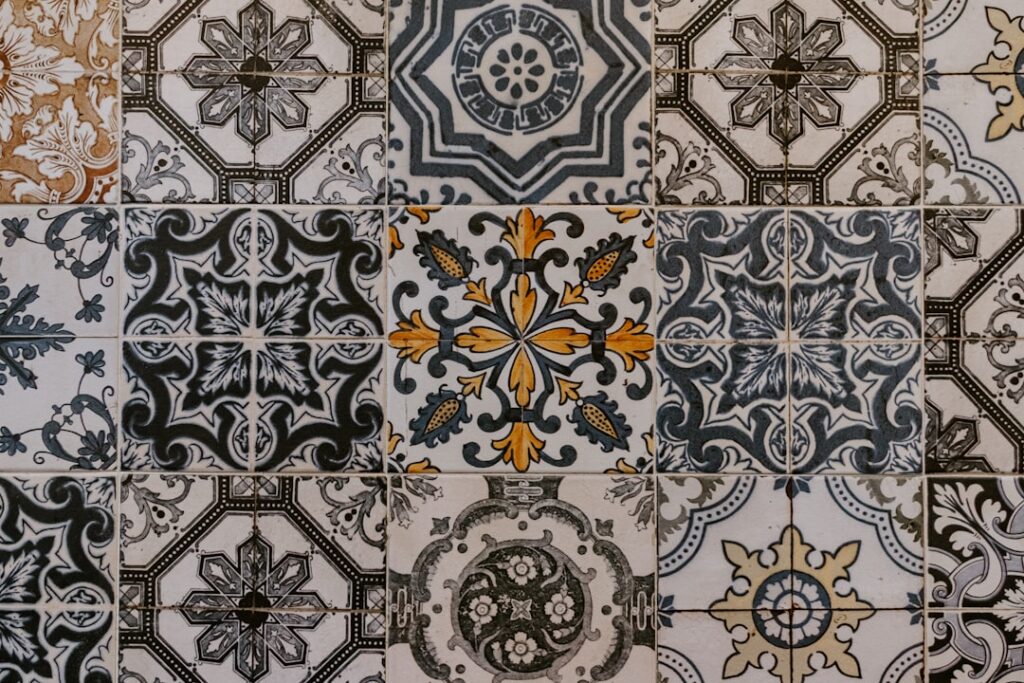
The patterns that define this category come straight from nineteenth-century floor design. Monochrome black-and-white checkerboards and diamonds are the most requested, particularly for period hallways where a bold graphic runway pulls the eye toward the front door. Then there are the more intricate options: eight-pointed stars, interlocking octagons with small square dots, and bordered mosaic panels that mimic a laid tile field with a decorative edge.
Color choices have broadened well beyond black and white. I regularly fit terracotta and cream combinations for cottage kitchens, muted sage or teal geometrics for modern renovations, and grey-toned patterns for people who want the period feel without a stark contrast. Scale matters too. A small bathroom looks best with a tighter, smaller-repeat pattern, while a generous hallway can carry a larger geometric without feeling busy. Always ask for a sample and lay it in the actual room, because print scale reads very differently on a showroom stand than on your own floor.
Cost Compared to Real Encaustic Tile
This is where sheet vinyl wins decisively. Genuine encaustic or cement Victorian tiles commonly run between 60 and 120 dollars per square meter for the tile alone, before you add adhesive, sealer, a skilled tiler and days of labor. A fully tiled Victorian hallway can easily climb past 3,000 dollars once everything is accounted for. Victorian tile effect sheet vinyl, by contrast, typically costs between 12 and 30 dollars per square meter for a good domestic grade, with premium branded ranges reaching perhaps 40 dollars.
Installation is the other saving. A competent handy homeowner can lay a small room in an afternoon, and a professional fitter will charge far less than a tiler because there is no setting-out grid, no grouting and no curing time. For a typical hallway you might spend 150 to 350 dollars on fitting rather than the four-figure labor bill a tile installation demands. When budget is the deciding factor, this is the single most cost-effective way to get the Victorian look on a floor.
Where It Works Best in the Home
Hallways are the natural home for this flooring, and it is no accident that the pattern originated as entrance-hall tiling. The geometric print hides everyday dirt far better than a plain floor, which is a genuine practical advantage right inside the front door. The cushioned surface is warmer and quieter than the ceramic it imitates, a welcome difference on cold mornings and in flats where noise transfer matters.
Kitchens and bathrooms are the next most popular rooms. Sheet vinyl is inherently water-resistant, and because a roll can often cover a small room in one continuous piece with no seams, there is nowhere for water to penetrate. That makes it a sound choice around a bath, a shower splash zone or a kitchen sink. I would still avoid using cushioned sheet vinyl in a room with very heavy point loads, such as under a large chest freezer on small feet, because the soft backing can take a permanent dent. For those situations a rigid luxury tile is the better call.
Measuring and Buying the Right Roll
Getting the quantity right starts with an accurate measurement of the room at its widest points, including door recesses and any alcoves, then adding at least 50 to 75mm of trim allowance on every edge. Sheet vinyl is unforgiving if you cut it short, so always round up. For a geometric pattern you also need to think about pattern repeat and matching, especially if the room is wider than the roll and you must seam two pieces together.
Roll width is the detail buyers most often overlook. If your room is 3.6m wide and you buy a 3m roll, you will have a visible seam and extra waste. Where possible choose a roll width that covers the room in one piece. Check the pattern repeat figure on the specification, because a large repeat means more offcut waste when you are matching a geometric design across a seam. Buy from the same batch or dye lot for the whole job so the colors match exactly, and keep a small offcut for future repairs.
Fitting Victorian Sheet Vinyl So the Pattern Lines Up
The single most important rule with a geometric print is to set out from the pattern, not the wall. Old houses rarely have square rooms, so if you align the design to a crooked wall the whole floor will look tilted. I center the main pattern axis down the middle of the hallway or to the most-seen sightline, then let the cuts fall where they will against the skirting. A pattern running true down the center reads as correct even when the edge cuts are slightly irregular.
Let the vinyl acclimatize in the room for 24 to 48 hours before fitting so it relaxes and lies flat. Fit it over a clean, dry, smooth subfloor; any grit or ridge underneath will telegraph through the thin material within weeks. For small rooms you can use double-sided tape around the perimeter, but for hallways and anything over a few square meters I strongly recommend a full spread of the correct vinyl adhesive to stop the sheet creeping and bubbling. Use a sharp hooked knife for the edge cuts, changing the blade often, and roll the whole floor with a hand roller to bed it down and expel trapped air.
Cleaning, Care and How Long It Lasts
Maintenance is genuinely easy, which is a large part of the appeal. A soft brush or vacuum on a hard-floor setting keeps grit off the wear layer, and a damp mop with a mild floor cleaner handles the rest. Avoid abrasive scouring pads and harsh solvents, as both can dull or scratch the printed surface over time. Wipe up spills reasonably promptly and use protective pads under furniture legs to prevent dents in the cushioned base.
Realistically, a good domestic Victorian tile effect sheet vinyl will give you between 8 and 15 years of service in a hallway, and longer in a lightly used room, before the wear layer starts to show traffic paths. That is shorter than genuine tile, which can last generations, but the far lower cost means you can refresh the look several times over for the price of one tiled floor. For homeowners who want period charm on a real-world budget, that trade-off is exactly why this product remains so popular.
Is It the Right Choice for You?
Choose Victorian tile effect sheet vinyl if you want the geometric heritage look quickly, affordably and with easy upkeep, and if the room in question is a hallway, kitchen or bathroom rather than a heavy-industrial space. It is warm, quiet, water-resistant and forgiving to fit. Look elsewhere, toward real encaustic tile or a rigid patterned luxury vinyl, only if you need decades of lifespan or are covering an area with severe point loading.
For most homeowners renovating a period property or simply wanting to add character to a plain floor, this flooring delivers remarkable value. Spend a little more for a thicker wear layer, choose a pattern scaled to your room, set it out from the center line, and you will have a floor that looks the part and stands up to years of daily traffic.
Prefer to explore on your own?
See how new flooring looks in your actual room in seconds — free, no signup.
Try the free Floor Studio →