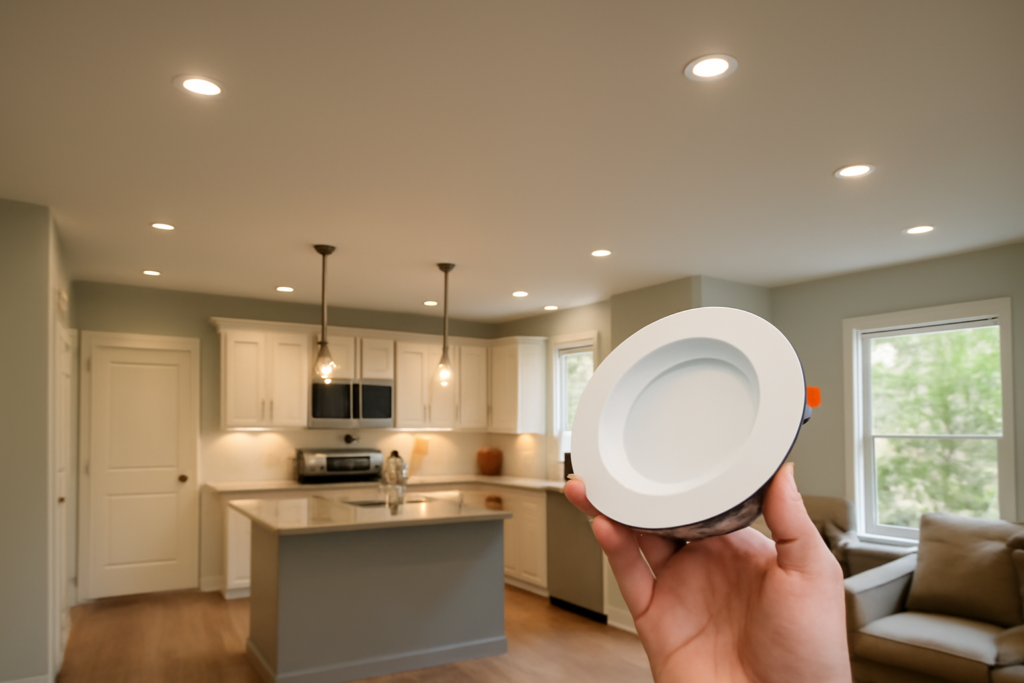
Walk into a well-designed modern home and the lighting you notice is the lighting you don’t notice — clean ceilings, no glare, warm even light with no visible fixtures. That look often comes from high-end recessed systems, and WAC recessed lighting is one of the brands architects and lighting designers reach for when they want performance beyond the builder-grade cans sold at big-box stores. WAC Lighting (Waterworks Anywhere Corporation) builds precision LED downlights with tight beam control, excellent color rendering, and trims that sit nearly flush with the ceiling. This guide explains their popular lines, the specs that matter, and how to choose the right fixtures for your rooms.
What Sets WAC Apart
The recessed lighting at a home center is functional but basic — wide beams, mediocre color, and visible trim rings. WAC targets the design market with fixtures engineered for a cleaner, more controlled result. Their downlights feature high color rendering (CRI 90 and above), meaning skin tones, wood, and artwork look true rather than washed out.
They also emphasize glare control. Many WAC lights use a regressed lens or a deep baffle that hides the LED source, so you see the light on your walls and floors, not a bright dot in your eyes when you look up. Trims sit trimless or nearly flush for a minimalist ceiling. That precision is why they cost more than a basic can and why they’re specified in high-end residential and commercial projects.
The Aether and Oculux Lines
WAC’s recessed catalog is deep, but two families cover most residential needs. Knowing the difference helps you spec correctly.
- Aether: WAC’s premium architectural downlight, available in 1-inch, 2-inch, 3.5-inch, and 4-inch apertures. It offers interchangeable trims, adjustable and fixed versions, and excellent glare control — the choice for a refined, designer look.
- Oculux: a more value-oriented architectural line, still trimless and clean, offered in 1.5-inch, 2-inch, and 3.5-inch apertures with round or square trims. A great balance of performance and price for whole-home installs.
- Lotos and new-construction/remodel housings: more traditional 4-inch and 6-inch downlights and IC-rated housings for standard applications.
Smaller apertures — 2 to 3.5 inches — read as modern and discreet; larger 4 to 6-inch cans throw more light per fixture and suit general ambient lighting on a budget.
Color Temperature and Rendering
The color of light shapes how a room feels, and WAC gives you control. Color temperature is measured in Kelvin: 2,700K glows warm and cozy like an incandescent bulb, 3,000K is a slightly crisper warm white popular in kitchens and living rooms, and 3,500K to 4,000K reads neutral to cool for task areas, garages, and baths.
Many WAC fixtures offer selectable CCT — a switch on the housing lets you pick the color temperature at install, so you can standardize on one product across the house and tune each room. Some premium models also feature “warm dim,” which shifts from 3,000K down toward a candle-like 1,800K as you dim, mimicking the cozy glow of a halogen. For color accuracy, look for the 90 or 95 CRI rating on the spec sheet — essential over kitchens, bathrooms, and anywhere you display art.
Dimming and Controls
Nothing frustrates homeowners more than LED lights that flicker, buzz, or drop out at low levels, so match the driver to your dimmer. WAC publishes dimmer compatibility charts, and their fixtures generally dim smoothly on quality ELV or TRIAC dimmers from Lutron and similar brands.
For the best low-end performance — dimming down to 1 percent or less without flicker — use the recommended dimmer from WAC’s compatibility list rather than whatever’s already on the wall. Some lines integrate with smart systems and 0-10V controls for whole-home automation. If you want dim-to-warm behavior, confirm the fixture specifically supports it, since not all do. Getting the dimmer right is the difference between a luxurious, flicker-free result and constant annoyance.
Ratings for Bathrooms and Outdoors
Not every downlight can go everywhere, and the ratings tell you where each fixture belongs. IC rating means the housing can contact insulation safely — required whenever the fixture sits in an insulated ceiling. Airtight (AT) housings stop drafts and energy loss between conditioned and unconditioned space.
For wet locations, check the rating. A shower or a covered porch needs a fixture rated for wet or damp locations with a sealed lens. WAC offers wet-rated WAC recessed lighting specifically for showers, soffits, and exterior overhangs. Using a dry-rated light in a shower is both a code violation and a shock hazard, so always match the rating to the room’s moisture exposure.
Layout and Spacing
Even the best fixture disappoints if you place it poorly. As a rough starting point, space recessed downlights apart by a distance equal to half your ceiling height — an 8-foot ceiling suggests about 4 feet between fixtures for even general lighting. Keep lights 18 to 24 inches off the walls to avoid scalloping, unless you specifically want wall-wash grazing.
Layer the light rather than blanketing the ceiling in a grid. Use general downlights for overall illumination, adjustable accent fixtures aimed at art or a fireplace, and closer spacing over work zones like a kitchen island. Smaller apertures let you add more fixtures without a cluttered ceiling. When in doubt, a lighting designer or WAC’s own layout tools can plan the spacing for your exact room.
Beam Angles and Light Distribution
Two identical-looking downlights can create completely different effects depending on beam angle, a spec homeowners routinely overlook. Beam angle describes how wide the cone of light spreads: a narrow 15 to 25-degree beam creates a tight, dramatic pool ideal for accenting art or a fireplace, while a wide 50 to 60-degree beam washes a broad area for general room lighting.
WAC offers different beam optics across its lines so you can tune the effect room by room. Use narrow beams for accenting and drama, medium beams for task areas like a kitchen counter, and wide beams for even ambient fill in a living room. Some Aether fixtures accept interchangeable optics, letting you change the spread without swapping the whole light. Adjustable “gimbal” versions tilt up to 30 or 40 degrees to aim light at a wall or a piece of art, which is how designers create the wall-grazing and accent effects that make a room feel layered rather than flatly lit. Matching beam angle to each fixture’s purpose is what separates a professional lighting plan from a ceiling dotted with identical cans.
Comparing WAC to Other Brands
WAC sits in the premium tier, so it helps to know where it lands against the alternatives. Compared to big-box builder-grade recessed cans, WAC delivers dramatically better color rendering, tighter glare control, smaller trimless apertures, and smoother dimming — the difference is obvious the moment you look at a wall lit by each.
Against other high-end brands like Halo’s designer lines, DMF, and Element by Tech Lighting, WAC competes on a broad catalog, strong CCT-selectable options, and solid dimmer compatibility at a somewhat more accessible price point than the most exclusive architectural names. For a whole-home project on a designer budget, the Oculux line offers much of the premium look for less, while Aether is the choice when you want the cleanest possible ceiling and the best glare control. The main trade-off versus cheap cans is cost — expect to pay several times more per fixture — but for spaces where lighting quality matters, the upgrade is visible every evening for the life of the home. If budget is tight, prioritize WAC fixtures in the rooms you see and use most, and use standard cans in closets and utility spaces.
Installation and Getting It Right
WAC offers both new-construction housings that mount to joists before drywall and remodel housings that clip into an existing ceiling through a cut hole. New construction gives the cleanest result and easiest wiring; remodel cans let you retrofit without tearing down the ceiling.
Because these are premium fixtures with specific driver and dimmer requirements, many homeowners hire a licensed electrician to ensure proper IC/airtight sealing, correct dimmer pairing, and code-compliant wet-location installs. If you DIY, cut power at the breaker, follow the housing’s clearance requirements from insulation on non-IC models, and verify your dimmer against WAC’s compatibility list before buttoning up the ceiling. Spec the right line, trim, color temperature, and rating for each room, and WAC recessed lighting delivers the clean, glare-free, true-color lighting that makes a home feel professionally designed.