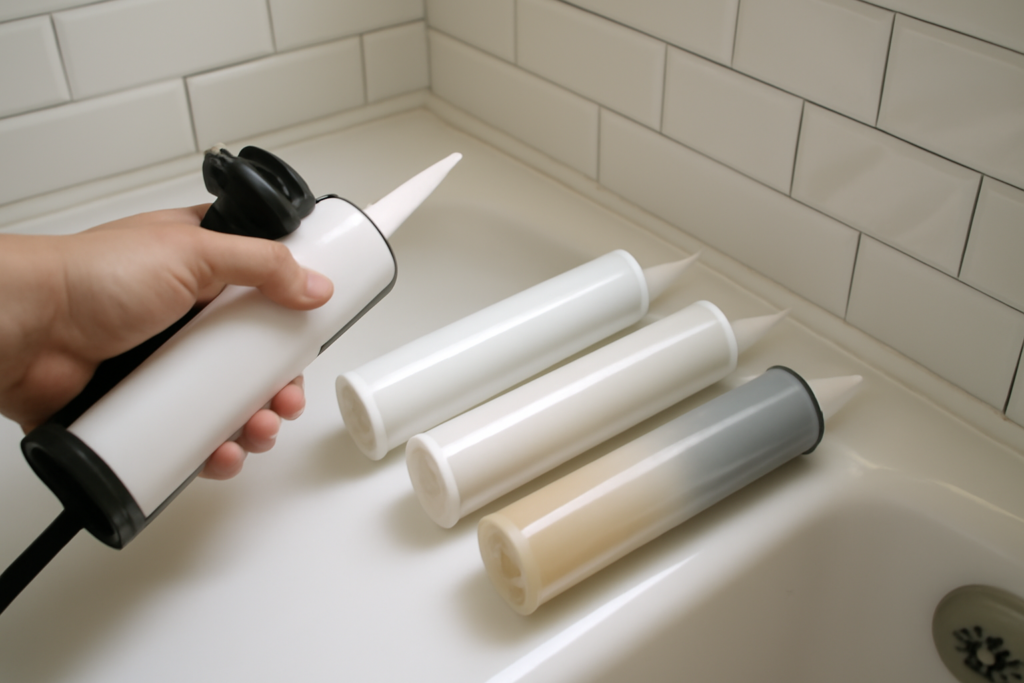
Stand in the caulk aisle of any home center and you’ll face forty tubes that all claim to be perfect for bathrooms. Most of them are wrong for the job. When clients ask me what caulk to use in shower corners, tub joints, and door tracks, my answer has been the same for twenty years: 100% silicone, mold-rated, in a color matched to your grout — with a couple of specific exceptions I’ll get into. This article is purely about picking the right tube. The application technique is its own skill, but ninety percent of failed shower caulk I get called to fix failed because somebody bought the wrong product, not because they tooled it badly.
Part of our Bathroom Remodeling & Flooring guide — explore the full guide →
The Short Answer
For every joint that gets directly wet — tub-to-tile, shower pan-to-wall, vertical corners inside the enclosure, around the drain flange of a solid-surface pan — use a 100% silicone sealant labeled for kitchen and bath, with a mold-inhibiting additive. Brands I trust and use weekly: GE Advanced Silicone 2 Kitchen & Bath, GE Supreme Silicone, DAP Silicone Max, and Loctite 100% Silicone. Expect to pay $8 to $14 per 10-ounce tube. That’s the whole answer for most showers. Everything below is the reasoning and the edge cases.
100% Silicone vs Siliconized Acrylic: The Real Difference
This is the choice that trips people up, because siliconized acrylic (also sold as “acrylic latex plus silicone,” “tub and tile caulk,” or “kitchen and bath caulk” at $4 to $6 a tube) sounds like it should be almost as good. It isn’t. The word “siliconized” means a small amount of silane additive was mixed into what is fundamentally a water-based acrylic latex caulk. It improves flexibility a little. It does not make the caulk perform like silicone.
| Property | 100% Silicone | Siliconized Acrylic |
|---|---|---|
| Waterproof when cured | Fully — repels water indefinitely | Water-resistant only; softens with prolonged soaking |
| Flexibility | Stays rubbery for decades; handles 25–50% joint movement | Hardens and cracks in 2–5 years in wet joints |
| Typical shower lifespan | 10–20 years | 1–4 years |
| Paintable | No | Yes |
| Cleanup | Mineral spirits before cure | Water |
| Price per tube | $8–$14 | $4–$6 |
The acrylic tube saves you six dollars and costs you a full re-caulk job every few years — and if it fails quietly behind a tub joint, it can cost you a rotted subfloor. Inside the wet zone of a shower, I consider siliconized acrylic a false economy, full stop. Its legitimate role is the dry perimeter: where the tub apron meets the floor tile outside the splash zone, or where trim meets the wall — places you want a paintable caulk and water exposure is incidental.
Why Mold-Rated Matters
Silicone itself doesn’t feed mold, but the soap scum and body oils that sit on it do. Kitchen-and-bath silicone formulas include a fungicide (the label will say “mold-free product protection,” “10-year mold-free,” or similar) that leaches slowly to the surface and suppresses growth on the film. It’s not magic — a never-cleaned shower will still grow mildew on top of anything — but the difference is dramatic. Plain “window and door” silicone from the same manufacturer lacks the additive and will show black speckling in a heavily used shower within a year or two. Check the front of the tube for kitchen/bath/mold language before it goes in your cart; the packaging otherwise looks nearly identical.
Matching Caulk to Your Grout
Bright white caulk against almond grout looks like a repair. The pro move is a color-matched caulk, and you have three routes:
- Stock colors. Every major silicone line comes in white, clear, almond/biscuit, gray, and black. That covers a surprising number of showers. Clear is the universal fallback — it disappears against any tile, though it shows every bit of trapped soap film beneath it.
- Grout-manufacturer caulk. Mapei, Custom Building Products (Polyblend), TEC, and Laticrete all sell caulk tinted to match their grout color charts — the same “Delorean Gray” or “Bone” your tile setter used. Two versions exist: sanded acrylic (matches sanded grout texture, but it’s acrylic — use it only outside the direct wet zone) and unsanded 100% silicone. For inside the shower, insist on the silicone version of the matching color. Tile shops stock these; big boxes carry a partial range at $9 to $15 per tube.
- Clear over a grout-colored joint. Where a silicone color match doesn’t exist, some setters grout the changes-of-plane joint, let it cure, then seal over it with clear silicone. I don’t love the method — grout in a movement joint eventually cracks under the clear film — but you’ll see it done.
The Edge Cases Worth Knowing
Fiberglass and acrylic surrounds
Still 100% silicone, but check the unit manufacturer’s guidance — a few one-piece surround makers specify “non-acid-cure” (neutral-cure) silicone because acetoxy-cure formulas can craze certain plastics. If the tube smells strongly of vinegar, it’s acetoxy cure. Neutral-cure products like GE Advanced Silicone 2 are the safe default on plastics.
Natural stone showers
Marble, travertine, and limestone need a silicone explicitly labeled stone-safe or neutral-cure. Standard acetoxy silicones and the plasticizers in cheap caulks can migrate into porous stone and leave a permanent oily halo along every joint. Laticrete Latasil and GE Advanced Silicone are my go-tos here, always tested on an offcut first.
Steam showers
Heat plus constant saturation is the toughest residential environment for sealant. Use a premium neutral-cure 100% silicone and expect to renew it more often than a standard shower — five to eight years is a good run in a daily-use steam enclosure.
Shower door frames and tracks
Clear 100% silicone, and follow the door manufacturer’s instruction on which side of the track gets sealed — most specify caulking the outside face and specific inside points while leaving weep paths open so the track can drain. Sealing a track completely shut traps water and grows a science experiment inside the frame.
Labels That Should Make You Put the Tube Back
- “Paintable silicone.” A hybrid with real uses elsewhere in the house, but inside a shower you don’t need paintability and you’re trading away wet performance.
- “Adhesive caulk” or “tub surround adhesive.” That’s for gluing panels, not sealing joints.
- Painter’s caulk / all-purpose acrylic. It will fail in months in a wet joint. It exists for trim and drywall.
- Anything without a mold-resistance claim going into a wet zone. Same chemistry family, wrong additive package.
- Bargain-bin silicone with no brand you recognize. Silicone quality varies more than the identical-looking tubes suggest. This is a $10 decision protecting thousands of dollars of tile and framing — buy the name brand.
Sheen and Finish: The Detail Nobody Mentions
One last selection factor that surprises people at the checkout: cured silicone finishes range from glossy to near-matte depending on the product line, and the difference shows against tile. Most standard kitchen-and-bath silicones cure glossy, which reads fine against glazed ceramic but looks plasticky next to matte porcelain or honed stone. Several premium lines and most grout-manufacturer silicones cure to a satin or matte finish specifically to sit quietly beside modern low-sheen tile. If your shower is matte-finish tile — and most new ones are — favor the grout-brand silicone or check the manufacturer’s spec sheet for cured gloss level. It’s a small thing that determines whether the joint line reads as part of the tilework or as a shiny stripe drawn around it.
How Much to Buy and How Long It Lasts
One 10-ounce cartridge caulks an average tub surround (tub joint plus two vertical corners) with plenty to spare; a full tile shower with a pan, three corners, a curb, and a door usually takes one to two tubes. Buy fresh stock — silicone has a real shelf life, typically 12 to 18 months from manufacture, and an old tube may skin poorly or never fully cure. There’s a stamped date on the cartridge; check it, because slow-moving hardware stores absolutely sell expired silicone.
Once the right product is in the joint, a quality mold-rated silicone should give you a decade or more before it needs renewal. When it does eventually peel or speckle beyond cleaning, the fix is complete removal and replacement — new silicone will not bond to old silicone residue. But that’s a different article. Today’s decision happens in the store aisle, and it’s simple: 100% silicone, kitchen-and-bath mold-rated, neutral-cure if plastics or stone are involved, in a color that matches your grout. Get those four things right and you’ve already won the longest-lasting shower caulk job on your block.