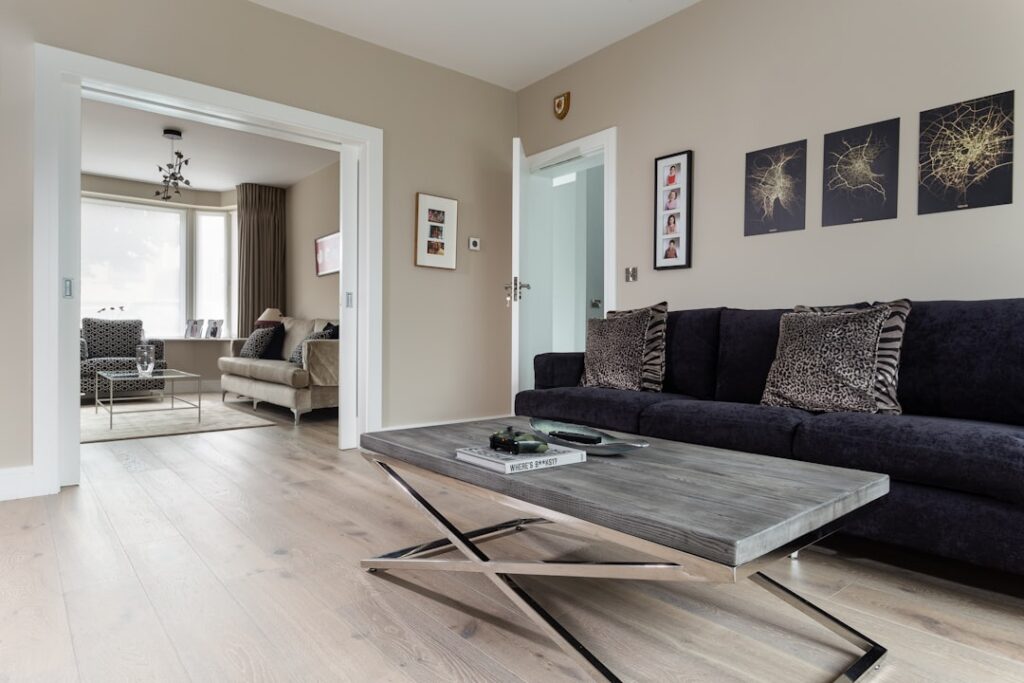
Walk into a modern home and you might step across convincing oak planks that are actually a printed photograph sealed under clear plastic. So what does laminate flooring look like? At its best, it is nearly indistinguishable from real hardwood, stone, or tile, thanks to high-resolution image layers and embossed surface textures. At its worst, it looks flat, plasticky, and obviously fake. The gap between those two outcomes comes down to a handful of features you can learn to spot. Here is how laminate actually appears, and how to tell quality from cheap imitation.
The Anatomy Behind the Look
Laminate’s appearance comes from a printed decorative layer, a high-resolution photograph of real wood or stone, laminated over a dense fiberboard core and sealed beneath a clear wear layer. The realism you see is driven by two things: the print quality of that image and the surface texture pressed into the wear layer. Premium products use varied plank images so no two boards look identical, mimicking the natural variation of real wood.
Cheaper laminate repeats the same three or four plank patterns across an entire room, and trained eyes catch the repetition quickly. The more unique board faces a product offers, the more natural the finished floor looks.
The Common Looks You Can Choose
Laminate today imitates far more than basic oak. The most popular looks include:
- Wood: Oak, hickory, maple, walnut, and exotic species in tones from pale whitewashed to deep espresso.
- Distressed and hand-scraped: Boards with intentional dents, saw marks, and worn edges for a reclaimed-barnwood feel.
- Wide-plank: Boards 7 inches or wider that read as upscale modern wood.
- Stone and tile: Marble, slate, travertine, and concrete looks, often in larger format pieces.
- Gray and weathered tones: The driftwood and coastal grays that dominate contemporary design.
Texture: Why Some Laminate Feels Real
Run your hand across a quality plank and you will feel ridges and grooves that follow the printed grain. This is embossed-in-register, or EIR, texturing, where the surface bumps line up exactly with the image beneath. EIR is the single biggest tell of premium laminate. It catches light the way real wood does and removes the glassy plastic sheen that gives cheap product away.
Lower-grade laminate uses a generic texture that does not match the print, or a smooth, glossy face that reflects light unnaturally. In photos and in person, that mismatch reads as fake almost instantly.
Sheen and Edges
Finish sheen dramatically changes the look. Matte and low-gloss laminate reads as natural, lived-in wood and hides scratches and dust well. High-gloss laminate looks dramatic but shows every footprint and scuff, and tends to read as artificial. For most homes, a matte or satin finish looks the most authentic.
Edge treatment matters too. Beveled edges create a small V-groove between planks, casting a subtle shadow line that mimics individual boards and adds depth. Square-edge laminate runs nearly seamless, giving a smoother, more contemporary surface. Micro-beveled edges split the difference and are the most common premium choice.
How to Spot Quality Versus Cheap
When shopping, look for three signals. First, count the number of unique board faces; more variation means a more realistic floor. Second, feel for EIR texture that aligns with the grain. Third, check the finish; matte beats glossy for realism. The thickness also hints at quality, with 10mm to 12mm boards generally feeling more substantial and solid underfoot than thin 7mm products, though thickness alone does not guarantee a better image.
An AC rating tells you durability, not looks, but higher-grade products usually pair better printing with tougher wear layers. AC4 and AC5 laminates are built for heavy use and tend to be the more convincing, longer-lasting options.
Where the Look Falls Short
Even good laminate has limits. Up close, you may notice the same plank image repeating somewhere in a large room. Laminate also lacks the genuine depth and warmth of real wood underfoot, and it cannot be refinished, so its appearance is locked in for life. Around the perimeter, the small expansion gap hidden under baseboards reminds you it is a floating floor, not nailed-down hardwood.
Water is the other weakness. Standard laminate can swell at the seams if liquid sits on it, and a swollen edge instantly looks damaged. Water-resistant laminate lines have improved this, but for bathrooms and laundry rooms, vinyl still looks better long-term because it never swells.
How Plank Size Changes the Look
Beyond color and texture, the dimensions of each board dramatically shape the finished appearance. Narrow strip-style planks around 5 inches wide read as traditional and busy, with more seams across the room. Wide planks of 7 to 9 inches look modern, upscale, and calmer, with fewer seam lines drawing the eye. Longer boards, some reaching 48 to 60 inches, make a space feel larger and more open.
Tile-look laminate comes in squares or rectangles that mimic stone and ceramic, often with grout-line grooves pressed into the edges for added realism. If you want a contemporary feel, lean toward wide, long planks; for a cozy, classic look, narrower boards suit better.
Seeing It in Your Own Space
Samples in a showroom look different from the same product in your home, because lighting changes everything. Bring home full-size sample planks and lay several side by side on the floor, then view them in morning light, afternoon light, and under your evening lamps. Gray and cool tones can look very different at noon versus under warm bulbs, and a busy grain pattern that looked great in the store may overwhelm a small room.
Pay attention to how the finish reflects light in your space. A floor that looked richly textured under showroom spotlights may read flatter in softer home lighting, and a glossy sample can show glare you did not notice in the store. Living with samples for a few days is the surest way to know what your laminate will actually look like.
The Bottom Line
So what does laminate flooring look like? When you choose a quality product, it looks remarkably like real hardwood, stone, or tile, with realistic grain, aligned texture, and a natural matte finish that fools most visitors. When you buy the cheapest option, it looks flat, repetitive, and plastic. Shop for embossed-in-register texture, plenty of unique board faces, a matte or satin sheen, and a 10mm-plus thickness with an AC4 or higher rating. Get those features right and your laminate will read as the real thing at a fraction of the price.
Prefer to explore on your own?
See how new flooring looks in your actual room in seconds — free, no signup.
Try the free Floor Studio →