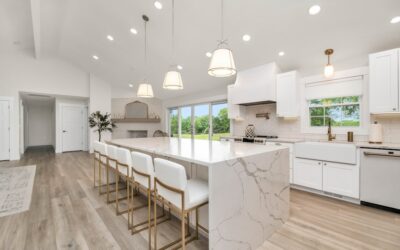
If you love the soft, gray-veined elegance of Italian Carrara marble but dread the staining, etching, and constant sealing it demands, white carrara quartz may be the perfect answer. Engineered quartz captures that delicate marble look in a surface that is non-porous, scratch-resistant, and virtually maintenance-free. It has become one of the most popular countertop choices in modern kitchens and baths precisely because it bridges luxury appearance with real-world durability.
Part of our Countertops guide — explore the full guide →
This guide explains what it is, how it compares to natural marble, where it works, what it costs, and how to keep it looking flawless.
What White Carrara Quartz Is
Quartz countertops are engineered from roughly 90 to 95 percent ground natural quartz bound with resins and pigments. To create the Carrara look, manufacturers add soft gray veining over a white or off-white base, mimicking the feathery, flowing pattern of real Carrara marble. Because the material is manufactured, the veining and color stay consistent from slab to slab, which makes matching multiple counters or a large island far easier than with natural stone.
Quartz vs. Real Carrara Marble
The look is similar, but performance is worlds apart:
- Porosity — quartz is non-porous and never needs sealing; marble is porous and must be sealed regularly.
- Etching — acidic foods like citrus and wine etch marble; quartz resists them.
- Stains — quartz resists staining; marble can absorb spills if not promptly wiped.
- Consistency — quartz patterns are uniform; marble is unique slab to slab.
- Heat — marble tolerates heat better; quartz can scorch, so always use trivets.
Where It Works Best
This surface adapts to nearly every space in the home. In kitchens it handles meal prep, spills, and daily wear without staining, making it a workhorse for counters and islands. In bathrooms it brings a spa-like, luxurious feel to vanities while shrugging off cosmetics, toothpaste, and water. It also performs beautifully on backsplashes, waterfall island edges, and even fireplace surrounds where a clean marble look is desired without the upkeep.
Style and Vein Variations
Not all Carrara-style quartz looks the same. Some lines feature subtle, fine gray veining for an understated look that reads almost solid white from a distance. Others offer bolder, more defined veins for a dramatic statement. Background tones range from bright cool white to warmer creamy whites, which affects how the counter pairs with cabinets and flooring. Bring home a sample and view it in your own lighting before committing, since showroom lights can shift the perceived tone.
What It Costs
Quartz sits in the mid-to-upper range of countertop pricing. Installed, white Carrara quartz typically runs $50 to $120 per square foot depending on the brand, slab thickness, and edge profile. That is often comparable to or slightly more than basic granite, and frequently less than premium natural marble once you factor in marble’s ongoing sealing and care. Professional fabrication and installation are standard, since quartz slabs are heavy and require precise cutting and seaming.
Caring for Quartz
Maintenance could hardly be simpler. Wipe the surface with mild dish soap and warm water and a soft cloth for daily cleaning — no sealing, no special stone products required. For dried-on messes, a gentle non-abrasive cleaner works fine. Avoid harsh chemicals like bleach and oven cleaners, abrasive scrubbing pads, and strongly alkaline cleaners, which can dull the finish over time. The non-porous surface resists bacteria and never needs the annual sealing that natural stone demands.
Pairing Quartz With Your Kitchen
Because white Carrara quartz is light and neutral, it pairs with almost any cabinet color, which is part of its appeal. Against white cabinets it creates a bright, airy, timeless kitchen. With navy, deep green, or charcoal cabinets, the white counter provides crisp contrast that makes the cabinets pop. Warm wood tones balance the cool gray veining for a more organic look. For backsplashes, you can run the same quartz up the wall for a seamless slab effect, or pair it with simple subway tile to let the counter remain the focal point. Coordinate your flooring undertone — cool or warm — with the white of the slab so the whole room feels cohesive.
Edge Profiles and Thickness
Small fabrication choices shape the final look more than people expect. Standard slab thicknesses are around 2 and 3 centimeters; the thicker option feels more substantial and premium, while a thinner slab can be built up at the edge to look thick for less material cost. Edge profiles range from a clean square or eased edge for modern kitchens to beveled, bullnose, or ogee profiles for traditional spaces. A waterfall edge, where the quartz runs vertically down the sides of an island, showcases the veining and creates a high-end statement. Discuss these options with your fabricator, since they affect both price and style.
Removing Stubborn Marks
While quartz resists most stains, occasional stubborn marks still happen, and they come off easily with the right approach. For dried food, grease, or soap scum, a non-abrasive cleaner or a paste of baking soda and water lifts the residue without scratching. Stuck-on gunk like gum or candle wax can be gently scraped off with a plastic putty knife after softening. For ink, permanent marker, or stubborn stains, a small amount of isopropyl alcohol on a soft cloth usually does the trick, followed by a rinse with soapy water. Always avoid abrasive pads and harsh solvents, and test any stronger cleaner on a hidden spot first to be safe.
One Important Limitation: Heat
Quartz has one real weakness worth respecting. The resins that bind it can be damaged by high heat, so a hot pan set directly on the surface may leave a scorch mark or discoloration. Always use trivets or hot pads under pots, pans, and small appliances like slow cookers. This single habit protects the surface for the life of the counter, and it is a small price for a material that needs no other special handling.
Final Thoughts
White Carrara quartz gives you the timeless beauty of marble without the fragility, delivering a non-porous, scratch-resistant, low-maintenance surface that fits kitchens, baths, and beyond. View samples in your own light to nail the right vein and tone, budget for professional installation, and simply remember to use trivets. With that, you get a luxurious marble look that stays gorgeous with nothing more than soap and water.