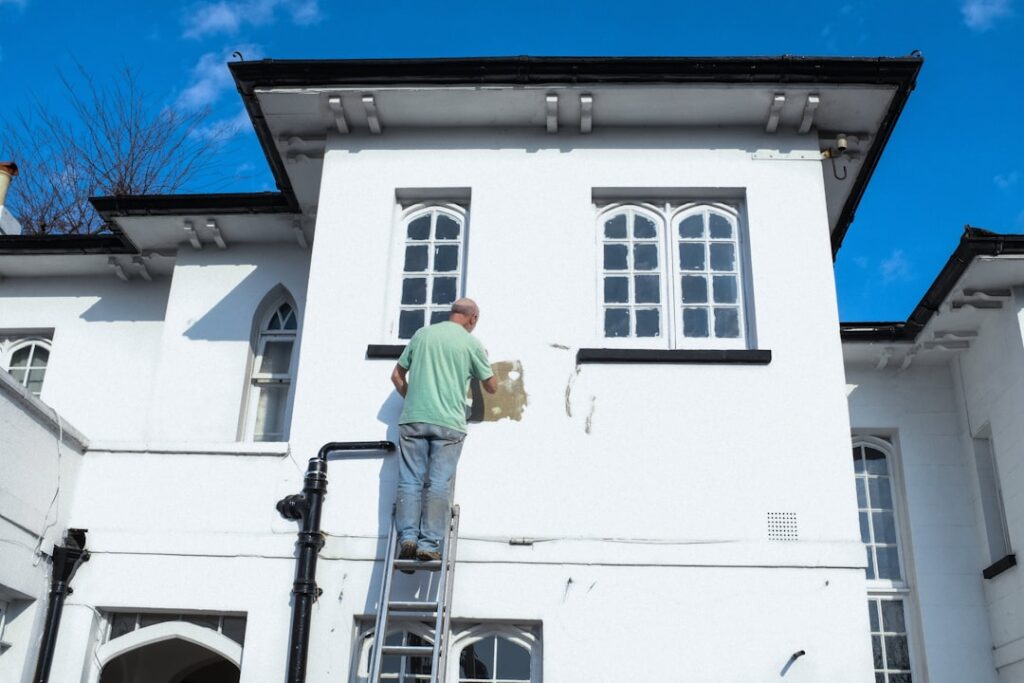
White never goes out of style on a house, but “just paint it white” is a trap. White exterior house paint comes in dozens of undertones, and the difference between a warm creamy white and a cool blue-white changes the entire character of a facade. Get it right and the house looks crisp, timeless, and expensive; get it wrong and it either glares blue-gray in shade or reads dingy yellow in the sun. Here’s how to choose the white that actually looks good on your home.
Part of our Paint & Walls guide — explore the full guide →
- Why White Endures
- Warm Whites vs. Cool Whites
- Best Warm White Shades
- Best Cool and Bright White Shades
- Reading the Undertone
- Matching White to Your Home’s Style
- Climate and Heat Reflection
- Choosing the Right Finish
- Pairing Trim, Door, and Roof
- Fight Mildew and Dirt From the Start
- Prep and Application for a Clean White
- Always Sample on the Wall
Why White Endures
White exteriors feel clean, classic, and current all at once, which is why the white-house-with-black-windows look has dominated the last decade. White reflects heat, making it practical in hot climates, and it flatters nearly every architectural style from farmhouse to Colonial to modern. It also gives you a blank canvas for high-contrast trim, doors, and landscaping.
The trade-off is maintenance. White shows dirt, mildew, and hose splash more than a mid-tone, so you’ll wash it more often and want a quality, mildew-resistant paint.
Warm Whites vs. Cool Whites
The first decision is temperature. Warm whites have yellow, cream, or greige undertones and feel soft, inviting, and traditional. Cool whites have gray or blue undertones and feel crisp, modern, and architectural. Your existing elements decide which way to lean: warm-toned brick, stone, or wood roofing wants a warm white, while a black-and-white modern scheme or a gray roof wants a cooler, cleaner white.
Beware the extremes. A pure, undertone-free white (like a bright ceiling white) looks stark and clinical outdoors and shows every imperfection. Almost every good exterior white has a whisper of undertone to soften it.
Best Warm White Shades
- Benjamin Moore White Dove (OC-17): the most-loved soft white — warm but not yellow, works on trim and whole exteriors alike.
- Sherwin-Williams Alabaster (SW 7008): a warm, creamy white that reads clean without going stark; the modern-farmhouse standard.
- Benjamin Moore Swiss Coffee / Navajo White: warmer, creamier options for traditional and Mediterranean homes.
- Sherwin-Williams Creamy (SW 7012): a cozy, warm white for a welcoming cottage feel.
Alabaster and White Dove are the two safest warm whites for a whole-house exterior — they flatter warm and neutral elements without turning yellow.
Best Cool and Bright White Shades
- Benjamin Moore Chantilly Lace (OC-65): the go-to crisp, clean white for modern homes and black-window schemes.
- Sherwin-Williams Pure White (SW 7005): a near-neutral white with the faintest warmth — versatile for body and trim.
- Sherwin-Williams Extra White (SW 7006): a cooler, brighter white for contemporary facades that want maximum contrast.
- Benjamin Moore Simply White (OC-117): a bright, slightly warm white that stays clean without going icy.
For the classic white-house-black-trim modern look, Chantilly Lace or Extra White gives you that crisp, high-contrast edge.
Reading the Undertone
Every white shifts toward one undertone: yellow, cream, gray, blue, or green. The mistake homeowners make is judging white against other whites in the store, where it always looks clean. Outdoors, sunlight amplifies the undertone dramatically — a slightly gray white can look distinctly blue in shade, and a warm white can flash yellow at golden hour.
Look at your fixed elements — roof, stone, brick, walkways — and pick a white whose undertone harmonizes with them. A warm stone base with a cool blue-white body will fight all day.
Matching White to Your Home’s Style
The right white depends heavily on architecture and the era of the house. A stark, cool white that makes a modern box look sharp can leave a traditional home feeling cold and flat. Read the house first:
- Modern farmhouse: a clean warm white like Alabaster with black windows and trim — the signature look of the last decade.
- Contemporary / modern: a crisp cool white (Chantilly Lace, Extra White) for maximum graphic contrast.
- Colonial and traditional: a soft warm white (White Dove) with black shutters and a colored door.
- Cottage and coastal: a creamy, welcoming white (Creamy, Simply White) with natural wood accents.
- Mediterranean and Spanish: warm, slightly creamy whites that complement terracotta roofs and stucco.
When the white’s temperature matches the home’s character, the facade looks intentional. A mismatch — a cold white on a warm-brick traditional — is the kind of thing you can’t unsee once it’s up.
Climate and Heat Reflection
White has a genuine practical edge: it reflects sunlight and heat, keeping the house cooler in hot climates and reducing the thermal stress that ages siding and paint. That reflectivity is why white is so popular across the Sun Belt and coastal South. The trade-off is that humid, shady, and tree-heavy sites promote mildew, which shows dramatically on white.
In a hot, dry climate you can lean into a bright, clean white and enjoy the heat rejection. In a humid or heavily shaded setting, prioritize a premium paint with a strong mildewcide and be ready to wash the house every year or two to keep it looking fresh rather than gray-streaked.
Choosing the Right Finish
Sheen affects durability and how the undertone shows:
- Flat / matte: hides siding imperfections beautifully and mutes the undertone; slightly harder to clean.
- Low-lustre / satin: the best all-around body sheen — sheds dirt, resists mildew, and cleans with a hose.
- Semi-gloss: for trim, doors, and shutters where you want durability and crisp definition.
On a white house, satin body with semi-gloss trim gives you an easy-clean surface and subtle depth between field and detail.
Pairing Trim, Door, and Roof
White is endlessly flexible for accents. The dominant modern move is white body with black or charcoal trim and windows — clean, graphic, and high-contrast. For a softer, traditional home, pair a warm white body with a slightly deeper white or greige trim and a stained wood or colored door. Watch the roof: a cool white pairs best with a gray or black roof, while a warm white sits happily under a brown or weathered-wood shingle.
A pop of color on the front door — navy, forest green, or a warm terracotta — keeps an all-white facade from feeling flat.
Think about the whole envelope, not just the walls. Gutters, garage doors, porch ceilings, and railings all read as part of the color scheme. Painting gutters and downspouts to match the trim (or the body) makes them disappear, while a stained-wood porch ceiling or a black metal railing adds warmth and depth. Coordinating these details is what separates a house that looks freshly painted from one that looks professionally designed.
Fight Mildew and Dirt From the Start
Because white shows everything, buy a premium exterior line with mildewcide and good dirt resistance — Sherwin-Williams Duration or Emerald, or Benjamin Moore Aura Exterior. These hold their brightness longer and resist the mildew streaking that plagues white houses in humid climates. Budget a wash every year or two and touch-ups where the hose and mower splash.
Prep and Application for a Clean White
White is the least forgiving color to apply because every miss, drip, and thin spot shows. Solid prep and technique are non-negotiable. Pressure wash to strip chalk and mildew, scrape and sand failing paint, caulk gaps, and prime bare wood and any stains so tannins and rust don’t bleed through the fresh white. Wood knots and water stains are notorious for ghosting through a white topcoat, so use a stain-blocking primer on them.
- Spot-prime stains and bare wood with a stain-blocking primer to stop bleed-through.
- Apply two full coats for even, opaque coverage and long life.
- Paint in mild, dry weather (50-85°F, low humidity) so the film cures properly.
- Keep gutters and downspouts clean afterward so overflow doesn’t streak the fresh paint.
Because white shows dirt, plan a maintenance rhythm from the start — a gentle wash every year or two keeps the brightness and catches mildew before it sets in.
Always Sample on the Wall
Never commit to white exterior house paint from a chip. Buy quart samples of your top two or three, paint large 2-by-2-foot patches on the sunniest and shadiest sides, and check them at morning, noon, and dusk. That’s the only way to catch a white that flashes blue in shade or yellow in sun. Once a shade stays clean and true across all that light, you can order gallons knowing the whole house will look as good as the sample did.