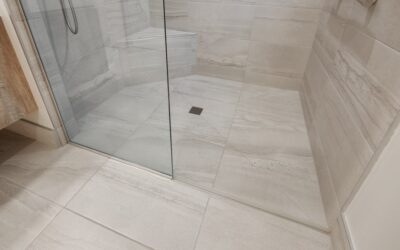
If I could quietly change one decision on half the showers I get called to restore, it would be this: they’d have grey grout instead of white. The white tile grey grout combination is the rare design choice that’s simultaneously more stylish and more practical than the default — it defines the pattern you paid for, and it forgives the everyday soiling that turns white grout lines grey anyway within a year. But “grey” covers everything from misty silver to charcoal, and the shade you pick completely changes the result. Here’s the full contractor’s take: why the pairing works, how to choose the right grey, where it doesn’t belong, and the execution details that make or break it.
Part of our Tile & Grout guide — explore the full guide →
- Why This Combination Became the Default Upgrade
- Picking Your Grey: The Contrast Decision
- Where Grey Grout Earns Its Keep — and Where It Doesn't
- Grout Type and Cost: Cement, High-Performance, or Epoxy
- Execution Details That Separate Crisp From Blotchy
- If Your White Grout Already Went Grey the Bad Way
- Pairing Grey Grout With the Rest of the Room
Why This Combination Became the Default Upgrade
Three reasons the white tile grey grout pairing keeps winning, in order of how often clients cite them after living with it:
- It hides real life. White grout is white for about six months on a floor and maybe a year in a shower. Dirt, mop water, body oils, and shampoo dyes all tint it toward grey no matter how you clean. Grey grout starts where white grout ends up, so it looks consistent for years instead of months. On floors this isn’t a style choice; it’s damage control.
- It reveals the pattern. White-on-white makes a wall read as one glossy slab — sometimes the goal, but it wastes a herringbone or basket-weave layout you paid extra labor for. Grey lines articulate every tile, turning layout into graphic design. A $4 subway wall in running bond with a mid-grey joint looks deliberate in a way white-on-white never does.
- It bridges palettes. Grey grout ties white tile to stainless appliances, chrome or black fixtures, marble counters, and colored vanities. It’s the neutral handshake between the tile and everything else in the room.
Picking Your Grey: The Contrast Decision
The single most important choice is contrast level, and I make clients look at all three tiers against their actual tile:
| Contrast Level | Typical Colors | Look | Best For |
|---|---|---|---|
| Light grey (subtle) | Mist, Silver, Frost, Platinum | Soft definition, calm, near-seamless | Small bathrooms, walls, spa looks |
| Mid grey (classic) | Delorean Grey, Grey, Pewter, Cement | Clear pattern, balanced, the default | Subway walls, most floors, rentals |
| Dark grey/charcoal (bold) | Charcoal, Graphite, Smoke | Graphic grid, industrial, high energy | Statement walls, farmhouse/industrial kitchens |
Rules of thumb from the field: light grey is the safe pick when you’re nervous — it gives you the maintenance benefit with barely-there definition. Mid grey is the crowd-pleaser and what I install most; on 3×6 subway it’s basically a permanent classic. Charcoal is gorgeous on day one and the most polarizing five years later; it also shows its own problems — white efflorescence, soap residue, and uneven curing read clearly against dark grout. And the smaller the tile, the more grout lines per square foot, so penny rounds and mosaics amplify whatever contrast you choose. Charcoal joints on penny tile is a bold graphic wall; make sure that’s what you want.
One more nuance: greys carry undertones. Cool blue-greys suit chrome and modern schemes; warm greige-greys (“cement,” “taupe-grey”) suit 2026’s warmer palettes and brass fixtures. Hold the grout stick against your tile and your fixture finish in daylight before committing.
Where Grey Grout Earns Its Keep — and Where It Doesn’t
Best applications for white tile grey grout: kitchen backsplashes (grease and cooking splatter disappear into a mid grey), bathroom and mudroom floors (the number-one place white grout fails), shower walls (shampoo and hard water tint white joints fast), and any patterned layout — herringbone, chevron, basket weave — where the geometry is the point.
Think twice: if you want the seamless-slab minimalist look, grout matched to the tile (i.e., white with white) is the correct call and grey defeats it; in tiny powder rooms, heavy grids of dark grout can make the room feel busier and smaller; and with marble or marble-look tile, a soft warm grey usually flatters the veining while a harsh dark grey fights it. Grey grout is also not a substitute for cleaning in a mold-prone shower — it hides staining, not biology, so ventilation and sealing still matter.
Grout Type and Cost: Cement, High-Performance, or Epoxy
Whatever shade you choose comes in three qualities. Standard sanded/unsanded cement grout (Polyblend Plus, Mapei Keracolor — $15–$25 per 10–25 lb bag) is fine everywhere but should be sealed, and its color consistency is the weakest. High-performance cement grouts (Mapei Ultracolor Plus FA, Custom Prism — $30–$45 a bag) cure faster, resist efflorescence, and hold their advertised color far more evenly — this is what I use for grey grout jobs, because blotchy curing is the classic grey-grout complaint. Epoxy grout (Laticrete Spectralock, Mapei Kerapoxy — $60–$120 per unit) is stain-proof and never needs sealing; in greys it stays exactly the shade you bought, which is the whole assignment. For a standard shower, the grout upgrade from basic to high-performance costs $20–$40 total. Take it.
Labor doesn’t change with color — grouting runs $1–$3 per square foot within a tile job either way — so the entire cost of this design decision is a bag of grout.
Execution Details That Separate Crisp From Blotchy
- Mix with measured water, exactly per the bag. Overwatered grey grout dries lighter and blotchy; extra water while sponging does the same locally. This is the cause of 90% of “my grey grout dried three colors” complaints.
- Mix full bags or weigh consistently so every batch matches, and buy all bags from the same lot number.
- Sponge with a wrung-out sponge, minimal passes. Flooding the joints during cleanup washes pigment out of the surface.
- Cure evenly. Keep the room at stable temperature, no fans blasting one wall, no foot traffic on floors for 24 hours.
- Seal cement grout after 48–72 hours with a penetrating sealer ($20–$30 a quart) — yes, even grey. Grey hides stains; sealing prevents them. Reapply yearly in showers.
- Joint width tunes the look: 1/16-inch joints whisper even in charcoal; 3/16-inch joints make even light grey read as a grid. Match width to how much definition you want.
If Your White Grout Already Went Grey the Bad Way
Here’s a happy secret: you can convert an existing white-tile shower or floor to intentional grey without regrouting. Grout colorants (Polyblend Grout Renew, Mapei Grout Refresh — $12–$18 a bottle) bond a uniform tinted sealer over cleaned grout lines in an afternoon. I use “Delorean Grey” and similar mid-grey colorants constantly on rental turnovers: the blotchy, half-stained white joints become one even grey, the pattern pops, and the finish doubles as a stain barrier for the next 5–10 years. Clean and dry the grout thoroughly first — colorant over soap film peels.
Pairing Grey Grout With the Rest of the Room
Because grey grout introduces a second neutral, it should agree with the room’s other hard finishes. The easy wins: chrome and stainless fixtures pair naturally with cool greys; brass, gold, and matte black fixtures look better against warm greige-greys. If the floor tile is grey, keep the wall grout within the same temperature family or the two greys will argue. Countertops matter too — marble and quartz with grey veining practically hand you the grout color; pull the mid-tone of the veining and the whole room links up. And in white-tile kitchens, I often match the grout grey loosely to the appliance finish, which sounds fussy but takes ten seconds with the fan deck in front of the range and makes the backsplash look specified rather than defaulted.
My verdict after setting miles of both: white tile grey grout is the rare choice I recommend to almost everyone — mid grey with high-performance grout for most rooms, light warm grey for spa bathrooms and marble looks, charcoal only when the client shows me an inspiration photo and swears they’ll still love the grid in 2036. Spend the extra $30 on quality grout, mix it by the book, seal it, and this is the last time you’ll ever think about your grout lines — which, in my trade, is the definition of getting it right.
Prefer to explore on your own?
See how new flooring looks in your actual room in seconds — free, no signup.
Try the free Floor Studio →