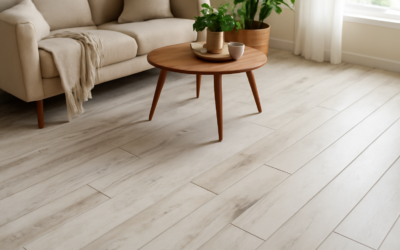
Walk into a Restoration Hardware showroom and the floor is almost always whitewashed European oak. The look — pale, weathered, with grain still showing through — has dominated coastal-modern interiors since 2018 and shows no signs of fading. Whitewash flooring is a finish technique, not a flooring type. It applies to oak, pine, ash, and engineered hardwood, and it can be done on-site or bought factory-applied. The difference between a beautiful whitewash and a chalky DIY mess comes down to technique and product chemistry.
What Whitewash Actually Is
Traditional whitewash was lime, water, and salt — a low-cost lime paint used on barns and farmhouses for 200+ years. Modern flooring whitewash is a translucent white stain or pickled finish that lets wood grain show through. The product is typically a water-based pigmented stain with white or off-white tinting, applied thin enough that 30 to 60 percent of the underlying wood color remains visible.
This differs from “limed” oak (a similar look using actual lime products), “white-stained” wood (more opaque coverage), and “lime-washed” oak (often used interchangeably with whitewashed). Subtle differences in pigmentation produce noticeably different results.
The Two Routes: Site-Finished vs Prefinished
You have two paths to a whitewashed floor. Site-finished hardwood is sanded raw, stained on-site, and sealed with polyurethane or oil-modified urethane. The look is fully customizable. The risk is high: a whitewash applied unevenly leaves blotches, lap marks, and dark zones where stain pooled. Best handled by a contractor with documented whitewash projects to show.
Prefinished hardwood is factory-coated with UV-cured aluminum-oxide topcoats over the whitewash stain. The finish is uniform, harder than any site-applied poly, and ready-to-walk-on. Pricing runs about 15-30 percent higher than equivalent natural-finish prefinished hardwood.
The Pros That Sell the Look
Whitewash earns its space in design portfolios for specific reasons:
- LRV (light reflectance) 55-72 — brightens north-facing rooms dramatically
- Hides dust and pet hair better than dark stains
- Pairs with virtually any cabinet color (white, cream, navy, sage, walnut)
- Coastal-modern aesthetic that hasn’t been overplayed yet
- Hides minor wear and scratches better than dark or natural finishes
- Wood grain remains visible — feels organic, not painted
For homeowners chasing the Hamptons, Cape Cod, Scandinavian-modern, or California coastal look, whitewash is the floor finish that delivers it most efficiently.
Honest Cons to Consider
Whitewash is harder to refinish than natural-stained wood. The pigmented stain penetrates 1-3 mm into the wood surface; sanding to bare wood can take three or four passes versus one or two on natural finishes. For prefinished engineered with thin (1-2 mm) wear layers, this means refinishing risk is higher.
Color matching after damage is also difficult. Whitewash formulations vary by manufacturer and batch. A repair board five years from now will not match perfectly without spot-blending technique most contractors don’t have. Order one extra box per 200 square feet at install and store climate-controlled.
UV fade is the third concern. Some whitewash pigments shift toward yellow within five to seven years of strong direct sun. Look for products with explicit UV-stability claims and aluminum-oxide finish certifications.
Best Wood Species for Whitewash
Not every species takes whitewash convincingly. The species that work:
- White oak: Best — neutral undertone, takes pickle stain evenly
- European oak: Equally good, slightly cooler base tone
- Ash: Strong open grain shows beautifully through whitewash
- Pine: Traditional choice but soft (Janka 380), dents easily
- Maple: Workable but tight grain pattern reduces character
Avoid red oak — the pink undertone bleeds through whitewash, producing salmon-tinted floors. Avoid walnut and cherry — the natural color is too dark to whitewash without ending up gray.
Real Pricing for 2025
For a typical 300-square-foot living room, expect total installed costs:
- Mid-range engineered whitewashed oak (5/8 in, 3 mm wear layer): $2,800-$4,500
- Premium European oak engineered (3/4 in, 6 mm wear layer): $5,200-$8,500
- Solid white oak unfinished + site-applied whitewash: $5,500-$9,000
- Prefinished solid oak whitewashed: $5,000-$8,000
- Wide-plank European oak engineered (8-10 inch): $6,500-$11,000
Wide planks (7-inch or wider) cost 30-50 percent more than 3-1/4 inch standard but the visual impact in modern rooms is significant.
DIY Whitewash on Existing Floors
If you have existing oak you want to whitewash, the process is achievable but demanding. Sand to 100-120 grit minimum, vacuum and tack-cloth thoroughly, then apply a water-based pickle or whitewash stain (Bona White, Minwax Whitewash Pickling Stain) with a synthetic-bristle brush. Wipe excess immediately with cotton rags moving with the grain. Let dry 24 hours. Apply two coats of water-based polyurethane (Bona Mega Clear, Varathane Diamond) at 24-hour intervals.
The biggest DIY risk is uneven application. Work in 4-by-6-foot sections, never let edges dry between adjacent sections, and always wipe off excess in the same direction.
Care and Long-Term Maintenance
Day-to-day maintenance is the same as any prefinished hardwood. Vacuum or microfiber dust mop daily. Clean weekly with Bona Hardwood Floor Cleaner ($16 a gallon). Avoid wax-based products and vinegar — both damage UV-cured aluminum-oxide topcoats. Felt pads under every chair leg are non-negotiable.
Plan a screen-and-recoat at year 7 to 10 ($1.50-$2.50 per sq ft) to refresh the topcoat without sanding through the wear layer. Full refinish — sanding back to bare wood and re-staining — is only viable on solid hardwood or engineered with 4 mm+ wear layers.
Bottom Line
Whitewash flooring is the right choice when the priority is light reflection, organic-modern aesthetic, and forgiveness of dust and minor wear. It is the wrong choice if you need easy color-matching or expect to refinish many times. For most homeowners, prefinished engineered European oak in a quality whitewash finish is the sweet spot — durable, beautiful, and ready to install in a week.
Pairing With Cabinets and Walls
Whitewashed floors pair best with warm-neutral palettes. Pure-white shaker cabinets, cream walls, and brass hardware look perfect on whitewashed oak. Sage green or muted navy cabinets create elegant contrast without competing with the floor. Avoid stark cool grays in adjacent walls; the result reads cold and washed-out. For trim, white satin (Benjamin Moore Simply White, Sherwin-Williams Pure White) coordinates beautifully without disappearing into the floor.
Prefer to explore on your own?
See how new flooring looks in your actual room in seconds — free, no signup.
Try the free Floor Studio →