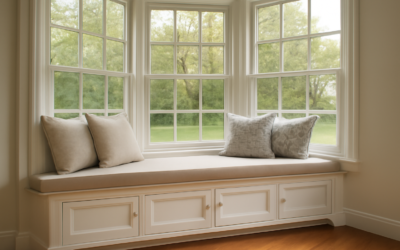
The single most-requested feature in custom builds and renovations over the past five years is one that adds maybe 20 square feet to a home but feels like it adds 200. Window benches turn dead corners into reading nooks, transform mudrooms into the most-used room in the house, and double as storage for everything from kids’ toys to seasonal blankets. The trick is matching the right style and proportions to the space, because an undersized window bench looks built-in by accident rather than on purpose.
Part of our Windows & Doors guide — explore the full guide →
Why Window Benches Work
A window bench accomplishes three things simultaneously:
- Creates seating in spaces too narrow for a chair
- Adds 4 to 8 cubic feet of hidden storage per linear foot
- Frames a window architecturally, making the view feel intentional
The combination is hard to replicate with any other furniture. A loveseat seats two but takes 6 feet of floor space and offers no storage. A storage ottoman seats one but doesn’t anchor a wall. A window bench does all three jobs in a footprint that’s already underused.
Standard Sizing Guidelines
Comfortable seats share consistent dimensions:
- Height — 17 to 19 inches from floor to top of cushion
- Depth — 18 to 24 inches; deeper for nap-friendly benches, shallower for occasional seating
- Length — fills the full width of the window opening, typically 4 to 8 feet
- Cushion thickness — 3 to 4 inches for daily use, 2 inches for accent only
The 17-19 inch seat height matches a dining chair and lets people sit comfortably with feet on the floor. Going lower turns the bench into a kid-only zone. Going higher requires a footrest that defeats the clean look.
Storage Options
Three storage configurations dominate residential builds:
- Lift-top bench — entire seat hinges up, most storage capacity, hardware needs to support 30+ pound lid
- Front drawers — easier daily access, slightly less capacity, more refined look
- Open cubbies — for baskets and bins, casual style, works well in mudrooms
For lift-top builds, use Blum Aventos HK-XS hinges with soft-close ($45 per pair) or quality piano hinges with safety stays. Skip cheap friction-fit lid supports — they fail within a year and the lid slams down on fingers.
Build vs Buy
The decision often comes down to wall configuration:
- Standard 60-inch window between two flat walls — buy a freestanding bench, $300 to $1,200, slide into place
- Built-in window seat with side cabinets — build custom, $1,500 to $4,000 in materials, looks dramatically better
- Bay window or angled wall — must be built custom, factory pieces never fit
- Mudroom drop zone — semi-custom; IKEA Sektion bases at $400 work as the base, add a custom top and cushion
For a clean built-in look, custom is almost always worth the upgrade. The bench should feel like part of the architecture, not furniture pushed against a wall.
Materials That Hold Up
Common construction approaches:
- 3/4-inch plywood box with hardwood face frames — most durable, paint-grade or stain-grade
- MDF with hardwood trim — paint-grade only, smoother finish
- Solid hardwood — heavy, expensive, used for showpiece pieces
- Pre-built kitchen cabinet bases — fastest path, sit on the floor with toe kicks removed
For paint-grade builds, MDF gives the smoothest finish but lacks screw-holding strength at hinge points. Reinforce hinge mounting points with a hardwood block screwed and glued behind the MDF panel.
Cushion Choices
The cushion makes or breaks comfort. Three approaches:
- Custom 3 to 4-inch high-density foam wrapped in fabric — best comfort, $200 to $500 from local upholsterer
- Pre-made bench cushions from Etsy or Wayfair — $80 to $250, sized to standard widths
- Loose pillows over a flat board — least comfortable, easiest to swap seasonally
For the longest service life, specify high-resilience (HR) foam at 2.5 lb density or higher. Cheaper polyurethane foam at 1.5 lb compresses permanently within months and turns the bench into a hard slab.
Design Styles That Work
Window bench style should match the rest of the room:
- Shaker built-in — clean rails and panels, painted, timeless
- Beadboard front — cottage style, white paint, great for kid spaces
- Modern slab front — flat panels, push-to-open or hidden hinges, contemporary
- Slatted wood — Scandinavian look, loose cushion, casual seating
- Built-in with bookshelves on both sides — library style, the holy grail of window seats
The library configuration with floor-to-ceiling shelves flanking the bench is the most visually impactful build, but it requires real planning to size all elements proportionally.
Bay Window Considerations
Bay windows almost demand a window bench. The angled walls create a natural enclosure that becomes a reading nook with one piece of furniture. Custom builds are required because of the geometry, but the work is straightforward:
- Measure each angled segment separately
- Build three matching boxes — center plus two angled ends
- Cap with a single mitered top to hide the joints
- Cushion in three matching sections
The result reads as a single curved piece even though it’s built from three separate boxes.
HVAC and Heating Considerations
If the window has a baseboard heater or floor register beneath it, you cannot block the airflow. Solutions:
- Cut a recessed cavity in the bench front to maintain register access
- For baseboard heating, end the bench short of the heater or build over with a vented panel
- Add a metal toe-kick grille that allows airflow under the bench
Blocking heat sources causes condensation, mold, and unhappy heating bills. Plan around the existing systems, not against them.
Cost Breakdown
For a 60-inch built-in window bench with lift-top storage:
- Plywood and hardwood materials — $200 to $400
- Soft-close hinges and hardware — $80
- Paint, primer, finishing supplies — $100
- Custom cushion — $250 to $400
- Total DIY — $630 to $980
Contractor build with similar materials runs $2,000 to $4,000. The cushion almost always comes from a local upholsterer regardless of who builds the bench itself.
Finishing Touches
Small details elevate the look:
- Match the bench paint to the trim color, not the wall color
- Run baseboard around the bench at the same height as the rest of the room
- Add a soft pendant light or wall sconce above the bench for reading
- Layer two or three throw pillows in coordinating fabrics
- Use a thin throw blanket folded across one end
Skip overdone styling. Three pillows and a blanket is plenty. Five pillows make the bench unusable for actual sitting.
Final Thoughts
Window benches reward modest effort with disproportionate impact. They claim wasted space, add storage, and make any room more inviting. Build them sized correctly to the window, use real lift hardware, and finish them as carefully as the surrounding millwork. Done right, the window seat becomes the most-used spot in the house — exactly the goal worth chasing.