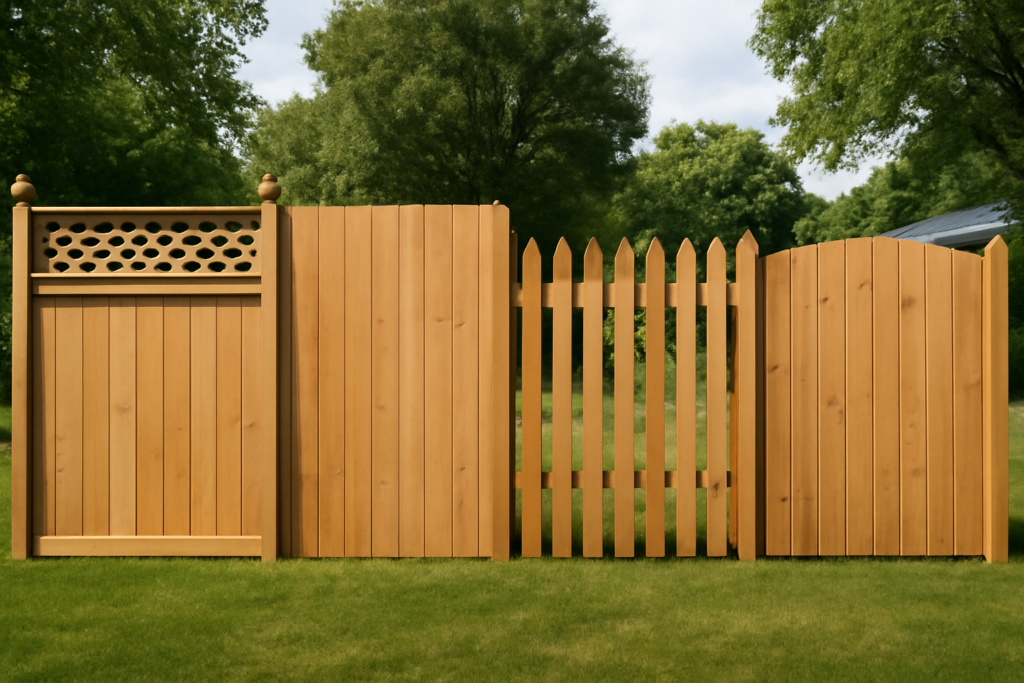
Walk a fence supplier’s yard and you will hear a dozen terms thrown around, and knowing the correct wood fence styles names saves you money and confusion when it comes time to order. A “shadowbox” and a “board-on-board” are the same idea; a “stockade” and a “dog-ear privacy” fence are close cousins with a key difference. Homeowners who show up already knowing the vocabulary get exactly the fence they pictured instead of a costly surprise. This guide names the major styles, describes how each looks, and tells you what privacy level and rough cost to expect from each.
Part of our Decks & Outdoor guide — explore the full guide →
Wood fences sort into a handful of families defined by picket spacing, top shape, and how the boards attach. Once you know the names, choosing becomes a matter of matching the style to your goal: privacy, decoration, containment, or curb appeal.
Picket Fence
The classic American picket fence is the one everyone pictures: evenly spaced vertical boards, or pickets, with gaps between them, typically 3 to 4 feet tall, often with pointed or rounded tops. It is decorative and defines a boundary without blocking the view, perfect for front yards, cottage gardens, and containing small pets or children while keeping an open, welcoming feel.
Picket spacing usually equals the picket width, giving that signature rhythm of board-gap-board. Top styles have their own names, dog-ear, French Gothic (pointed), and flat-top among them. Because pickets use less lumber and stand shorter, this is one of the more affordable styles, commonly $15 to $30 per linear foot installed. It offers essentially no privacy, which is the whole point: a picket fence charms rather than screens.
Privacy and Stockade Fences
When the goal is to block sightlines, you move to solid-board styles. A privacy fence sets boards edge to edge with no gaps, usually 6 feet tall, for a full visual screen. The dog-ear privacy fence, with its clipped 45-degree top corners, is the most common and economical version.
A stockade fence is a close relative, tightly packed pickets often with pointed tops, historically for maximum barrier. Both deliver full privacy but look finished on only one side, the rail side faces your neighbor, which matters for shared boundaries. Solid privacy fences run $25 to $45 per linear foot installed depending on wood. The one caution: because the boards butt tightly, natural wood shrinkage opens small gaps within a year, which is why some homeowners step up to a shadowbox design instead.
Shadowbox (Board-on-Board)
The shadowbox, also called board-on-board or good-neighbor fence, solves the shrinkage-gap problem elegantly. Boards alternate on opposite sides of the rails, overlapping slightly, so there is no straight-through sightline even as the wood dries and shrinks, and the fence looks identical and attractive from both sides.
That two-sided finish is why it earns the good-neighbor name; nobody gets stuck with the ugly rail side. It also allows some airflow through the offset gaps, which reduces wind load compared with a solid panel, a real advantage in gusty areas. The tradeoff is cost: alternating boards uses more lumber, so a shadowbox typically runs $30 to $50 per linear foot installed. For long-term privacy that stays private, this is usually the best style.
Lattice-Top and Decorative Styles
Several styles blend privacy with decoration by combining solid and open sections. A lattice-top fence puts a solid privacy panel on the bottom with a crisscross lattice section on top, adding height, light, and airflow along with a softer, more ornamental look, popular around patios and gardens.
Related decorative options include the scalloped fence, where the top edge of each section dips in a gentle curve, and the convex or arched top, which rises in the middle. A framed or capped fence adds a top rail and sometimes a bottom rail and post caps for a tidy, high-end appearance. These decorative touches add cost, generally $35 to $55 per linear foot, but they lift a plain fence into a design feature. Lattice and open tops also cut wind load while keeping privacy at eye level below.
Horizontal and Modern Styles
For contemporary homes, running the boards sideways changes the whole character of the fence. A horizontal fence orients the boards horizontally between posts for a clean, modern, architectural look that has surged in popularity. It reads as sleek and current, especially in cedar with a clear sealer that shows the grain.
Horizontal fences demand straighter, higher-quality boards because any bow shows badly when the board runs level, and posts must be sturdy and well spaced since the boards span horizontally. Variations include tight-gap horizontal for privacy and spaced-slat horizontal for a screen that still allows light and air. Expect $35 to $60 per linear foot installed given the material selectivity and labor. This is the style to choose when you want the fence itself to look modern rather than traditional.
Split Rail, Post-and-Rail, and Ranch Styles
At the opposite end from privacy sit the open, rustic styles built for boundaries and containment rather than screening. A split-rail fence uses split logs as horizontal rails threaded through or mortised into posts, with two or three rails, for a classic country and ranch look. It marks property lines and contains large animals while leaving the view wide open.
Post-and-rail and ranch-rail fences are similar clean-lined, low-privacy styles common on rural and semi-rural lots. Because they use minimal lumber and no pickets, they are among the cheapest wood fences, often $12 to $25 per linear foot installed, and they install quickly. You can add wire mesh behind a split rail to contain small animals without losing the open look. Choose these when you want to define space affordably and keep the landscape visible.
Fence Top Treatments and Their Names
Beyond the overall style, the shape of the fence top has its own vocabulary, and it changes the character of an otherwise plain fence. A flat-top runs straight across for a clean, modern line, often finished with a top cap rail for a tidy edge. A dog-ear top clips each board’s upper corners at 45 degrees, the most common and economical treatment. A French Gothic top brings each picket to a decorative point, giving a traditional, formal look.
Curved tops add real personality. A scalloped top dips the middle of each section in a gentle concave curve, while a convex or arched top rises in the center, both softening the fence line. A cap-and-trim or framed top wraps the section in a top and sometimes bottom rail with post caps for a high-end, architectural finish. These treatments layer onto the base style, so you might order a dog-ear privacy fence, a flat-top horizontal fence, or a scalloped picket, and knowing the top’s name lets you specify exactly the profile you want.
Matching a Style to Your Home and Goal
The right style balances what your house looks like with what you need the fence to do. Traditional and colonial homes suit picket, French Gothic, and scalloped fences that echo their classic lines. Craftsman and farmhouse homes pair well with board-on-board, framed, and lattice-top designs. Modern and contemporary houses call for horizontal fences or clean flat-tops. Ranch and rural properties look right with split-rail and post-and-rail fences that keep the landscape open.
Then weigh function against looks. If privacy is the goal, a shadowbox or dog-ear privacy fence delivers it while a picket or split-rail never will. If you want curb appeal at the front and privacy in the back, many homeowners mix styles, a low picket or scalloped fence facing the street and a 6-foot privacy fence around the backyard. Consider maintenance too: simpler styles with fewer boards and cuts are faster to build, stain, and repair than intricate lattice or heavily framed designs. Weigh privacy, budget, upkeep, and how the style suits your home, and the choice usually narrows to one or two clear options.
Choosing the Right Style
Match the name to your goal and the decision is easy. Want charm and a defined front yard with an open view? A picket fence. Need full backyard privacy on a budget? A dog-ear privacy or stockade. Want privacy that stays gap-free and looks good from both sides? A shadowbox. After a modern, architectural statement? A horizontal fence. Marking a rural boundary cheaply? Split rail. Adding a decorative flourish? A lattice-top or scalloped design.
Whatever you choose, the wood species and post installation matter as much as the style for how long it lasts, so pair a good style with cedar or treated lumber and properly concreted posts. Knowing the wood fence styles names up front means you walk into the supplier or contractor conversation speaking their language, order exactly the look you want, and avoid paying for a fence that turns out to be the wrong style for your yard.