A flat painted wall costs $40 in paint; add $150 of lumber in the right pattern and it becomes the architectural focal point of the room. That leverage is why wood trim accent wall ideas dominate renovation feeds — trim walls deliver custom-millwork character at DIY prices, and most patterns need nothing more than a miter saw, a level, construction adhesive, and a brad nailer. The trick is picking a pattern that suits your room’s style and ceiling height, then executing the layout math before the first board goes up.
Board and Batten: The Reliable Classic
Board and batten — vertical battens (typically 1×2, 1×3, or 1×4) spaced evenly over a flat wall, usually with a top rail — is the most forgiving trim wall for a first-timer. Traditional versions run to chair-rail height at 32 to 38 inches; the modern take runs battens floor-to-ceiling or to two-thirds wall height (about 60 to 66 inches on an 8-foot wall), which visually raises the ceiling.
Spacing drives the look: 12 to 16 inches between battens reads farmhouse; 18 to 24 inches reads more modern and minimal. Work the math so spacing is even across the wall — measure wall width, subtract total batten width, and divide the remainder into equal gaps. If your drywall is smooth, you can skip full backing boards and batten directly over the painted wall, which keeps a 12-foot wall project around $100 to $250 in primed pine or MDF. Paint everything one color, wall and trim alike, for the current tailored look.
Modern Slat Walls: Warmth and Rhythm
Vertical slat walls — closely spaced 1x2s or 1.5-inch strips with ½-inch to 1-inch gaps, usually in stained oak, walnut, or poplar — bring Scandinavian and mid-century warmth, and they pair beautifully behind a bed, a TV, or a home-office desk. Because the slats are stained rather than painted, material choice matters: expect $300 to $900 in hardwood for a 10 to 12 foot wall, or less using stain-grade pine. Pre-finished acoustic slat panels (wood veneer slats on a felt backing) install even faster at roughly $10 to $20 per square foot and add measurable sound dampening.
Two execution tips: paint or line the wall behind the slats a dark color first (black or deep charcoal) so the gaps read as crisp shadow lines, and finish all four sides of each slat before installation — staining between installed slats is misery.
Geometric and Grid Patterns: The Statement Makers
When you want the wall to be the room’s art, go geometric. Popular versions include:
- Full grid (modern wainscoting): horizontal and vertical 1x3s forming even squares or rectangles across the whole wall. Orderly and architectural; works in dining rooms and offices.
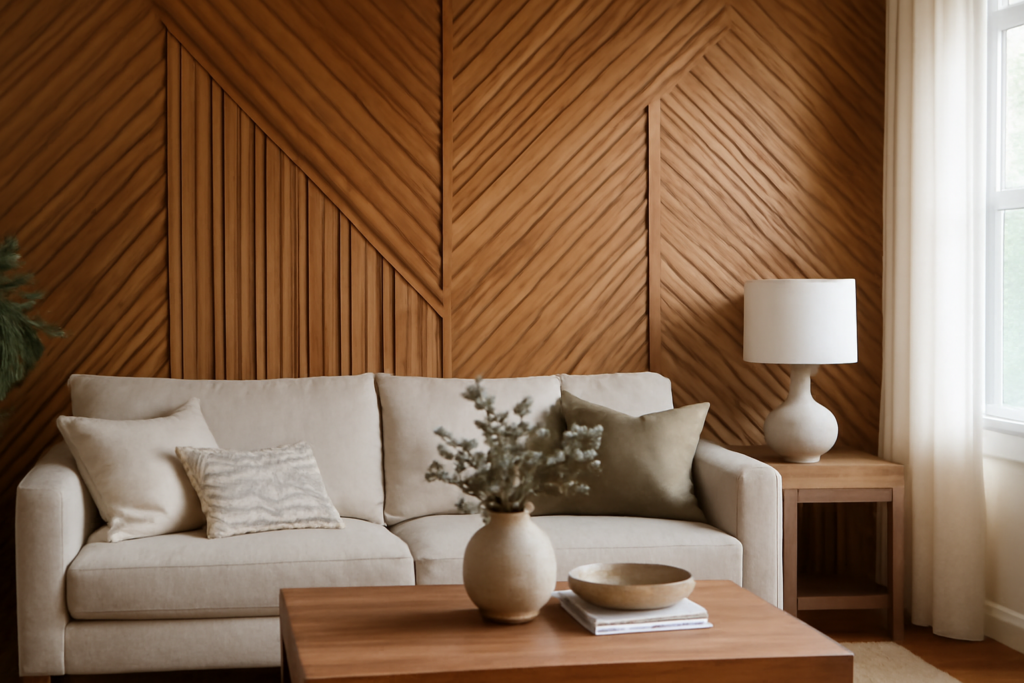
- Diamond or chevron layouts: battens run at 45 degrees, meeting in diamonds or herringbone-style Vs. Highest wow factor, highest miter-cutting skill requirement.
- Asymmetric or “random” geometric: an irregular web of angled boards, usually painted a single moody color. Forgiving of imperfect walls because nothing has to be evenly spaced — but sketch it to scale first or it turns chaotic.
- Half-wall grid with ledge: grid to 60 inches topped with a small display ledge — practical in entries and kids’ rooms.
Angled patterns burn 15 to 25 percent more lumber to waste cuts, so buy accordingly. A painter’s tape mockup on the actual wall is the cheapest design tool available — live with the taped pattern for two days before cutting.
Picture Frame Molding: Traditional Elegance
Rectangular frames of panel molding (base cap or chair-rail profiles, mitered at corners) applied in a rhythm along the wall create the classic look of Georgian and Parisian interiors. Standard proportions: frames 3 to 4 inches from casings, ceilings, and each other, with frame height roughly two-thirds of the space they occupy. Run one large frame row on a full-height wall, or two stacked rows split by a chair rail at 32 to 36 inches.
This is the pattern that most rewards paint strategy. Painted the same color as the wall in a satin or semi-gloss sheen, it reads subtle and expensive; in a contrasting deep color (navy, forest, charcoal) it turns dramatic. Material cost is modest — panel molding runs $1 to $3 per linear foot — and a bedroom feature wall typically needs $80 to $200 of molding.
Rustic and Textural Directions
Not every trim wall is paint-grade and crisp. Shiplap laid horizontally (or vertically for height) remains a warm, casual standby at $2 to $7 per square foot depending on material. Reclaimed-look plank walls in mixed-tone boards suit dens and cabins. A chunky timber mantel wall — thick horizontal members framing a fireplace with vertical infill — anchors great rooms. And wainscoting hybrids, like tongue-and-groove lower walls under a deep top rail with hooks, earn their keep in mudrooms and baths. For humid rooms, choose MDF cautiously: it swells if soaked, so PVC or primed pine trim is the safer call around tubs and entry floors.
Planning, Costs, and Common Mistakes
Whatever the pattern, the process is the same: find studs where you can (adhesive plus 18-gauge brads into drywall is fine for lightweight trim; heavy slats want studs), level and plumb every line rather than trusting floors and ceilings, caulk every seam and nail hole, then prime and paint. Budget realistically: most painted trim accent walls land between $100 and $400 in materials DIY, or $800 to $2,500 hired out. A miter saw, brad nailer, 4-foot level, stud finder, caulk, and adhesive cover the tool list — about $250 to buy new, less to rent or borrow.
The mistakes that separate crisp results from amateur ones: skipping the layout math so the last batten lands 3 inches from a corner; not caulking gaps before painting; using warped lumber (sight down every board at the store); and choosing a busy pattern for a small room that needed a calm one. When in doubt, simpler patterns in richer paint colors beat complicated patterns in white.
Matching the Pattern to the Room
A quick pairing guide from jobs that consistently photograph well: board and batten for entries, hallways, and farmhouse bedrooms; slat walls behind TVs, beds, and desks; full grids for dining rooms and offices; picture frame molding for living rooms and formal bedrooms; shiplap for baths, laundry rooms, and cottages. Bedrooms take the boldest colors well because the accent wall sits behind the headboard rather than in your sightline. Whichever direction you choose, one strong wall per room is the rule — trim walls are like statement jewelry, and two in one space compete rather than compound.