A good yard cart saves your back on every mulch, gravel, and firewood job you tackle for the next decade. I’ve burned through cheap ones and babied good ones for twenty years on job sites, and the difference between a yard cart that lasts and one that folds up under its first load of wet topsoil comes down to three things: bed material, axle configuration, and honest capacity ratings. Marketing numbers lie constantly in this category. A cart stickered at 1,200 pounds often rides on wheels rated for half that.
- The Main Types of Yard Carts
- Poly Dump Carts: The Workhorse Choice
- Steel Mesh and Flatbed Carts
- Two Wheels or Four?
- Capacity Ratings: Reading Past the Sticker
- Tires, Bearings, and the Parts That Actually Fail
- Top Picks by Budget and Job
- Towing Behind a Mower: Hitch Notes
- Maintenance That Doubles the Lifespan
The Main Types of Yard Carts
Walk any hardware aisle and you’ll find five basic designs. Each one earns its keep in a different situation, so match the cart to the loads you actually haul, not the loads you imagine hauling.
- Poly dump carts: One-piece polyethylene tub on a steel frame, usually with a foot-pedal or lever dump release. Best all-arounder for dirt, mulch, and stone. Typical capacity: 600 to 1,200 lb.
- Steel mesh carts: Open wire-mesh bed, often with fold-down sides that convert the cart to a flatbed. Ideal for brush, branches, and bagged goods. Typical capacity: 400 to 1,000 lb.
- Flatbed utility wagons: No sides at all, or removable stake sides. Made for hauling flats of plants, lumber, and coolers. Usually 800 to 1,500 lb ratings.
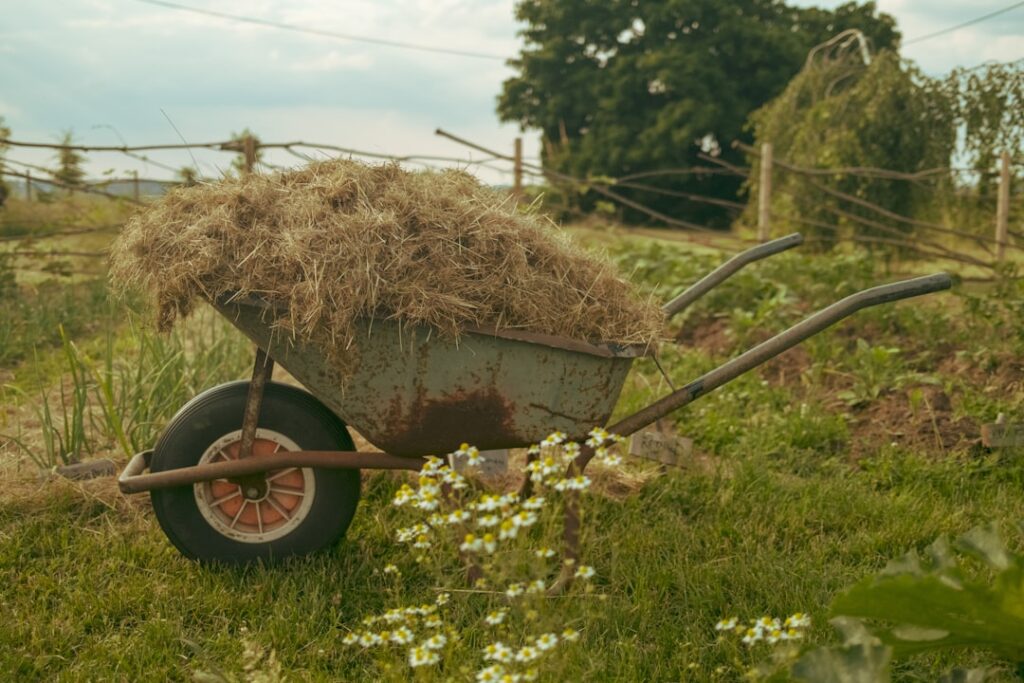
- Two-wheel garden carts: Tall bicycle-style wheels, plywood or poly bed, balanced over the axle. The classic Vermont cart design carries 300 to 400 lb with almost no lifting effort.
- Folding fabric wagons: Collapsible frames with 600-denier fabric beds. Fine for beach chairs and light mulch bags; keep loads under 150 lb.
Poly Dump Carts: The Workhorse Choice
For nine out of ten homeowners, a poly dump cart is the right answer. The tub won’t rust, won’t splinter, and shrugs off concrete chunks that would dent sheet steel. The dump function matters more than people expect. Shoveling 800 pounds of gravel out of a fixed bed takes ten minutes; tripping a dump lever takes two seconds.
Look for a tub wall thickness you can’t flex easily by hand, a full-width dump pivot rather than two skinny stamped brackets, and a pull handle that also accepts a tow hitch pin. Gorilla Carts dominates this segment for a reason. Their GOR4PS (600 lb, around $110) handles most suburban yards, while the GOR6PS (1,200 lb, quick-release dump, roughly $190) is the one I recommend for anyone hauling stone or firewood regularly. The heavy 1,500 lb GCG-1500 runs about $250 and rides on 15-inch pneumatic tires that roll over tree roots without hanging up.
Steel Mesh and Flatbed Carts
Mesh carts shine when your loads are bulky rather than dense. Brush, prunings, leaf bags, and hay bales sit better in an open mesh bed with fold-down sides than in a deep poly tub. The convertible feature is genuinely useful: drop all four sides and you’ve got a rolling flatbed for a sheet of plywood or three bags of concrete laid flat.
The weakness is corrosion. Powder coating on a $90 mesh cart chips the first time you toss a shovel in, and rust follows within a season if it lives outside. Either garage the cart or budget for a better build. Ohio Steel’s 1,000 lb mesh cart (about $160) uses heavier 12-gauge mesh and holds up noticeably better than the big-box house brands. For flatbeds, look at a 48 x 24 inch deck minimum; anything smaller won’t carry standard 40 lb mulch bags two abreast.
Two Wheels or Four?
Axle count changes how the cart behaves more than any other spec, and it’s worth thinking through before you buy.
- Two-wheel carts pivot on the spot, follow you through tight gates, and tip forward for easy loading. But you carry part of the load weight in your hands, and on a hill the cart wants to run away or flip. Keep them under 400 lb of cargo.
- Four-wheel carts carry 100 percent of the load on the wheels, tow behind a lawn tractor, and sit flat while you load. The tradeoff is a wide turning radius; a 1,200 lb cart with a fixed rear axle needs a five-foot arc to turn around.
On sloped properties I always steer people to four wheels. A loaded two-wheel cart on a 15-degree grade is a wrist injury waiting to happen. Flat quarter-acre lot with narrow side gates? The two-wheeler’s maneuverability wins.
Capacity Ratings: Reading Past the Sticker
Manufacturers rate carts under static, evenly distributed load on flat pavement. Real yards have roots, ruts, and slopes that multiply stress on the axle. My rule from years of breaking equipment: run a cart at 60 to 70 percent of its sticker rating and it lasts; run it at 100 percent and you’ll bend an axle within two seasons.
Do the material math before you load. A cubic foot of dry topsoil weighs about 75 lb; wet, it pushes 100 lb. A typical 4-cubic-foot poly tub filled level with wet soil is already at 400 lb. Gravel runs roughly 100 lb per cubic foot, so the same tub heaped with crushed stone can hit 500 to 600 lb fast. Green firewood averages 55 to 70 lb per cubic foot. That “1,200 lb capacity” starts sounding less like overkill and more like a sensible margin.
Tires, Bearings, and the Parts That Actually Fail
Carts almost never fail at the bed. They fail at the wheels. Three things to check before buying:
- Pneumatic vs. flat-free tires. Air-filled 13 to 15 inch tires roll easiest over rough ground but go flat, usually the morning you need the cart. Flat-free polyurethane foam tires cost $15 to $25 more per wheel and never strand you; they ride slightly harder. On thorny properties, flat-free is worth every penny.
- Bearings vs. bushings. Ball-bearing hubs roll a heavy load with half the effort of plain plastic bushings and last years longer. Any cart rated over 600 lb should have real bearings; if the listing doesn’t say, assume bushings.
- Axle diameter. A 5/8-inch axle is the minimum for serious loads; 3/4-inch is better. Half-inch axles bend.
Top Picks by Budget and Job
Prices float around, but these are the carts I’d put my own money on as of this year:
- Under $100 — Gorilla Carts GCG-4: 4 cu ft poly bed, 600 lb rating, 10-inch tires. Fine for mulch and leaves on flat lots. About $80 to $100.
- Best overall — Gorilla Carts GOR6PS: 6 cu ft, 1,200 lb, quick-release dump, 13-inch pneumatics. Around $180 to $200 and worth it.
- Heavy hauling — Polar Trailer HD 1200: 10 cu ft tub, 1,200 lb, huge 20-inch spoked wheels that float over soft ground. Roughly $330 to $400.
- Brush and bulk — Ohio Steel 1,000 lb mesh cart: Fold-flat sides, tractor tow hitch, about $150 to $170.
- Tight spaces — Carts Vermont Large Garden Cart: Classic two-wheel design, 400 lb, 26-inch wheels, about $350. Expensive but these last 25 years.
Towing Behind a Mower: Hitch Notes
Most four-wheel carts include a clevis-style tow bar that pins to a lawn tractor’s rear hitch plate, and towing transforms what you can move in an afternoon — a tractor pulls a 1,200 lb cart up grades that would stop a human cold. Two cautions from experience. First, respect the mower’s tow rating: most residential lawn tractors are rated to pull 400 to 600 lb, zero-turns often less, and exceeding it on a downhill is how mowers jackknife. Second, loaded carts push. Descend slopes straight, slow, and never across the face of a hill; a 900 lb cart shoving a 500 lb mower sideways ends in the ditch. Check that the cart’s hitch height matches the tractor plate within an inch or two, and use a locking hitch pin — the $3 clip pins bounce out on rough ground and you’ll look back to find the cart parked 200 feet behind you.
Hand-pulling the same cart, keep loads to what you can hold back on your steepest path, not what you can start moving on flat ground. Starting is easy; stopping is the test.
Maintenance That Doubles the Lifespan
Five minutes of care per season keeps a cart out of the scrap pile. Grease the axle and wheel bearings each spring with standard lithium grease. Check tire pressure monthly; most cart tires want 30 psi and lose air slowly all season, and a soft tire rolls off its bead under load. Store the cart tipped up or under cover so water doesn’t pool in the tub, because standing water degrades poly in UV sun and rusts steel from the inside of every weld.
One last habit worth building: never leave a load sitting overnight. A cart parked for a week with 700 pounds of stone in it develops flat spots on the tires and a permanent sag in the axle. Dump it, rinse it, park it empty, and even a mid-priced yard cart will still be hauling for you fifteen years from now.