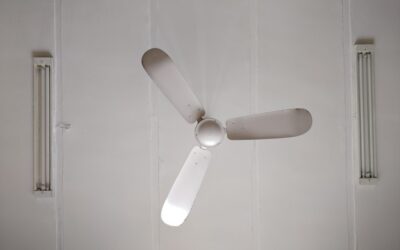
Most ceiling fans plug into the same 120-volt household wiring as your lights, but there is an entire category built for a different world entirely. A 12 volt ceiling fan runs on low-voltage direct current instead of standard household alternating current, which makes it the natural choice for RVs, boats, cabins, and off-grid solar homes where the whole electrical system is 12V DC. If you have a battery bank, a solar array, or a vehicle house battery, this kind of fan lets you move air without an inverter and without draining your power. Here is how these fans work, where they shine, and how to choose and wire one.
- How a 12 Volt Fan Differs From a Standard Fan
- Where 12 Volt Ceiling Fans Make Sense
- Understanding Power Draw and Battery Life
- Sizing the Fan for Your Space
- Wiring a 12 Volt Ceiling Fan
- Features Worth Looking For
- Installation and Mounting Tips
- Pairing a Fan With a Solar System
- Troubleshooting Common Issues
- The Bottom Line
How a 12 Volt Fan Differs From a Standard Fan
The core difference is the motor and the power source. A conventional ceiling fan uses an AC motor fed by your home’s 120V wiring. A 12-volt fan uses a DC motor fed directly from a 12V battery or DC circuit, the same voltage that runs your car, RV, or a typical solar battery bank. That single distinction cascades into a set of practical advantages:
- No inverter needed: in an off-grid or mobile system, you avoid the cost, bulk, and power loss of converting DC to AC just to run a fan.
- High efficiency: DC motors are inherently efficient and draw very little current, often just 1 to 3 amps.
- Battery-friendly: low draw means you can run the fan for many hours without significantly depleting a battery bank.
- Safer low voltage: 12V DC is far less hazardous to handle than 120V AC.
The tradeoff is that 12-volt fans are generally smaller and less powerful than full-size household fans, and they are wired into a DC system rather than plugged into a standard outlet.
Where 12 Volt Ceiling Fans Make Sense
These fans are a niche product, but within that niche they are close to essential. Common applications include:
- RVs and campers, where the entire house system runs on 12V from the coach battery
- Boats and marine cabins, which use 12V or 24V DC electrical systems
- Off-grid cabins and tiny homes powered by solar panels and a battery bank
- Vans and overland builds, where efficiency and low draw are everything
- Barns, sheds, and workshops wired to a small solar or battery setup
If you live in a standard grid-connected house, you almost certainly want a normal 120V fan instead. The 12-volt version earns its place specifically when your power comes from batteries or solar.
Understanding Power Draw and Battery Life
The headline benefit of a 12V fan is how little energy it uses, and understanding the numbers helps you plan. A typical 12-volt DC ceiling fan draws somewhere between 1 and 3 amps depending on speed, which translates to roughly 12 to 36 watts. Compare that to the constant sip it takes from a battery: on a 100 amp-hour battery, a fan pulling 2 amps could theoretically run for around 50 hours before fully draining the battery, though you would never take a battery that low in practice.
Because the draw is so modest, a 12-volt fan is one of the most efficient ways to stay comfortable off-grid. Running a fan to circulate air often lets you avoid or delay running an air conditioner, which is a massive power hog by comparison. Many DC fans also feature variable-speed controls and reversible direction, so you can dial the draw down to a trickle overnight.
Sizing the Fan for Your Space
Twelve-volt fans come in smaller blade spans than household units, which suits the compact spaces they usually live in. Common sizes and their best fits:
- 12 to 24 inch blade span: vans, boat cabins, and small RV bedrooms
- 30 to 42 inch: RV living areas, tiny homes, and cabin rooms
- 44 to 52 inch: larger off-grid rooms, though these need more robust DC supply
Match the fan size to the room the way you would any fan: a small cabin bedroom does fine with a 24- to 36-inch fan, while an open cabin great room benefits from a larger span. Ceiling height matters too. Low RV and van ceilings favor low-profile or flush-mount 12V fans that keep the blades safely above head height.
Wiring a 12 Volt Ceiling Fan
Wiring a DC fan is simpler in some ways than AC work because there is no neutral and the voltage is low, but polarity matters. General guidance, keeping in mind that you should always follow the manufacturer’s instructions:
- Confirm your system voltage. The fan must match your bank, whether 12V or 24V. Wiring a 12V fan to 24V will destroy it.
- Observe polarity. DC has a positive and a negative wire; connect them correctly or the fan will not run and may be damaged.
- Size the wire and fuse for the fan’s amperage and the run length, and install an inline fuse or breaker on the positive line.
- Add a switch or speed controller rated for DC, since standard AC wall switches are not designed for DC loads.
- Mount securely to a rated ceiling box or blocking, especially in a moving vehicle where vibration is constant.
If your system uses solar, the fan simply connects to the same 12V distribution as your other DC loads. When in doubt, especially in a marine or vehicle setting, have the connection checked by someone experienced with 12V systems.
Features Worth Looking For
Not all 12-volt fans are equal, so a few features separate the good ones. Variable speed control lets you trim power draw to the minimum, a reversible motor pushes warm air down in winter and pulls it up in summer, and a built-in LED light adds function without a second circuit. In RVs and boats, look for models rated for the vibration and humidity of mobile use, and consider a remote or wall controller for convenience. Brushless DC motors run quieter and last longer than brushed motors, which matters when the fan runs all night beside your bed.
Installation and Mounting Tips
In fixed cabins, mounting is much like any ceiling fan: anchor to a fan-rated box or solid blocking that can carry the weight and the dynamic load of spinning blades. In vehicles, the game changes. Constant road vibration works fasteners loose over time, so use lock washers or thread locker, mount to a reinforced ceiling frame member, and periodically check the hardware. Keep blade clearance in mind under low ceilings, and position the fan where it circulates air across the sleeping and living areas rather than into a corner.
Pairing a Fan With a Solar System
For off-grid setups, a 12-volt fan integrates cleanly into a solar power system, and understanding how helps you size everything correctly. Solar panels charge a battery bank through a charge controller, and your DC loads, including the fan, draw from that bank. Because a fan pulling 2 amps uses so little, even a modest 100-watt solar panel and a single deep-cycle battery can comfortably run a fan for many hours a day while still powering lights and small devices. The fan’s steady, low draw makes it one of the easiest loads to plan around.
If you are building a system from scratch, add up all your DC loads in amp-hours per day, size your battery bank to store at least a day or two of that total, and size your panels to replace what you use plus a margin for cloudy days. A fan running eight hours at 2 amps only consumes about 16 amp-hours, a small slice of a typical off-grid budget, which is exactly why fans are a staple comfort item in vans, boats, and cabins.
Troubleshooting Common Issues
If a 12-volt fan will not run, the culprit is usually simple. Check the fuse first, since a blown inline fuse cuts all power. Verify polarity, because reversed positive and negative connections prevent operation. Confirm the battery voltage is actually near 12 volts and not drained, and inspect the wiring connections for corrosion or a loose terminal, which is common in humid marine and RV environments. If the fan runs slowly, low battery voltage or an undersized wire causing voltage drop over a long run is the likely cause. Most issues trace back to power supply rather than the fan itself.
The Bottom Line
A 12-volt ceiling fan is a specialized but genuinely useful tool for anyone living or traveling on battery and solar power. It runs straight off your DC system without an inverter, sips a fraction of the energy a normal fan uses, and keeps you comfortable in an RV, boat, van, or off-grid cabin where every amp counts. Match the voltage and blade size to your setup, wire it with correct polarity and a proper fuse, and choose a brushless, variable-speed model for the best efficiency and quietest operation. For grid-tied homes, stick with a standard fan; but off the grid, a 12V fan is one of the smartest comfort upgrades you can make.