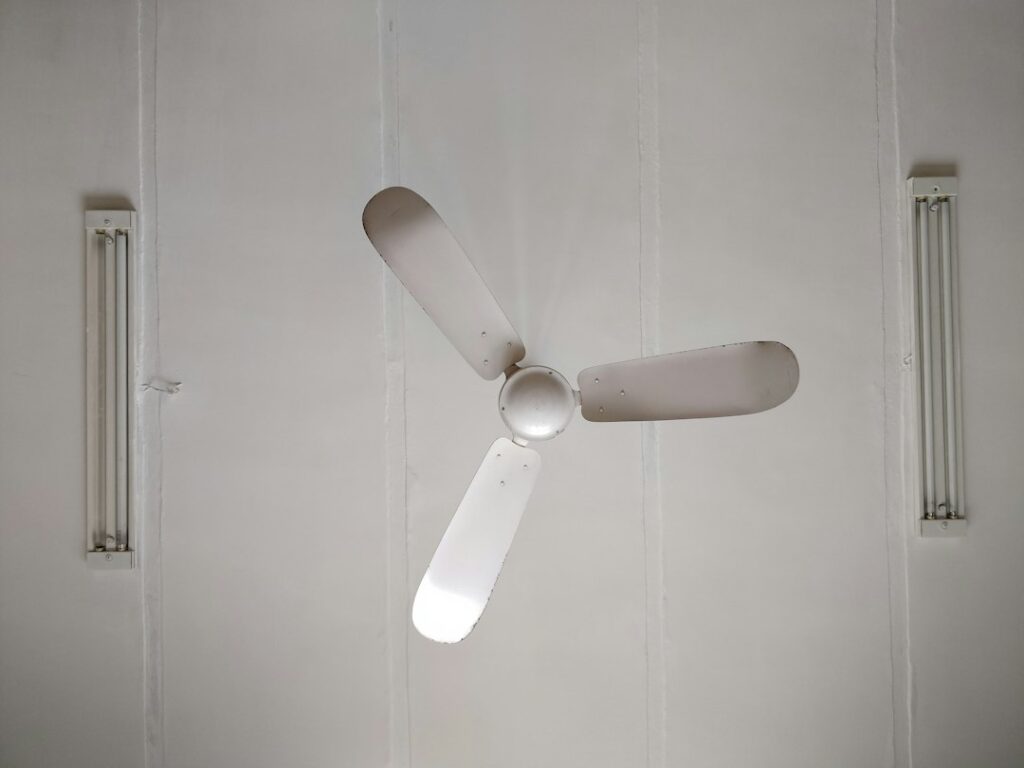
Running a fan on sunshine sounds almost too good to be true, but for the right spaces it is entirely practical. A solar ceiling fan uses photovoltaic panels to power a low-voltage DC motor, delivering cooling air where running a conventional AC circuit would be expensive, impractical, or impossible. Think sheds, patios, cabins, RVs, and off-grid tiny homes. The category spans everything from simple panel-and-fan kits to hybrid units that fall back on batteries or grid power at night, so matching the type to your situation is the whole game.
How Solar Ceiling Fans Work
Unlike a standard fan that draws 120V alternating current, a solar fan runs on low-voltage direct current, typically 12V or 24V, the same kind a solar panel naturally produces. A photovoltaic panel converts sunlight into DC electricity, which drives an efficient brushless DC motor. Because there is no energy lost converting between AC and DC, these fans are remarkably efficient and can spin briskly on a modest panel.
The tradeoff is inherent: no sun, no power, unless the system stores energy. That single fact shapes every buying decision you will make.
The Main Types Explained
Solar fans fall into a few distinct categories, and the right one depends on when you need airflow.
- Direct solar (panel-to-fan): The panel powers the fan only while the sun shines. Simplest and cheapest, ideal for daytime spaces like patios and greenhouses.
- Battery-backed solar: The panel charges a battery that runs the fan into the evening or on cloudy days. More versatile, more expensive.
- Hybrid grid-plus-solar: Runs on solar when available and switches to household power otherwise, so the fan never stops.
- DC fan on a home solar system: A standard efficient DC ceiling fan powered by an existing whole-house solar array.
For a fan that must run 24/7 indoors, a battery-backed or hybrid system is the only realistic choice. For a sunroom or porch used mainly in daylight, a direct panel kit is cheaper and simpler.
Sizing the Fan and the Panel
Two numbers drive performance: fan wattage and panel output. A typical solar ceiling fan motor draws 15 to 40 watts, far less than an AC fan, so a 50 to 100 watt panel comfortably powers one fan with headroom. For battery systems, size the battery to your desired runtime; a 100 watt-hour battery runs a 20-watt fan for roughly five hours after dark.
Blade span still follows normal rules. A 42-inch fan cools a small room or porch, while 52 inches suits a larger patio or open shop. Airflow is measured in CFM, and a good solar fan moves 3,000 to 5,000 CFM on high, competitive with a standard fan.
Where Solar Fans Make the Most Sense
The strongest use cases share one trait: running a wire there is a hassle. Detached structures top the list.
- Sheds and workshops: No need to trench a power line to an outbuilding.
- Patios and pergolas: Cooling for outdoor living without an electrician.
- Cabins and off-grid homes: Comfort where there is no utility service.
- RVs and boats: Native 12V systems pair perfectly with DC fans.
- Greenhouses and barns: Ventilation that costs nothing to run.
In a standard grid-connected house, a solar ceiling fan makes less financial sense than a good efficient AC fan, unless you are already running a whole-home solar array.
Installation Considerations
Installing the fan itself mirrors a normal ceiling fan: secure it to a fan-rated electrical box or beam, confirm the downrod height, and balance the blades. The solar side adds a panel that needs unobstructed sun, usually roof- or pole-mounted and angled toward the equator, plus DC wiring from panel to fan and, if used, a charge controller and battery.
Keep the DC wire runs short and use adequately sized wire to avoid voltage drop that saps performance. A charge controller is essential on any battery system to protect the battery from overcharging and to extend its life.
Cost Expectations
A basic direct-solar patio fan kit with a small panel runs $80 to $250. A quality battery-backed indoor solar fan system with panel, controller, and battery typically costs $300 to $700. A premium DC ceiling fan intended to run off a whole-house solar system is $150 to $500 for the fan alone, plus whatever your existing array cost.
Running costs are the payoff: essentially zero. Over years, a solar fan on an outbuilding pays back the modest premium by avoiding the cost of trenching and wiring a dedicated circuit, which alone can exceed $1,000. Add the value of never seeing the fan on an electric bill and the economics tilt further in solar’s favor for any detached structure.
Budget for one ongoing expense that catches buyers off guard: the battery. Rechargeable batteries in a solar system typically last three to five years before their capacity fades and evening runtime shrinks. A replacement lithium battery runs $50 to $200 depending on capacity, so factor that periodic swap into the long-term cost of any battery-backed or hybrid system.
Common Mistakes to Avoid
The first mistake is expecting a direct-solar fan to run at night; without a battery, it stops when the sun sets. Match the type to your usage hours. The second is undersizing the panel or battery, leaving the fan sluggish on cloudy days. Build in a comfortable margin. Finally, homeowners sometimes mount the panel where a tree or roofline shades it part of the day, which cripples output. Scout the sun path before mounting, and keep the panel clear of shade and debris.
Is a Solar Ceiling Fan Worth It
A solar ceiling fan is a smart, genuinely money-saving solution wherever running conventional power is difficult or costly, from a backyard shed to an off-grid cabin. Choose direct-solar for daytime-only spaces and battery-backed or hybrid for around-the-clock comfort, size the panel and battery with headroom, and mount the panel in full sun. Get those choices right and you get quiet, effective cooling powered entirely by the sky.