If you own a 1920s bungalow, Craftsman, or Tudor, the floors are a huge part of what makes the house feel like itself, and ripping them out for modern wide-plank is a mistake you cannot undo. Authentic 1920s flooring has a distinct vocabulary: narrow-strip oak in the living spaces, tiny hexagon and penny-round tile in the bathrooms, decorative parquet borders, and the new wonder material of the era, linoleum, in kitchens. Whether you are restoring an original floor or recreating the look in a newer home, knowing what the decade actually used is the key to getting it right.
Narrow-Strip Oak: The Defining Floor of the Decade
The signature 1920s floor is narrow-strip hardwood, most often white or red oak laid in thin boards, typically around 1.5 to 2.25 inches wide. This is much narrower than the 5- and 7-inch planks popular today, and that slimness is the single biggest tell of an authentic period floor. The boards were nailed down board by board over a subfloor, often in long unbroken runs that make rooms feel orderly and elegant.
Maple was also used, particularly in more utilitarian or northern homes, prized for its hardness and pale, even grain. Whatever the species, the look is tight, linear, and refined, a deliberate contrast to the rustic wide planks of earlier American homes.
Parquet and Decorative Borders
The 1920s loved a bit of geometry. In grander homes and formal rooms, you will find parquet patterns and inlaid borders framing the main field of strip flooring. A common treatment ran a contrasting wood border, sometimes a darker species like walnut, a few feet in from the walls, outlining the room like a picture frame. Herringbone and basketweave parquet appeared in entries and dining rooms as a mark of craftsmanship. These details are labor-intensive and instantly read as period-correct.
Hexagon and Penny Tile in the Bathroom
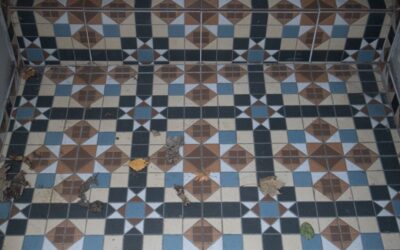
Step into an unrestored 1920s bathroom and the floor is almost always small white mosaic tile. Two patterns dominate the era:
- Hexagon tile: Small white hex “honeycomb” mosaics, frequently with a contrasting accent, a black border, scattered black hexes, or a simple geometric inset, set in the field.
- Penny tile: Round, coin-sized tiles in white or black-and-white, mortared in dense mosaic sheets.
These tiny tiles were practical: durable, water-resistant, and easy to clean, with abundant grout lines for slip resistance. Subway tile climbed the walls to meet them. The crisp white-and-black palette is so associated with the era that it has never really gone out of style for period baths.
Early Linoleum in the Kitchen
The kitchen of the 1920s was the proving ground for linoleum, then a cutting-edge, affordable, and hygienic material. Made from linseed oil, cork, and other natural ingredients, it came in solid colors, marbled jaspe patterns, and printed designs, including tile and rug imitations. Linoleum was warm underfoot, easy to mop, and cheaper than tile, which made it the practical choice for kitchens, pantries, and back halls. An authentic 1920s kitchen floor is far more likely to be linoleum than wood or ceramic.
How to Recreate the 1920s Look Today
You can capture the era convincingly with modern or salvaged materials:
- Use narrow-strip oak: Order 1.5- to 2.25-inch oak strip flooring rather than wide planks. A medium amber or natural finish suits the period; avoid gray and ultra-white tones.
- Add a wood border: Frame a formal room with a contrasting inlaid border for an authentic, custom touch.
- Choose small mosaic tile for baths: White hex or penny tile, optionally with a black accent, nails the period bathroom instantly.
- Pick linoleum or linoleum-look for the kitchen: Genuine sheet linoleum is still made; a marbled or jaspe pattern reads as authentically vintage.
- Keep finishes low-sheen: Period floors were satin or matte, not glossy, and warmer in tone than today’s cool grays.
The Influence of Style Movements
To understand 1920s floors, it helps to know the design currents pulling at them. The decade sat at a crossroads. The Arts and Crafts and Craftsman movements, still strong early in the decade, favored honest natural materials, quarter-sawn oak, simple borders, and warm earthy tones, which is why so many bungalows of the period have understated, well-crafted oak floors. At the same time, Art Deco was rising, bringing bolder geometry, contrast, and glamour that showed up in striking tile patterns and inlaid wood designs in more fashionable homes.
This tension between cozy craftsmanship and emerging modern flair is part of what makes 1920s flooring so appealing today. A Craftsman bungalow calls for warm, simple strip oak with maybe a modest border, while a more upscale or Deco-leaning home of the era can carry dramatic black-and-white bathroom tile and geometric parquet. Matching your floor choices to the home’s specific architectural style keeps the result authentic rather than generically “old-timey.”
Pros and Cons of 1920s-Style Flooring
The era’s floors have genuine strengths and a few headaches:
- Pro: Timeless, characterful, and a major boost to a period home’s value and authenticity.
- Pro: Original oak strip floors can be sanded and refinished multiple times, lasting a century or more.
- Pro: Hex and penny tile is durable, water-resistant, and never goes out of style.
- Con: Narrow-strip oak and inlaid borders are labor-intensive and pricier to install than modern wide plank.
- Con: Tiny mosaic tile means a lot of grout to clean and seal.
- Con: Original floors may hide old adhesives or, in some homes, asbestos-containing materials under later layers, test before disturbing.
A Note on Restoring Originals
If you have original 1920s floors, restoration almost always beats replacement. Solid oak strip can be sanded back to bare wood and refinished, erasing decades of wear. Original hex and penny tile, even with a few cracked pieces, is worth saving and patching. Before sanding old floors or pulling up old resilient flooring and adhesives from this era, have suspect materials tested, since some mid-century products contained asbestos. Done carefully, restored 1920s flooring rewards you with surfaces that no modern product can authentically replicate, and that are a defining feature of the home’s character.
Prefer to explore on your own?
See how new flooring looks in your actual room in seconds — free, no signup.
Try the free Floor Studio →